

Nutrient Distribution and Cycling
255
Table 18.1. Mean nutrient concentrations (mg g-l) in holm oak in Prades· (P) and MontsenY'
(M) experimental areas
Tree component
N
P
K
Ca
Mg
Leaves
P
13.3
1.1
6.2
9.8
1.0
M
12.8 ± 0.3
1.0 ± 0.2
5.4 ± 1.3
5.8 ± 1.4
1.1 ± 0.3
Current-year twigs
P
9.2
1.2
7.9
13.8
1.4
Me
9.6
1.3
5.1
4.3
0.9
Branch wood (0 <5 cm) M
2.1
0.8
2.4
3.3
0.5
Branch bark (0 <5 cm) M
4.9
0.4
3.0
27.0
1.1
Bole wood (0 >5 cm)
pd
1.4 ±0.2
0.7 ±0.2
2.1 ±0.6
3.3 ± 1.0
0.5 ±0.2
M
1.2
0.3
1.8
2.5
0.4
Bole bark (0 >5 cm)
pd
4.3 ± 0.8
0.2 ±0.07
2.3 ± 0.5
42.4 ± 11
0.8 ±0.2
M
4.5
0.3
3.5
30.9
1.7
Male inflorescences
p'
15.0
0.4
13.5
5.0
1.4
Mf .14.7
1.2
4.7
5.1
0.8
Fruits
pe,g
7.0
0.6
8.3
3.0
1.0
Mf,g 7.5
0.7
4.8
2.3
0.7
a Unless otherwise stated, data for Prades are mean figures for the Avic catchment.
b Unless otherwise stated, data for Montseny are mean figures for the permanent plot near outlet
of the Torrent de la Mina catchment (La Castanya).
e Mean of 11 trees sampled on 29 April 1981.
d Values from the north-facing slope of Torners (C. Gracia and S. Sabate, unpubl. data).
• From Bellot et al. (1992) and Clemente (1983).
f N, P, K and Mg measured in 18 closed-canopy plots in the Torrent de la Mina catchment, after
Mayor (1990). Ca measured in the permanent plot, after Verdu (1984).
g Acorns and cups of non-aborted fruits.
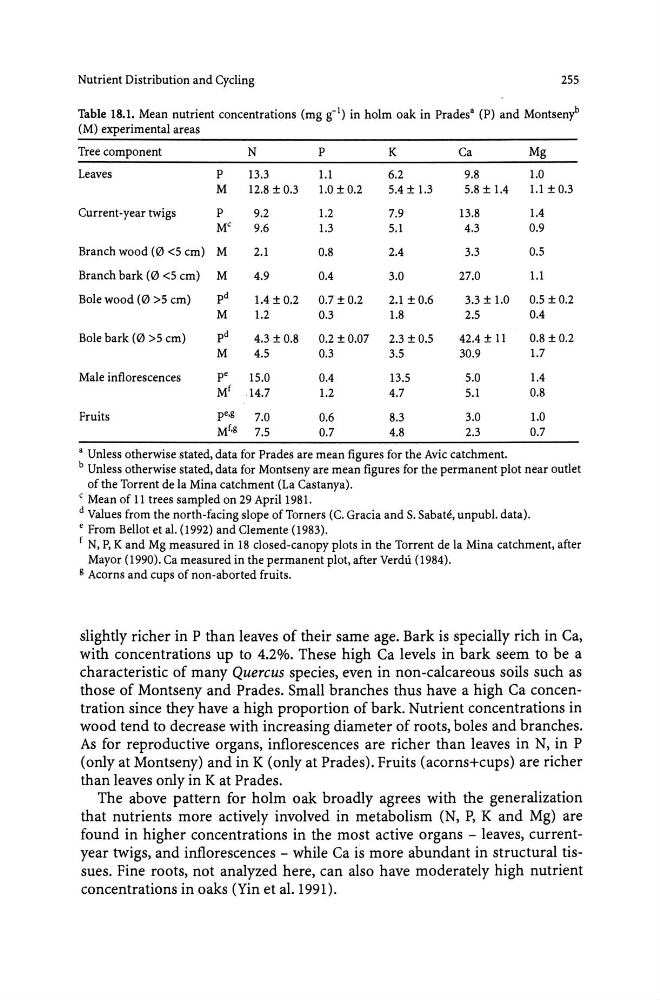
slightly richer in P than leaves of their same age. Bark is specially rich in Ca,
with concentrations up to 4.2%. These high Ca levels in bark seem to be a
characteristic of many Quercus species, even in non-calcareous soils such as
those of Montseny and Prades. Small branches thus have a high Ca concentration since they have a high proportion of bark. Nutrient concentrations in
wood tend to decrease with increasing diameter of roots, boles and branches.
As for reproductive organs, inflorescences are richer than leaves in N, in P
(only at Montseny) and in K (only at Prades). Fruits (acorns+cups) are richer
than leaves only in K at Prades.
The above pattern for holm oak broadly agrees with the generalization
that nutrients more actively involved in metabolism (N, P, K and Mg) are
found in higher concentrations in the most active organs - leaves, currentyear twigs, and inflorescences - while Ca is more abundant in structural tissues, Fine roots, not analyzed here, can also have moderately high nutrient
concentrations in oaks (Yin et al. 1991).
255
Table 18.1. Mean nutrient concentrations (mg g-l) in holm oak in Prades· (P) and MontsenY'
(M) experimental areas
Tree component
N
P
K
Ca
Mg
Leaves
P
13.3
1.1
6.2
9.8
1.0
M
12.8 ± 0.3
1.0 ± 0.2
5.4 ± 1.3
5.8 ± 1.4
1.1 ± 0.3
Current-year twigs
P
9.2
1.2
7.9
13.8
1.4
Me
9.6
1.3
5.1
4.3
0.9
Branch wood (0 <5 cm) M
2.1
0.8
2.4
3.3
0.5
Branch bark (0 <5 cm) M
4.9
0.4
3.0
27.0
1.1
Bole wood (0 >5 cm)
pd
1.4 ±0.2
0.7 ±0.2
2.1 ±0.6
3.3 ± 1.0
0.5 ±0.2
M
1.2
0.3
1.8
2.5
0.4
Bole bark (0 >5 cm)
pd
4.3 ± 0.8
0.2 ±0.07
2.3 ± 0.5
42.4 ± 11
0.8 ±0.2
M
4.5
0.3
3.5
30.9
1.7
Male inflorescences
p'
15.0
0.4
13.5
5.0
1.4
Mf .14.7
1.2
4.7
5.1
0.8
Fruits
pe,g
7.0
0.6
8.3
3.0
1.0
Mf,g 7.5
0.7
4.8
2.3
0.7
a Unless otherwise stated, data for Prades are mean figures for the Avic catchment.
b Unless otherwise stated, data for Montseny are mean figures for the permanent plot near outlet
of the Torrent de la Mina catchment (La Castanya).
e Mean of 11 trees sampled on 29 April 1981.
d Values from the north-facing slope of Torners (C. Gracia and S. Sabate, unpubl. data).
• From Bellot et al. (1992) and Clemente (1983).
f N, P, K and Mg measured in 18 closed-canopy plots in the Torrent de la Mina catchment, after
Mayor (1990). Ca measured in the permanent plot, after Verdu (1984).
g Acorns and cups of non-aborted fruits.
slightly richer in P than leaves of their same age. Bark is specially rich in Ca,
with concentrations up to 4.2%. These high Ca levels in bark seem to be a
characteristic of many Quercus species, even in non-calcareous soils such as
those of Montseny and Prades. Small branches thus have a high Ca concentration since they have a high proportion of bark. Nutrient concentrations in
wood tend to decrease with increasing diameter of roots, boles and branches.
As for reproductive organs, inflorescences are richer than leaves in N, in P
(only at Montseny) and in K (only at Prades). Fruits (acorns+cups) are richer
than leaves only in K at Prades.
The above pattern for holm oak broadly agrees with the generalization
that nutrients more actively involved in metabolism (N, P, K and Mg) are
found in higher concentrations in the most active organs - leaves, currentyear twigs, and inflorescences - while Ca is more abundant in structural tissues, Fine roots, not analyzed here, can also have moderately high nutrient
concentrations in oaks (Yin et al. 1991).