

152
' r/)
N
'E
"0
E
E
w
r/)
N
E
"0
E
E
Cl
OIl
Valley Bottom - July 13 1989
Sun Leaves
Shade leaves
4.-------------,-------------,
3
2
200
150
100
50
5
- - 0 - slmulaled
measured
10
15
5
Time . hr
10
15
20
Anna Sala
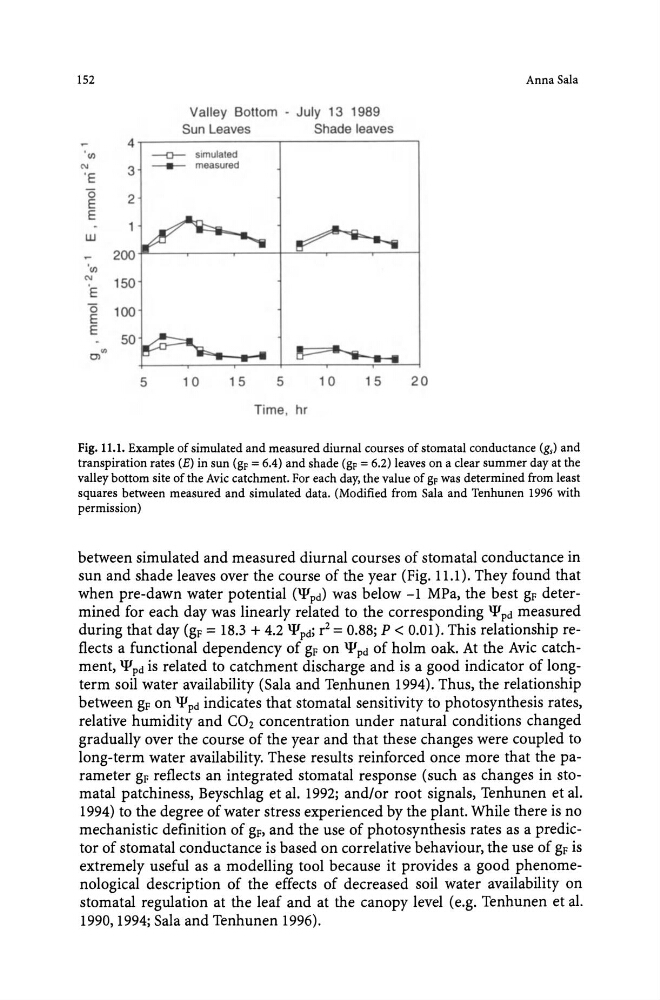
Fig. 11.1. Example of simulated and measured diurnal courses of stomatal conductance (g,) and
transpiration rates (E) in sun (gF = 6.4) and shade (gF = 6.2) leaves on a clear summer day at the
valley bottom site of the Avic catchment. For each day, the value of gF was determined from least
squares between measured and simulated data. (Modified from Sala and Tenhunen 1996 with
permission)
between simulated and measured diurnal courses of stomatal conductance in
sun and shade leaves over the course of the year (Fig. 11.0. They found that
when pre-dawn water potential ('P pd ) was below -1 MPa, the best gF determined for each day was linearly related to the corresponding 'P pd measured
during that day (gF = 18.3 + 4.2 'P pd ; r2 = 0.88; P < 0.0l). This relationship reflects a functional dependency of gF on 'Ppd of holm oak. At the Avic catchment, 'Ppd is related to catchment discharge and is a good indicator of longterm soil water availability (Sala and Tenhunen 1994). Thus, the relationship
between gF on 'Ppd indicates that stomatal sensitivity to photosynthesis rates,
relative humidity and CO2 concentration under natural conditions changed
gradually over the course of the year and that these changes were coupled to
long-term water availability. These results reinforced once more that the parameter gF reflects an integrated stomatal response (such as changes in stomatal patchiness, Beyschlag et al. 1992; and/or root signals, Tenhunen et al.
1994) to the degree of water stress experienced by the plant. While there is no
mechanistic definition of gF, and the use of photosynthesis rates as a predictor of stomatal conductance is based on correlative behaviour, the use of gF is
extremely useful as a modelling tool because it provides a good phenomenological description of the effects of decreased soil water availability on
stomatal regulation at the leaf and at the canopy level (e.g. Tenhunen et al.
1990,1994; Sala and Tenhunen 1996).
' r/)
N
'E
"0
E
E
w
r/)
N
E
"0
E
E
Cl
OIl
Valley Bottom - July 13 1989
Sun Leaves
Shade leaves
4.-------------,-------------,
3
2
200
150
100
50
5
- - 0 - slmulaled
measured
10
15
5
Time . hr
10
15
20
Anna Sala
Fig. 11.1. Example of simulated and measured diurnal courses of stomatal conductance (g,) and
transpiration rates (E) in sun (gF = 6.4) and shade (gF = 6.2) leaves on a clear summer day at the
valley bottom site of the Avic catchment. For each day, the value of gF was determined from least
squares between measured and simulated data. (Modified from Sala and Tenhunen 1996 with
permission)
between simulated and measured diurnal courses of stomatal conductance in
sun and shade leaves over the course of the year (Fig. 11.0. They found that
when pre-dawn water potential ('P pd ) was below -1 MPa, the best gF determined for each day was linearly related to the corresponding 'P pd measured
during that day (gF = 18.3 + 4.2 'P pd ; r2 = 0.88; P < 0.0l). This relationship reflects a functional dependency of gF on 'Ppd of holm oak. At the Avic catchment, 'Ppd is related to catchment discharge and is a good indicator of longterm soil water availability (Sala and Tenhunen 1994). Thus, the relationship
between gF on 'Ppd indicates that stomatal sensitivity to photosynthesis rates,
relative humidity and CO2 concentration under natural conditions changed
gradually over the course of the year and that these changes were coupled to
long-term water availability. These results reinforced once more that the parameter gF reflects an integrated stomatal response (such as changes in stomatal patchiness, Beyschlag et al. 1992; and/or root signals, Tenhunen et al.
1994) to the degree of water stress experienced by the plant. While there is no
mechanistic definition of gF, and the use of photosynthesis rates as a predictor of stomatal conductance is based on correlative behaviour, the use of gF is
extremely useful as a modelling tool because it provides a good phenomenological description of the effects of decreased soil water availability on
stomatal regulation at the leaf and at the canopy level (e.g. Tenhunen et al.
1990,1994; Sala and Tenhunen 1996).