

114
Miguel A. Zavala
100 %
--_ .. ----,
dominance
,
dom;","ce I
0%
!
800mm
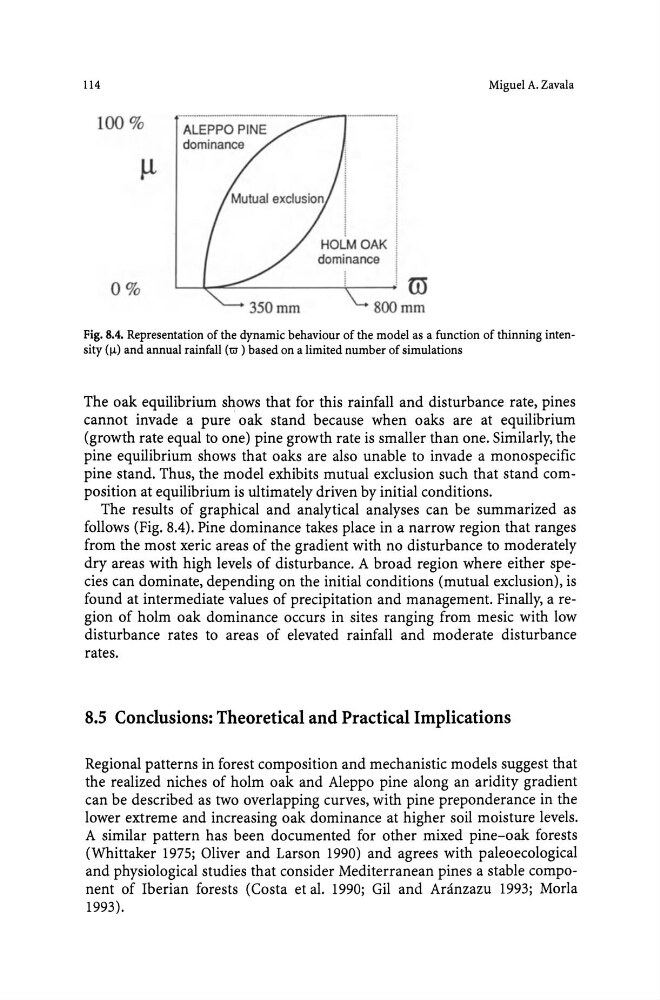
Fig. 8.4. Representation of the dynamic behaviour of the model as a function of thinning intensity (11) and annual rainfall (w ) based on a limited number of simulations
The oak equilibrium shows that for this rainfall and disturbance rate, pines
cannot invade a pure ' oak stand because when oaks are at equilibrium
(growth rate equal to one) pine growth rate is smaller than one. Similarly, the
pine equilibrium shows that oaks are also unable to invade a mono specific
pine stand. Thus, the model exhibits mutual exclusion such that stand composition at equilibrium is ultimately driven by initial conditions.
The results of graphical and analytical analyses can be summarized as
follows (Fig. 8.4). Pine dominance takes place in a narrow region that ranges
from the most xeric areas of the gradient with no disturbance to moderately
dry areas with high levels of disturbance. A broad region where either species can dominate, depending on the initial conditions (mutual exclusion), is
found at intermediate values of precipitation and management. Finally, a region of holm oak dominance occurs in sites ranging from mesic with low
disturbance rates to areas of elevated rainfall and moderate disturbance
rates.
8.5 Conclusions: Theoretical and Practical Implications
Regional patterns in forest composition and mechanistic models suggest that
the realized niches of holm oak and Aleppo pine along an aridity gradient
can be described as two overlapping curves, with pine preponderance in the
lower extreme and increasing oak dominance at higher soil moisture levels.
A similar pattern has been documented for other mixed pine-oak forests
(Whittaker 1975; Oliver and Larson 1990) and agrees with paleoecological
and physiological studies that consider Mediterranean pines a stable component of Iberian forests (Costa et al. 1990; Gil and Aninzazu 1993; Morla
1993).
Miguel A. Zavala
100 %
--_ .. ----,
dominance
,
dom;","ce I
0%
!
800mm
Fig. 8.4. Representation of the dynamic behaviour of the model as a function of thinning intensity (11) and annual rainfall (w ) based on a limited number of simulations
The oak equilibrium shows that for this rainfall and disturbance rate, pines
cannot invade a pure ' oak stand because when oaks are at equilibrium
(growth rate equal to one) pine growth rate is smaller than one. Similarly, the
pine equilibrium shows that oaks are also unable to invade a mono specific
pine stand. Thus, the model exhibits mutual exclusion such that stand composition at equilibrium is ultimately driven by initial conditions.
The results of graphical and analytical analyses can be summarized as
follows (Fig. 8.4). Pine dominance takes place in a narrow region that ranges
from the most xeric areas of the gradient with no disturbance to moderately
dry areas with high levels of disturbance. A broad region where either species can dominate, depending on the initial conditions (mutual exclusion), is
found at intermediate values of precipitation and management. Finally, a region of holm oak dominance occurs in sites ranging from mesic with low
disturbance rates to areas of elevated rainfall and moderate disturbance
rates.
8.5 Conclusions: Theoretical and Practical Implications
Regional patterns in forest composition and mechanistic models suggest that
the realized niches of holm oak and Aleppo pine along an aridity gradient
can be described as two overlapping curves, with pine preponderance in the
lower extreme and increasing oak dominance at higher soil moisture levels.
A similar pattern has been documented for other mixed pine-oak forests
(Whittaker 1975; Oliver and Larson 1990) and agrees with paleoecological
and physiological studies that consider Mediterranean pines a stable component of Iberian forests (Costa et al. 1990; Gil and Aninzazu 1993; Morla
1993).