

44
Alaknanda basin distantly located from these
basins, supports the alternate hypothesis (Corkum
1990 ) that even adjacent basins (Alaknanda
and Pindar) can be dissimilar despite identical
climatic and physiographic conditions and distant localities can be similar, as discussed below
on the basis of Principal Component Analysis for
the sites.
Both distantly located basins showed forest–
agriculture-type land use resulting in similar
food chain, which support the similarity between
these basins. It seems that the similarity is infl uenced by factors, which become powerful at
local scale, such as altitude as the river fl ows
towards decreasing elevation. In conjunction
with soil type, it would infl uence the vegetation.
Since the streams are heterotrophic in headwaters, the type of vegetation together with the climatic conditions (by virtue of altitude) and
slope of the stream, substrate type and discharge
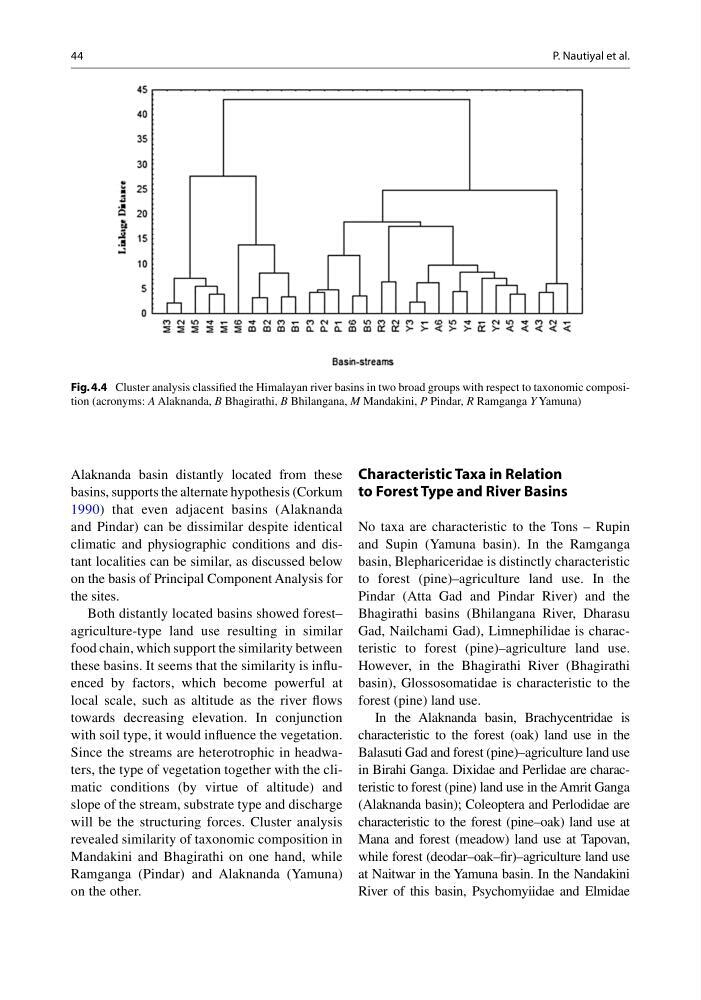
will be the structuring forces. Cluster analysis
revealed similarity of taxonomic composition in
Mandakini and Bhagirathi on one hand, while
Ramganga (Pindar) and Alaknanda (Yamuna)
on the other.
Characteristic Taxa in Relation
to Forest Type and River Basins
No taxa are characteristic to the Tons – Rupin
and Supin (Yamuna basin). In the Ramganga
basin, Blephariceridae is distinctly characteristic
to forest (pine)–agriculture land use. In the
Pindar (Atta Gad and Pindar River) and the
Bhagirathi basins (Bhilangana River, Dharasu
Gad, Nailchami Gad), Limnephilidae is characteristic to forest (pine)–agriculture land use.
However, in the Bhagirathi River (Bhagirathi
basin), Glossosomatidae is characteristic to the
forest (pine) land use.
In the Alaknanda basin, Brachycentridae is
characteristic to the forest (oak) land use in the
Balasuti Gad and forest (pine)–agriculture land use
in Birahi Ganga. Dixidae and Perlidae are characteristic to forest (pine) land use in the Amrit Ganga
(Alaknanda basin); Coleoptera and Perlodidae are
characteristic to the forest (pine–oak) land use at
Mana and forest (meadow) land use at Tapovan ,
while forest (deodar–oak–fi r)–agriculture land use
at Naitwar in the Yamuna basin. In the Nandakini
River of this basin, Psychomyiidae and Elmidae
Fig. 4.4 Cluster analysis classifi ed the Himalayan river basins in two broad groups with respect to taxonomic composition (acronyms: A Alaknanda, B Bhagirathi, B Bhilangana, M Mandakini, P Pindar, R Ramganga Y Yamuna)
P. Nautiyal et al.
Alaknanda basin distantly located from these
basins, supports the alternate hypothesis (Corkum
1990 ) that even adjacent basins (Alaknanda
and Pindar) can be dissimilar despite identical
climatic and physiographic conditions and distant localities can be similar, as discussed below
on the basis of Principal Component Analysis for
the sites.
Both distantly located basins showed forest–
agriculture-type land use resulting in similar
food chain, which support the similarity between
these basins. It seems that the similarity is infl uenced by factors, which become powerful at
local scale, such as altitude as the river fl ows
towards decreasing elevation. In conjunction
with soil type, it would infl uence the vegetation.
Since the streams are heterotrophic in headwaters, the type of vegetation together with the climatic conditions (by virtue of altitude) and
slope of the stream, substrate type and discharge
will be the structuring forces. Cluster analysis
revealed similarity of taxonomic composition in
Mandakini and Bhagirathi on one hand, while
Ramganga (Pindar) and Alaknanda (Yamuna)
on the other.
Characteristic Taxa in Relation
to Forest Type and River Basins
No taxa are characteristic to the Tons – Rupin
and Supin (Yamuna basin). In the Ramganga
basin, Blephariceridae is distinctly characteristic
to forest (pine)–agriculture land use. In the
Pindar (Atta Gad and Pindar River) and the
Bhagirathi basins (Bhilangana River, Dharasu
Gad, Nailchami Gad), Limnephilidae is characteristic to forest (pine)–agriculture land use.
However, in the Bhagirathi River (Bhagirathi
basin), Glossosomatidae is characteristic to the
forest (pine) land use.
In the Alaknanda basin, Brachycentridae is
characteristic to the forest (oak) land use in the
Balasuti Gad and forest (pine)–agriculture land use
in Birahi Ganga. Dixidae and Perlidae are characteristic to forest (pine) land use in the Amrit Ganga
(Alaknanda basin); Coleoptera and Perlodidae are
characteristic to the forest (pine–oak) land use at
Mana and forest (meadow) land use at Tapovan ,
while forest (deodar–oak–fi r)–agriculture land use
at Naitwar in the Yamuna basin. In the Nandakini
River of this basin, Psychomyiidae and Elmidae
Fig. 4.4 Cluster analysis classifi ed the Himalayan river basins in two broad groups with respect to taxonomic composition (acronyms: A Alaknanda, B Bhagirathi, B Bhilangana, M Mandakini, P Pindar, R Ramganga Y Yamuna)
P. Nautiyal et al.