

522
C.B. Field et al.
a
Sufficient H 2 0 and N
0.8
N Stress
H 2 0 Stress
•
0.7
•
•
en c- 0.6
•
w
0.5
•
0.4
•
•
0.3
1! 0.030
<>
0 Sufficient H 2 0 and N
« c..
<> N Stress
0
t> H 2 0 Stress
E
N
0.025
0
()
0
.s
>- 0.020
<>
0
c:
CIl
'u
<>
~
0
~ 0.015
~
&
c >- rJl
0
(5
~
0.010
c..
t>
0.07
0.09
0.10
0.11
0.12
PRI
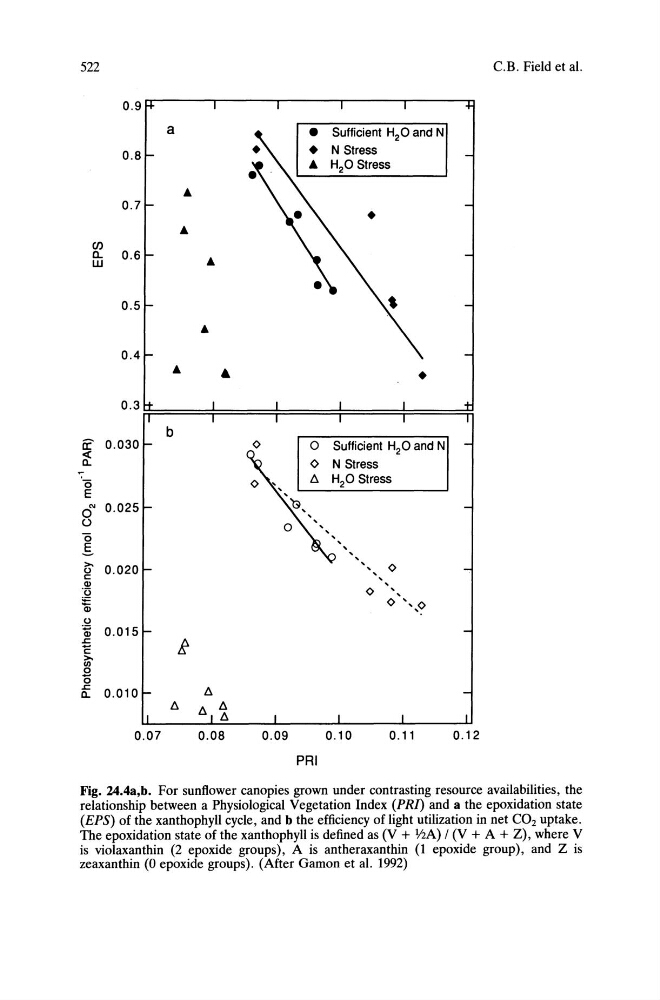
Fig. 24.4a,b. For sunflower canopies grown under contrasting resource availabilities, the
relationship between a Physiological Vegetation Index (PR!) and a the epoxidation state
(EPS) of the xanthophyll cycle, and b the efficiency of light utilization in net CO2 uptake.
The epoxidation state of the xanthophyll is defined as (V + V2A) / (V + A + Z), where V
is violaxanthin (2 epoxide groups), A is antheraxanthin (1 epoxide group), and Z is
zeaxanthin (0 epoxide groups). (After Gamon et al. 1992)
C.B. Field et al.
a
Sufficient H 2 0 and N
0.8
N Stress
H 2 0 Stress
•
0.7
•
•
en c- 0.6
•
w
0.5
•
0.4
•
•
0.3
1! 0.030
<>
0 Sufficient H 2 0 and N
« c..
<> N Stress
0
t> H 2 0 Stress
E
N
0.025
0
()
0
.s
>- 0.020
<>
0
c:
CIl
'u
<>
~
0
~ 0.015
~
&
c >- rJl
0
(5
~
0.010
c..
t>
0.07
0.09
0.10
0.11
0.12
PRI
Fig. 24.4a,b. For sunflower canopies grown under contrasting resource availabilities, the
relationship between a Physiological Vegetation Index (PR!) and a the epoxidation state
(EPS) of the xanthophyll cycle, and b the efficiency of light utilization in net CO2 uptake.
The epoxidation state of the xanthophyll is defined as (V + V2A) / (V + A + Z), where V
is violaxanthin (2 epoxide groups), A is antheraxanthin (1 epoxide group), and Z is
zeaxanthin (0 epoxide groups). (After Gamon et al. 1992)