

502
F.1. Woodward and T.M. Smith
35
- 30
";"(1)
~
E
"0 25
E
.5
·0 20
(I)
E
0
15
L..
0+ti Q)
L..
10
a.
~
E 5
«
0
0
5
10
15
20
25
30
Amax observed (t£mol m"2 S"1)
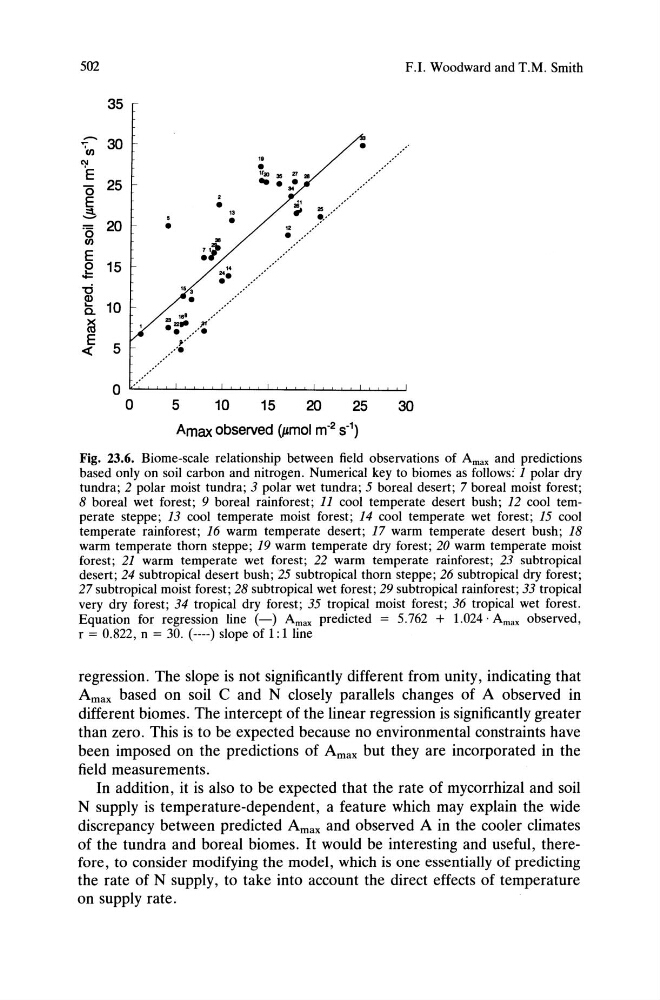
Fig. 23.6. Biome-scale relationship between field observations of Amax and predictions
based only on soil carbon and nitrogen. Numerical key to biomes as follows: 1 polar dry
tundra; 2 polar moist tundra; 3 polar wet tundra; 5 boreal desert; 7 boreal moist forest;
8 boreal wet forest; 9 boreal rainforest; 11 cool temperate desert bush; 12 cool temperate steppe; 13 cool temperate moist forest; 14 cool temperate wet forest; 15 cool
temperate rainforest; 16 warm temperate desert; 17 warm temperate desert bush; 18
warm temperate thorn steppe; 19 warm temperate dry forest; 20 warm temperate moist
forest; 21 warm temperate wet forest; 22 warm temperate rainforest; 23 subtropical
desert; 24 subtropical desert bush; 25 subtropical thorn steppe; 26 subtropical dry forest;
27 subtropical moist forest; 28 subtropical wet forest; 29 subtropical rainforest; 33 tropical
very dry forest; 34 tropical dry forest; 35 tropical moist forest; 36 tropical wet forest.
Equation for regression line (-) Amax predicted = 5.762 + 1.024· Amax observed,
r = 0.822, n = 30. (----) slope of 1: 1 line
regression. The slope is not significantly different from unity, indicating that
Amax based on soil C and N closely parallels changes of A observed in
different biomes. The intercept of the linear regression is significantly greater
than zero. This is to be expected because no environmental constraints have
been imposed on the predictions of Amax but they are incorporated in the
field measurements.
In addition, it is also to be expected that the rate of mycorrhizal and soil
N supply is temperature-dependent, a feature which may explain the wide
discrepancy between predicted Amax and observed A in the cooler climates
of the tundra and boreal biomes. It would be interesting and useful, therefore, to consider modifying the model, which is one essentially of predicting
the rate of N supply, to take into account the direct effects of temperature
on supply rate.
F.1. Woodward and T.M. Smith
35
- 30
";"(1)
~
E
"0 25
E
.5
·0 20
(I)
E
0
15
L..
0+ti Q)
L..
10
a.
~
E 5
«
0
0
5
10
15
20
25
30
Amax observed (t£mol m"2 S"1)
Fig. 23.6. Biome-scale relationship between field observations of Amax and predictions
based only on soil carbon and nitrogen. Numerical key to biomes as follows: 1 polar dry
tundra; 2 polar moist tundra; 3 polar wet tundra; 5 boreal desert; 7 boreal moist forest;
8 boreal wet forest; 9 boreal rainforest; 11 cool temperate desert bush; 12 cool temperate steppe; 13 cool temperate moist forest; 14 cool temperate wet forest; 15 cool
temperate rainforest; 16 warm temperate desert; 17 warm temperate desert bush; 18
warm temperate thorn steppe; 19 warm temperate dry forest; 20 warm temperate moist
forest; 21 warm temperate wet forest; 22 warm temperate rainforest; 23 subtropical
desert; 24 subtropical desert bush; 25 subtropical thorn steppe; 26 subtropical dry forest;
27 subtropical moist forest; 28 subtropical wet forest; 29 subtropical rainforest; 33 tropical
very dry forest; 34 tropical dry forest; 35 tropical moist forest; 36 tropical wet forest.
Equation for regression line (-) Amax predicted = 5.762 + 1.024· Amax observed,
r = 0.822, n = 30. (----) slope of 1: 1 line
regression. The slope is not significantly different from unity, indicating that
Amax based on soil C and N closely parallels changes of A observed in
different biomes. The intercept of the linear regression is significantly greater
than zero. This is to be expected because no environmental constraints have
been imposed on the predictions of Amax but they are incorporated in the
field measurements.
In addition, it is also to be expected that the rate of mycorrhizal and soil
N supply is temperature-dependent, a feature which may explain the wide
discrepancy between predicted Amax and observed A in the cooler climates
of the tundra and boreal biomes. It would be interesting and useful, therefore, to consider modifying the model, which is one essentially of predicting
the rate of N supply, to take into account the direct effects of temperature
on supply rate.