

Predictions and Measurements of the Maximum Photosynthetic Rate
495
The measurements of photosynthesis were made over a range of temperatures at saturating irradiance. This provided the temperature response of
photosynthesis about its optimum. The effects of vpd on photosynthesis
were removed by calculating the rate of photosynthesis at the maximum
observed stomatal conductance (Gmax), when vpd was less than 0.75 kPa
(Friend and Woodward 1990).
Plants were harvested in July and analyzed for total dry weight, leaf, and
whole-plant N and soil N (Kjeldahl total N analysis, Wild 1988). All soils in
the experiments have more than 800gm- 2 of N. The occurrence and type of
mycorrhizal infection was determined by staining for all species (Harley and
Smith 1983). The bulk density of the soil was measured and converted to an
estimate of soil C (Wild 1988). In brief, the soil types may be described as
an acid peat soil (under Calluna vulgaris and Vaccinium myrtillus heath), a
deep gray rendzina (under Fagus sylvatica woodland), a shallow rendzina
(under Anthoxanthum adoratum and Festuca rubra grassland) and a fertile
loam (previously under wheat but following the end of production, now
under Arrhenatherum elatius and Latium perenne).
50
40
4
•
";"(/)
'l'
30
4
E
•
(5
4
•
E
3
.=:.
•
3
~ 20
•
3
E
•
«
10
~
2
2 2
•
a a 1000 2000 3000 4000 5000 6000
N uptake (/.IgN g-1 d- 1 )
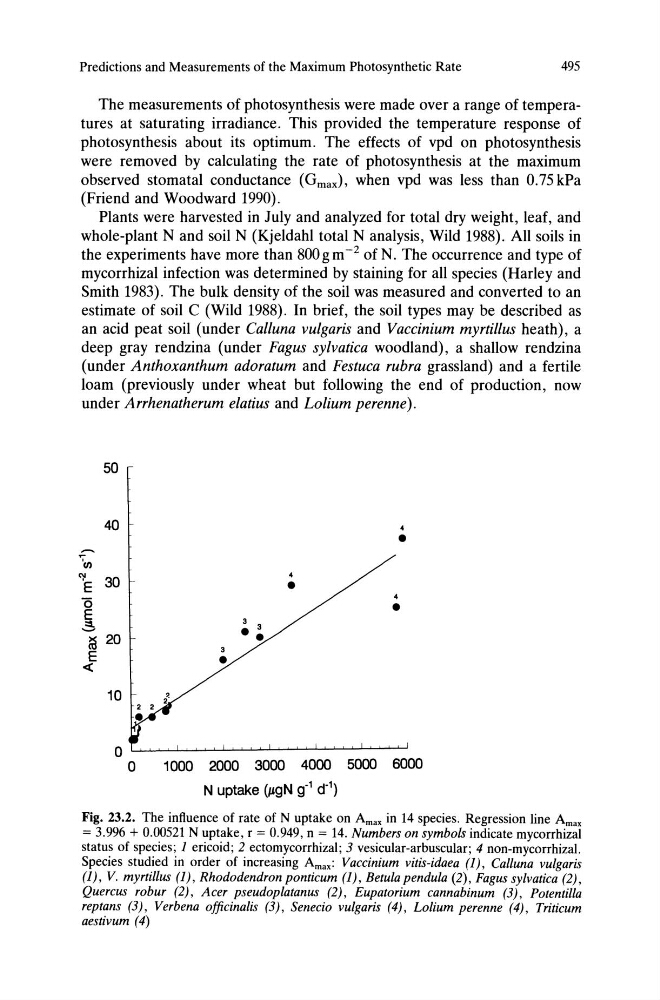
Fig. 23.2. The influence of rate of N uptake on Amax in 14 species. Regression line Amax
= 3.996 + 0.00521 N uptake, r = 0.949, n = 14. Numbers on symbols indicate mycorrhizal
status of species; 1 ericoid; 2 ectomycorrhizal; 3 vesicular-arbuscular; 4 non-mycorrhizal.
Species studied in order of increasing Amax: Vaccinium vitis-idaea (1), Calluna vulgaris
(1), V. myrtillus (1), Rhododendron ponticum (1), Betula pendula (2), Fagus sylvatica (2),
Quercus robur (2), Acer pseudoplatanus (2), Eupatorium cannabinum (3), Potentilla
reptans (3), Verbena officinalis (3), Senecio vulgaris (4), Lolium perenne (4), Triticum
aestivum (4)
495
The measurements of photosynthesis were made over a range of temperatures at saturating irradiance. This provided the temperature response of
photosynthesis about its optimum. The effects of vpd on photosynthesis
were removed by calculating the rate of photosynthesis at the maximum
observed stomatal conductance (Gmax), when vpd was less than 0.75 kPa
(Friend and Woodward 1990).
Plants were harvested in July and analyzed for total dry weight, leaf, and
whole-plant N and soil N (Kjeldahl total N analysis, Wild 1988). All soils in
the experiments have more than 800gm- 2 of N. The occurrence and type of
mycorrhizal infection was determined by staining for all species (Harley and
Smith 1983). The bulk density of the soil was measured and converted to an
estimate of soil C (Wild 1988). In brief, the soil types may be described as
an acid peat soil (under Calluna vulgaris and Vaccinium myrtillus heath), a
deep gray rendzina (under Fagus sylvatica woodland), a shallow rendzina
(under Anthoxanthum adoratum and Festuca rubra grassland) and a fertile
loam (previously under wheat but following the end of production, now
under Arrhenatherum elatius and Latium perenne).
50
40
4
•
";"(/)
'l'
30
4
E
•
(5
4
•
E
3
.=:.
•
3
~ 20
•
3
E
•
«
10
~
2
2 2
•
a a 1000 2000 3000 4000 5000 6000
N uptake (/.IgN g-1 d- 1 )
Fig. 23.2. The influence of rate of N uptake on Amax in 14 species. Regression line Amax
= 3.996 + 0.00521 N uptake, r = 0.949, n = 14. Numbers on symbols indicate mycorrhizal
status of species; 1 ericoid; 2 ectomycorrhizal; 3 vesicular-arbuscular; 4 non-mycorrhizal.
Species studied in order of increasing Amax: Vaccinium vitis-idaea (1), Calluna vulgaris
(1), V. myrtillus (1), Rhododendron ponticum (1), Betula pendula (2), Fagus sylvatica (2),
Quercus robur (2), Acer pseudoplatanus (2), Eupatorium cannabinum (3), Potentilla
reptans (3), Verbena officinalis (3), Senecio vulgaris (4), Lolium perenne (4), Triticum
aestivum (4)