

Leaf Diffusive Conductances in the Major Vegetation Types of the Globe
477
have been found for Pinus contorta (projected needle area, gin mmolm- 2
-1 T
. °C)·
s , min III
.
gpot = 14.0 Tmin + 85 Fahey (1979)
gpot = 17.3 Tmin + 139 Graham and Running (1984).
On an average, mean minimum air temperatures for the preceding night
of less than -6°C cause gpot to approach gmin independently of daytime
temperature. However, as mentioned above, soil temperature is a much
more precise predictor of gpot which approaches gmin in Pinus sylvestris and
possibly other conifers whenever soil temperatures decrease to + 1 °C (Fig.
22.1b).
Predawn water potentials also correlate with gpot in conifers. Graham and
Running (1984) report a linear decline in Pinus contorta following the
equation
gpot = 171'P + 320.
Thus, gpot is approaching gmin at predawn potentials of less than -1.6 MPa.
DeLucia et al. (1988) report similar slopes for three pine species of which
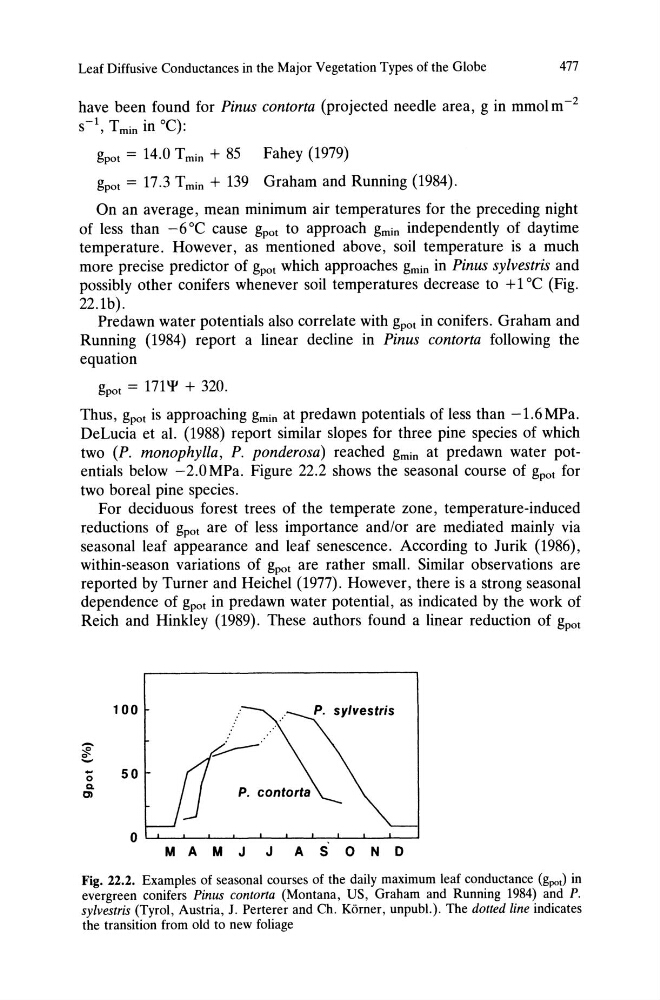
two (P. monophylla, P. ponderosa) reached gmin at predawn water potentials below -2.0 MPa. Figure 22.2 shows the seasonal course of gpot for
two boreal pine species.
For deciduous forest trees of the temperate zone, temperature-induced
reductions of gpot are of less importance and/or are mediated mainly via
seasonal leaf appearance and leaf senescence. According to Jurik (1986),
within-season variations of gpot are rather small. Similar observations are
reported by Turner and Heichel (1977). However, there is a strong seasonal
dependence of gpot in predawn water potential, as indicated by the work of
Reich and Hinkley (1989). These authors found a linear reduction of gpot
- o
Q.
OJ
100
50
o LL _ _ L-~~ __ ~~~~~~ __ L-~
MAMJ
J
A S O N D
Fig. 22.2. Examples of seasonal courses of the daily maximum leaf conductance (gpot) in
evergreen conifers Pinus contorta (Montana, US, Graham and Running 1984) and P.
sylvestris (Tyrol, Austria, J. Perterer and Ch. Korner, unpubl.). The dotted line indicates
the transition from old to new foliage
477
have been found for Pinus contorta (projected needle area, gin mmolm- 2
-1 T
. °C)·
s , min III
.
gpot = 14.0 Tmin + 85 Fahey (1979)
gpot = 17.3 Tmin + 139 Graham and Running (1984).
On an average, mean minimum air temperatures for the preceding night
of less than -6°C cause gpot to approach gmin independently of daytime
temperature. However, as mentioned above, soil temperature is a much
more precise predictor of gpot which approaches gmin in Pinus sylvestris and
possibly other conifers whenever soil temperatures decrease to + 1 °C (Fig.
22.1b).
Predawn water potentials also correlate with gpot in conifers. Graham and
Running (1984) report a linear decline in Pinus contorta following the
equation
gpot = 171'P + 320.
Thus, gpot is approaching gmin at predawn potentials of less than -1.6 MPa.
DeLucia et al. (1988) report similar slopes for three pine species of which
two (P. monophylla, P. ponderosa) reached gmin at predawn water potentials below -2.0 MPa. Figure 22.2 shows the seasonal course of gpot for
two boreal pine species.
For deciduous forest trees of the temperate zone, temperature-induced
reductions of gpot are of less importance and/or are mediated mainly via
seasonal leaf appearance and leaf senescence. According to Jurik (1986),
within-season variations of gpot are rather small. Similar observations are
reported by Turner and Heichel (1977). However, there is a strong seasonal
dependence of gpot in predawn water potential, as indicated by the work of
Reich and Hinkley (1989). These authors found a linear reduction of gpot
- o
Q.
OJ
100
50
o LL _ _ L-~~ __ ~~~~~~ __ L-~
MAMJ
J
A S O N D
Fig. 22.2. Examples of seasonal courses of the daily maximum leaf conductance (gpot) in
evergreen conifers Pinus contorta (Montana, US, Graham and Running 1984) and P.
sylvestris (Tyrol, Austria, J. Perterer and Ch. Korner, unpubl.). The dotted line indicates
the transition from old to new foliage