

Leaf Diffusive Conductances in the Major Vegetation Types of the Globe
475
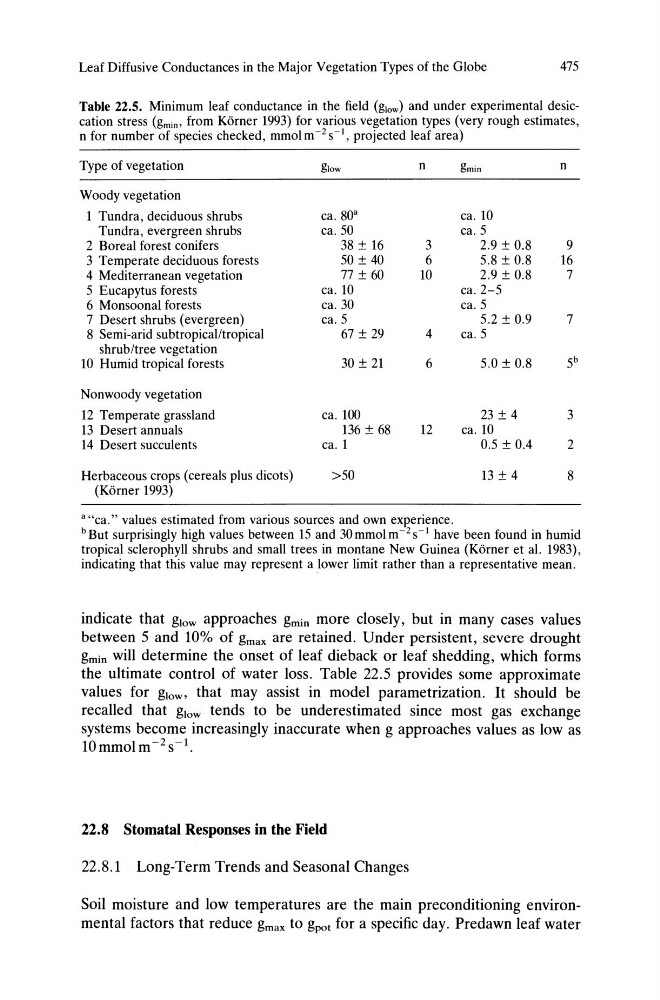
Table 22.5. Minimum leaf conductance in the field (glow) and under experimental desiccation stress (gmin, from Korner 1993) for various vegetation types (very rough estimates,
n for number of species checked, mmol m ~2 s~ 1, projected leaf area)
Type of vegetation
glow
n
gmin
n
Woody vegetation
1 Tundra, deciduous shrubs
ca. 80 a
ca. 10
Tundra, evergreen shrubs
ca. 50
ca. 5
2 Boreal forest conifers
38 ± 16
3
2.9 ± 0.8
9
3 Temperate deciduous forests
50 ± 40
6
5.8 ± 0.8
16
4 Mediterranean vegetation
77 ± 60
10
2.9 ± 0.8
7
5 Eucapytus forests
ca. 10
ca. 2-5
6 Monsoonal forests
ca. 30
ca. 5
7 Desert shrubs (evergreen)
ca. 5
5.2 ± 0.9
7
8 Semi-arid subtropical/tropical
67 ± 29
4
ca. 5
shrub/tree vegetation
10 Humid tropical forests
30 ± 21
6
5.0 ± 0.8
5 b
Nonwoody vegetation
12 Temperate grassland
ca. 100
23 ± 4
3
13 Desert annuals
136 ± 68
12
ca. 10
14 Desert succulents
ca. 1
0.5 ± 0.4
2
Herbaceous crops (cereals plus dicots)
>50
13 ± 4
8
(Korner 1993)
a "ca." values estimated from various sources and own experience.
b But surprisingly high values between 15 and 30 mmol m~2 S~l have been found in humid
tropical sc\erophyll shrubs and small trees in montane New Guinea (Korner et al. 1983),
indicating that this value may represent a lower limit rather than a representative mean.
indicate that glow approaches gmin more closely, but in many cases values
between 5 and 10% of gmax are retained. Under persistent, severe drought
gmin will determine the onset of leaf die back or leaf shedding, which forms
the ultimate control of water loss. Table 22.5 provides some approximate
values for glow, that may assist in model parametrization. It should be
recalled that glow tends to be underestimated since most gas exchange
systems become increasingly inaccurate when g approaches values as low as
1Ommolm- 2 s- 1 .
22.8 Stomatal Responses in the Field
22.8.1 Long-Term Trends and Seasonal Changes
Soil moisture and low temperatures are the main preconditioning environmental factors that reduce gmax to gpot for a specific day. Predawn leaf water
475
Table 22.5. Minimum leaf conductance in the field (glow) and under experimental desiccation stress (gmin, from Korner 1993) for various vegetation types (very rough estimates,
n for number of species checked, mmol m ~2 s~ 1, projected leaf area)
Type of vegetation
glow
n
gmin
n
Woody vegetation
1 Tundra, deciduous shrubs
ca. 80 a
ca. 10
Tundra, evergreen shrubs
ca. 50
ca. 5
2 Boreal forest conifers
38 ± 16
3
2.9 ± 0.8
9
3 Temperate deciduous forests
50 ± 40
6
5.8 ± 0.8
16
4 Mediterranean vegetation
77 ± 60
10
2.9 ± 0.8
7
5 Eucapytus forests
ca. 10
ca. 2-5
6 Monsoonal forests
ca. 30
ca. 5
7 Desert shrubs (evergreen)
ca. 5
5.2 ± 0.9
7
8 Semi-arid subtropical/tropical
67 ± 29
4
ca. 5
shrub/tree vegetation
10 Humid tropical forests
30 ± 21
6
5.0 ± 0.8
5 b
Nonwoody vegetation
12 Temperate grassland
ca. 100
23 ± 4
3
13 Desert annuals
136 ± 68
12
ca. 10
14 Desert succulents
ca. 1
0.5 ± 0.4
2
Herbaceous crops (cereals plus dicots)
>50
13 ± 4
8
(Korner 1993)
a "ca." values estimated from various sources and own experience.
b But surprisingly high values between 15 and 30 mmol m~2 S~l have been found in humid
tropical sc\erophyll shrubs and small trees in montane New Guinea (Korner et al. 1983),
indicating that this value may represent a lower limit rather than a representative mean.
indicate that glow approaches gmin more closely, but in many cases values
between 5 and 10% of gmax are retained. Under persistent, severe drought
gmin will determine the onset of leaf die back or leaf shedding, which forms
the ultimate control of water loss. Table 22.5 provides some approximate
values for glow, that may assist in model parametrization. It should be
recalled that glow tends to be underestimated since most gas exchange
systems become increasingly inaccurate when g approaches values as low as
1Ommolm- 2 s- 1 .
22.8 Stomatal Responses in the Field
22.8.1 Long-Term Trends and Seasonal Changes
Soil moisture and low temperatures are the main preconditioning environmental factors that reduce gmax to gpot for a specific day. Predawn leaf water