

424
A. desertorum
P. spicoto
r---_.--~r---_.---.
b
3 a
'1/1
2
. . .
~(5
< E 0
::t
....... -1
300
........
. .
'1/1 200
. .
::J
0- (5 100
..... E
a.. ::t
....... 0
0.7
1/1
CD
0.6
>
0
Q)= 0.5
c: c:
:J 0.4
0 1/1
0+u
0
0.3
~
0.2
.....
4
e
8
- - Mea
- - 90 0
12
50 0
30 0
00
16
f
4
Time (h)
8
w. Beyschlag et al.
12
16
20
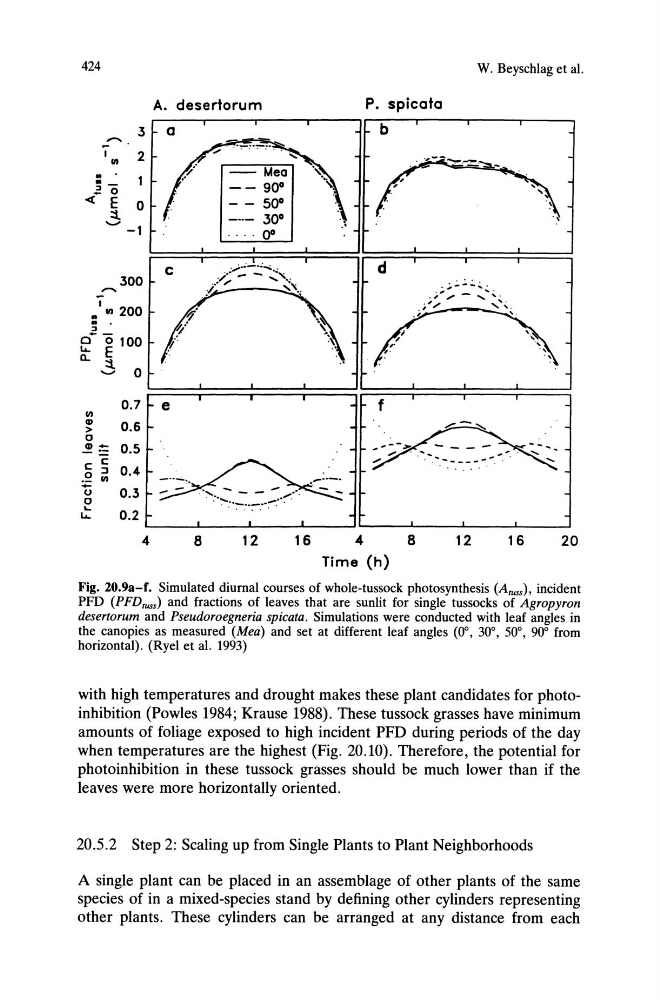
Fig. 20.9a-f. Simulated diurnal courses of whole-tussock photosynthesis (Atuss), incident
PFD (PFD,uss) and fractions of leaves that are sunlit for single tussocks of Agropyron
desertorum and Pseudoroegneria spicata. Simulations were conducted with leaf angles in
the canopies as measured (Mea) and set at different leaf angles (0°, 30°, 50°, 90° from
horizontal). (Ryel et al. 1993)
with high temperatures and drought makes these plant candidates for photoinhibition (Powles 1984; Krause 1988). These tussock grasses have minimum
amounts of foliage exposed to high incident PFD during periods of the day
when temperatures are the highest (Fig. 20.10). Therefore, the potential for
photoinhibition in these tussock grasses should be much lower than if the
leaves were more horizontally oriented.
20.5.2 Step 2: Scaling up from Single Plants to Plant Neighborhoods
A single plant can be placed in an assemblage of other plants of the same
species of in a mixed-species stand by defining other cylinders representing
other plants. These cylinders can be arranged at any distance from each
A. desertorum
P. spicoto
r---_.--~r---_.---.
b
3 a
'1/1
2
. . .
~(5
< E 0
::t
....... -1
300
........
. .
'1/1 200
. .
::J
0- (5 100
..... E
a.. ::t
....... 0
0.7
1/1
CD
0.6
>
0
Q)= 0.5
c: c:
:J 0.4
0 1/1
0+u
0
0.3
~
0.2
.....
4
e
8
- - Mea
- - 90 0
12
50 0
30 0
00
16
f
4
Time (h)
8
w. Beyschlag et al.
12
16
20
Fig. 20.9a-f. Simulated diurnal courses of whole-tussock photosynthesis (Atuss), incident
PFD (PFD,uss) and fractions of leaves that are sunlit for single tussocks of Agropyron
desertorum and Pseudoroegneria spicata. Simulations were conducted with leaf angles in
the canopies as measured (Mea) and set at different leaf angles (0°, 30°, 50°, 90° from
horizontal). (Ryel et al. 1993)
with high temperatures and drought makes these plant candidates for photoinhibition (Powles 1984; Krause 1988). These tussock grasses have minimum
amounts of foliage exposed to high incident PFD during periods of the day
when temperatures are the highest (Fig. 20.10). Therefore, the potential for
photoinhibition in these tussock grasses should be much lower than if the
leaves were more horizontally oriented.
20.5.2 Step 2: Scaling up from Single Plants to Plant Neighborhoods
A single plant can be placed in an assemblage of other plants of the same
species of in a mixed-species stand by defining other cylinders representing
other plants. These cylinders can be arranged at any distance from each