

382
J. R. Ehleringer
found in a large number of species from deserts throughout the world
(Winter and Troughton 1978; Winter 1981; Rundel and Sharifi 1993), suggesting that long-lived species are very conservative in their set point.
Within populations, there can be variation in Ll values corresponding to Cj
value differences of 30 ~ll-I (Schuster et al. 1992), suggesting life-history
variation not only at the species level but also variation within a species.
Ehleringer (1993a) examined variation in Ll values among adjacent Encelia
farinosa shrubs and showed that high-Ll genotypes grew faster than low-Ll
genotypes, but were also more sensitive to drought. In response to the
extremes in precipitation patterns that characterize the desert, there appeared
to be tradeoffs, with one end of the temporal water-availability spectrum
favoring high-Ll genotypes and the other favoring low-Ll genotypes. Thus,
variation at the population level in this case mirrored patterns also seen at
the community level in terms of variation in Cj.
18.6 Integrating Gas Exchange Across Complex Environmental Gradients
18.6.1 Evaporative Gradients
A common observation is that in response to a decreased humidity level,
stomata partially or completely close (Lange et al. 1971), resulting in a
reduced Cj value. When plants are grown under reduced humidity levels, Cj
values are reduced, as indicated by heavier 013C values (Winter et al. 1982).
If plants show this environmental plasticity, it seems reasonable to expect
that populations adapted to different climatic regimes should show corresponding differences. On an instantaneous basis, transpiration (E) is the
product of leaf conductance (g) and the leaf-to-air water vapor gradient
divided by total atmospheric pressure (v). Temporal variations in the growing
season among sites can be incorporated without bias by averaging the
saturation vapor pressure expressed as a mole fraction (ea,sat/Ptotal) over
each month of the year, using the monthly ratio of precipitation (P) to
potential evapotranspiration (Ep) as a weighting factor (Comstock and
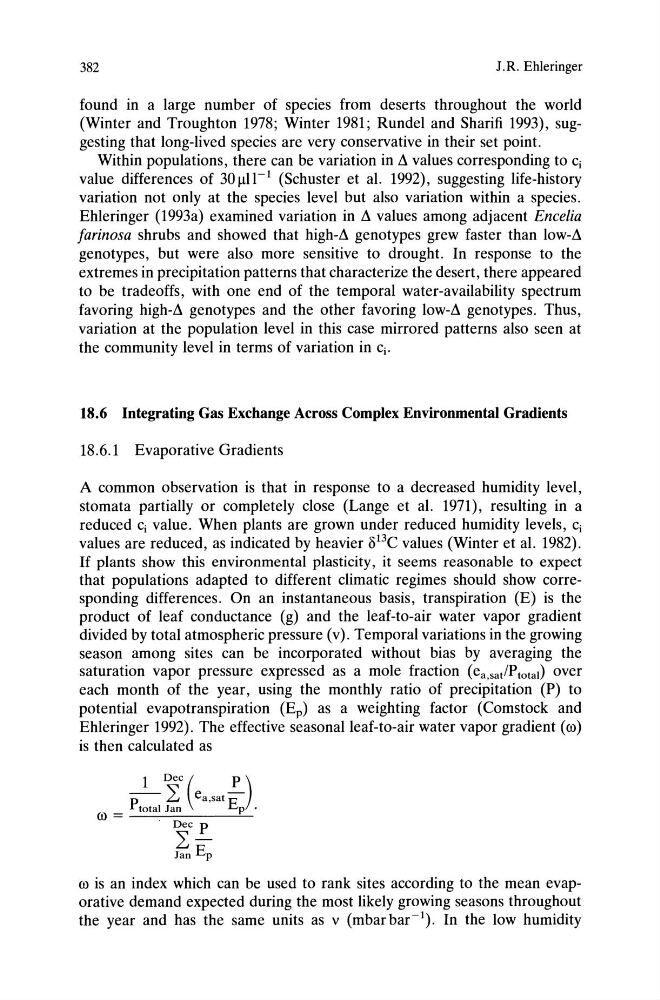
Ehleringer 1992). The effective seasonalleaf-to-air water vapor gradient (0))
is then calculated as
1 DeC( P)
-- 2: ea,sat0) = Ptotal Jan
Ep .
. Dec P
2:Jan Ep
0) is an index which can be used to rank sites according to the mean evaporative demand expected during the most likely growing seasons throughout
the year and has the same units as v (mbar bar-I). In the low humidity
J. R. Ehleringer
found in a large number of species from deserts throughout the world
(Winter and Troughton 1978; Winter 1981; Rundel and Sharifi 1993), suggesting that long-lived species are very conservative in their set point.
Within populations, there can be variation in Ll values corresponding to Cj
value differences of 30 ~ll-I (Schuster et al. 1992), suggesting life-history
variation not only at the species level but also variation within a species.
Ehleringer (1993a) examined variation in Ll values among adjacent Encelia
farinosa shrubs and showed that high-Ll genotypes grew faster than low-Ll
genotypes, but were also more sensitive to drought. In response to the
extremes in precipitation patterns that characterize the desert, there appeared
to be tradeoffs, with one end of the temporal water-availability spectrum
favoring high-Ll genotypes and the other favoring low-Ll genotypes. Thus,
variation at the population level in this case mirrored patterns also seen at
the community level in terms of variation in Cj.
18.6 Integrating Gas Exchange Across Complex Environmental Gradients
18.6.1 Evaporative Gradients
A common observation is that in response to a decreased humidity level,
stomata partially or completely close (Lange et al. 1971), resulting in a
reduced Cj value. When plants are grown under reduced humidity levels, Cj
values are reduced, as indicated by heavier 013C values (Winter et al. 1982).
If plants show this environmental plasticity, it seems reasonable to expect
that populations adapted to different climatic regimes should show corresponding differences. On an instantaneous basis, transpiration (E) is the
product of leaf conductance (g) and the leaf-to-air water vapor gradient
divided by total atmospheric pressure (v). Temporal variations in the growing
season among sites can be incorporated without bias by averaging the
saturation vapor pressure expressed as a mole fraction (ea,sat/Ptotal) over
each month of the year, using the monthly ratio of precipitation (P) to
potential evapotranspiration (Ep) as a weighting factor (Comstock and
Ehleringer 1992). The effective seasonalleaf-to-air water vapor gradient (0))
is then calculated as
1 DeC( P)
-- 2: ea,sat0) = Ptotal Jan
Ep .
. Dec P
2:Jan Ep
0) is an index which can be used to rank sites according to the mean evaporative demand expected during the most likely growing seasons throughout
the year and has the same units as v (mbar bar-I). In the low humidity