

Variation in Gas Exchange Characteristics Among Desert Plants
22
20
18
16
14
Oatman, Arizona
T
S ~
~
w
long-lived
perennials
(50+ yr)
W
T ~
s Q
E1
medium-lived
perennials
(10-40 yr)
w
short-lived
perennials
(1-10 yr)
S = slope
T = transition
W = wash
381
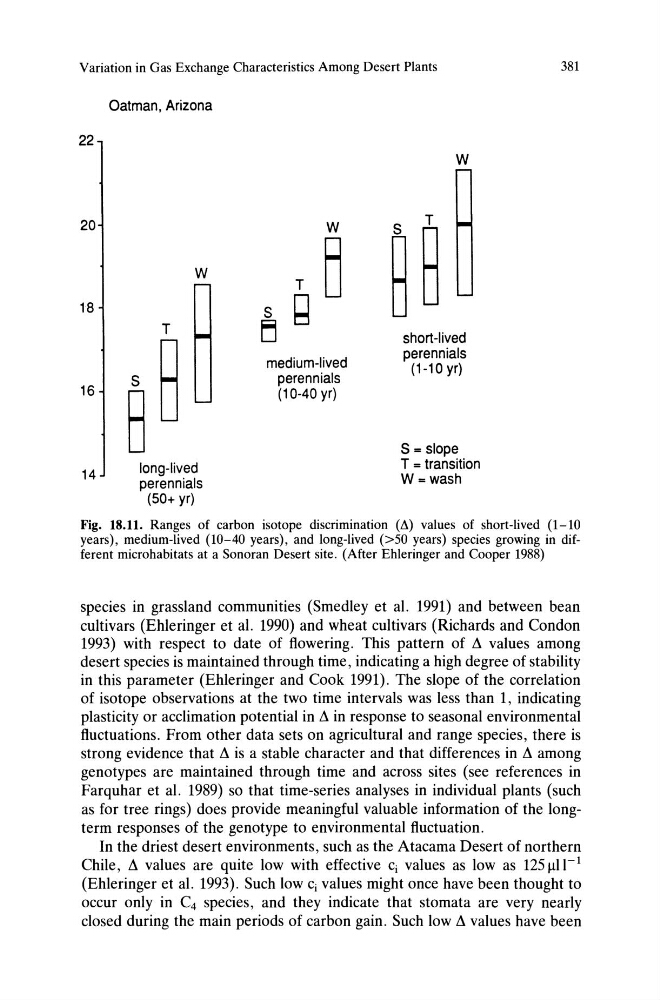
Fig. 18.11. Ranges of carbon isotope discrimination (~) values of short-lived (1-10
years), medium-lived (10-40 years), and long-lived (>50 years) species growing in different microhabitats at a Sonoran Desert site. (After Ehleringer and Cooper 1988)
species in grassland communities (Smedley et al. 1991) and between bean
cultivars (Ehleringer et al. 1990) and wheat cultivars (Richards and Condon
1993) with respect to date of flowering. This pattern of ~ values among
desert species is maintained through time, indicating a high degree of stability
in this parameter (Ehleringer and Cook 1991). The slope of the correlation
of isotope observations at the two time intervals was less than 1, indicating
plasticity or acclimation potential in ~ in response to seasonal environmental
fluctuations. From other data sets on agricultural and range species, there is
strong evidence that ~ is a stable character and that differences in ~ among
genotypes are maintained through time and across sites (see references in
Farquhar et al. 1989) so that time-series analyses in individual plants (such
as for tree rings) does provide meaningful valuable information of the longterm responses of the genotype to environmental fluctuation.
In the driest desert environments, such as the Atacama Desert of northern
Chile, ~ values are quite low with effective Cj values as low as 1251l11-1
(Ehleringer et al. 1993). Such low Cj values might once have been thought to
occur only in C4 species, and they indicate that stomata are very nearly
closed during the main periods of carbon gain. Such low ~ values have been
22
20
18
16
14
Oatman, Arizona
T
S ~
~
w
long-lived
perennials
(50+ yr)
W
T ~
s Q
E1
medium-lived
perennials
(10-40 yr)
w
short-lived
perennials
(1-10 yr)
S = slope
T = transition
W = wash
381
Fig. 18.11. Ranges of carbon isotope discrimination (~) values of short-lived (1-10
years), medium-lived (10-40 years), and long-lived (>50 years) species growing in different microhabitats at a Sonoran Desert site. (After Ehleringer and Cooper 1988)
species in grassland communities (Smedley et al. 1991) and between bean
cultivars (Ehleringer et al. 1990) and wheat cultivars (Richards and Condon
1993) with respect to date of flowering. This pattern of ~ values among
desert species is maintained through time, indicating a high degree of stability
in this parameter (Ehleringer and Cook 1991). The slope of the correlation
of isotope observations at the two time intervals was less than 1, indicating
plasticity or acclimation potential in ~ in response to seasonal environmental
fluctuations. From other data sets on agricultural and range species, there is
strong evidence that ~ is a stable character and that differences in ~ among
genotypes are maintained through time and across sites (see references in
Farquhar et al. 1989) so that time-series analyses in individual plants (such
as for tree rings) does provide meaningful valuable information of the longterm responses of the genotype to environmental fluctuation.
In the driest desert environments, such as the Atacama Desert of northern
Chile, ~ values are quite low with effective Cj values as low as 1251l11-1
(Ehleringer et al. 1993). Such low Cj values might once have been thought to
occur only in C4 species, and they indicate that stomata are very nearly
closed during the main periods of carbon gain. Such low ~ values have been