

Variation in Gas Exchange Characteristics Among Desert Plants
379
nonstressed conditions, and, if in response to abiotic stresses, any changes in
the absolute value of a set point resulted in the relative ran kings of plants
remaining constant.
Using long-term estimates of the Cj value as a measure of the set point for
gas exchange metabolism provides a comparative estimate of the extent to
which stomatal conductance and water-related process limit photosynthesis
instead of photosynthetic capacity and mineral-nutrition-related processes
under a specific set of climatic conditions. This is exactly analogous to
previous indications of tradeoffs between water-use efficiency and nitrogenuse efficiency (Field et al. 1983). Both parameters cannot be simultaneously
increased and the operational point represents a relative difference in the
extent to which gas exchange is controlled by mineral-related components
versus water-related components. Annuals and perennials would be expected
to represent two ends of this spectrum, with limitations in the gas exchange
of perennial plants largely controlled by water-related components (e.g.,
leaf conductance, hydraulic conductance).
18.5.3 Carbon Isotope Discrimination as a Measure
of Intercellular Carbon Dioxide Concentration
18.5.3.1 C 3 Plants
Over extended time periods, the intercellular CO2 concentration can be
estimated through measurement of the carbon isotopic composition of plant
material (Farquhar et al. 1989). Carbon isotope discrimination (L\) in C 3
plants is related to photosynthetic gas exchange; because L\ is in part determined by c/ca , the ratio of CO2 concentrations in the leaf intercellular
spaces to that in the atmosphere. This ratio, c/ca , differs among plants
because of variation in stomatal opening (affecting the supply rate of CO 2 ),
and because of variation in the chloroplast demand for CO2. Of the models
linking C3 photosynthesis and l3Ci 12 C composition, the one developed by
Farquhar et al. (1982) has been the most extensively tested. In its simplest
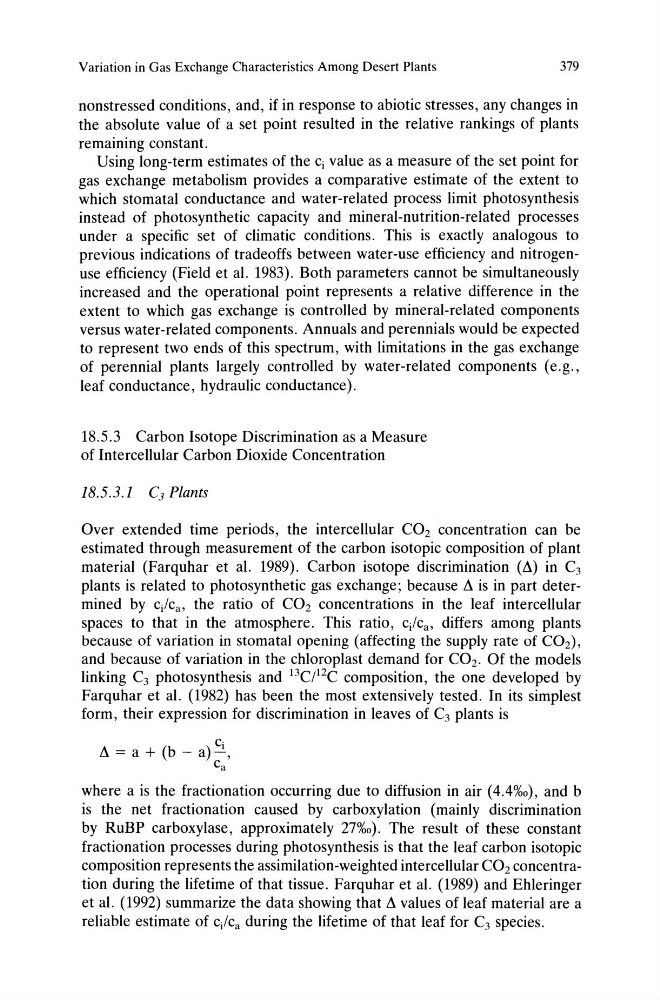
form, their expression for discrimination in leaves of C 3 plants is
where a is the fractionation occurring due to diffusion in air (4.4%0), and b
is the net fractionation caused by carboxylation (mainly discrimination
by RuBP carboxylase, approximately 27%0). The result of these constant
fractionation processes during photosynthesis is that the leaf carbon isotopic
composition represents the assimilation-weighted intercellular CO 2 concentration during the lifetime of that tissue. Farquhar et al. (1989) and Ehleringer
et al. (1992) summarize the data showing that L\ values of leaf material are a
reliable estimate of c/ca during the lifetime of that leaf for C 3 species.
379
nonstressed conditions, and, if in response to abiotic stresses, any changes in
the absolute value of a set point resulted in the relative ran kings of plants
remaining constant.
Using long-term estimates of the Cj value as a measure of the set point for
gas exchange metabolism provides a comparative estimate of the extent to
which stomatal conductance and water-related process limit photosynthesis
instead of photosynthetic capacity and mineral-nutrition-related processes
under a specific set of climatic conditions. This is exactly analogous to
previous indications of tradeoffs between water-use efficiency and nitrogenuse efficiency (Field et al. 1983). Both parameters cannot be simultaneously
increased and the operational point represents a relative difference in the
extent to which gas exchange is controlled by mineral-related components
versus water-related components. Annuals and perennials would be expected
to represent two ends of this spectrum, with limitations in the gas exchange
of perennial plants largely controlled by water-related components (e.g.,
leaf conductance, hydraulic conductance).
18.5.3 Carbon Isotope Discrimination as a Measure
of Intercellular Carbon Dioxide Concentration
18.5.3.1 C 3 Plants
Over extended time periods, the intercellular CO2 concentration can be
estimated through measurement of the carbon isotopic composition of plant
material (Farquhar et al. 1989). Carbon isotope discrimination (L\) in C 3
plants is related to photosynthetic gas exchange; because L\ is in part determined by c/ca , the ratio of CO2 concentrations in the leaf intercellular
spaces to that in the atmosphere. This ratio, c/ca , differs among plants
because of variation in stomatal opening (affecting the supply rate of CO 2 ),
and because of variation in the chloroplast demand for CO2. Of the models
linking C3 photosynthesis and l3Ci 12 C composition, the one developed by
Farquhar et al. (1982) has been the most extensively tested. In its simplest
form, their expression for discrimination in leaves of C 3 plants is
where a is the fractionation occurring due to diffusion in air (4.4%0), and b
is the net fractionation caused by carboxylation (mainly discrimination
by RuBP carboxylase, approximately 27%0). The result of these constant
fractionation processes during photosynthesis is that the leaf carbon isotopic
composition represents the assimilation-weighted intercellular CO 2 concentration during the lifetime of that tissue. Farquhar et al. (1989) and Ehleringer
et al. (1992) summarize the data showing that L\ values of leaf material are a
reliable estimate of c/ca during the lifetime of that leaf for C 3 species.