

378
canopy leaf area
C/)
'00
Q)
.L:
C
>.
C/)
o
(5
.L:
a.
C/)
'00
Q)
.L:
C
>.
C/)
o
(5
.L:
a.
J. R. Ehleringer
Transpiration
Intercellular carbon dioxide
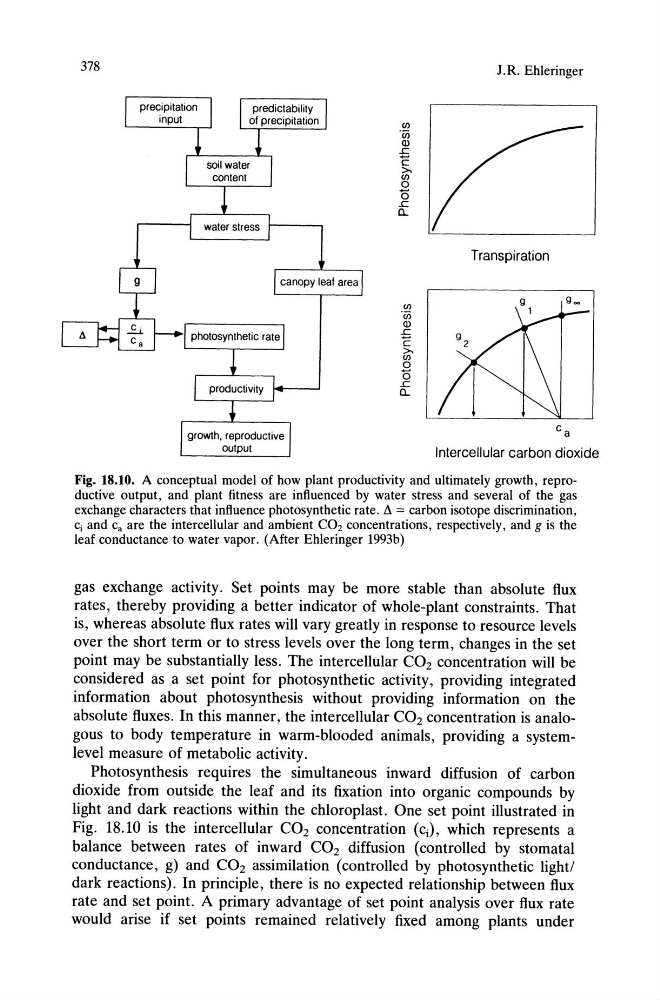
Fig. IS.10. A conceptual model of how plant productivity and ultimately growth, reproductive output, and plant fitness are influenced by water stress and several of the gas
exchange characters that influence photosynthetic rate. !l = carbon isotope discrimination,
Cj and C a are the intercellular and ambient CO2 concentrations, respectively, and g is the
leaf conductance to water vapor. (After Ehleringer 1993b)
gas exchange activity. Set points may be more stable than absolute flux
rates, thereby providing a better indicator of whole-plant constraints. That
is, whereas absolute flux rates will vary greatly in response to resource levels
over the short term or to stress levels over the long term, changes in the set
point may be substantially less. The intercellular CO2 concentration will be
considered as a set point for photosynthetic activity, providing integrated
information about photosynthesis without providing information on the
absolute fluxes. In this manner, the intercellular CO2 concentration is analogous to body temperature in warm-blooded animals, providing a systemlevel measure of metabolic activity.
Photosynthesis requires the simultaneous inward diffusion of carbon
dioxide from outside the leaf and its fixation into organic compounds by
light and dark reactions within the chloroplast. One set point illustrated in
Fig. 18.10 is the intercellular CO2 concentration (Cj) , which represents a
balance between rates of inward CO2 diffusion (controlled by stomatal
conductance, g) and CO2 assimilation (controlled by photosynthetic light/
dark reactions). In principle, there is no expected relationship between flux
rate and set point. A primary advantage of set point analysis over flux rate
would arise if set points remained relatively fixed among plants under
canopy leaf area
C/)
'00
Q)
.L:
C
>.
C/)
o
(5
.L:
a.
C/)
'00
Q)
.L:
C
>.
C/)
o
(5
.L:
a.
J. R. Ehleringer
Transpiration
Intercellular carbon dioxide
Fig. IS.10. A conceptual model of how plant productivity and ultimately growth, reproductive output, and plant fitness are influenced by water stress and several of the gas
exchange characters that influence photosynthetic rate. !l = carbon isotope discrimination,
Cj and C a are the intercellular and ambient CO2 concentrations, respectively, and g is the
leaf conductance to water vapor. (After Ehleringer 1993b)
gas exchange activity. Set points may be more stable than absolute flux
rates, thereby providing a better indicator of whole-plant constraints. That
is, whereas absolute flux rates will vary greatly in response to resource levels
over the short term or to stress levels over the long term, changes in the set
point may be substantially less. The intercellular CO2 concentration will be
considered as a set point for photosynthetic activity, providing integrated
information about photosynthesis without providing information on the
absolute fluxes. In this manner, the intercellular CO2 concentration is analogous to body temperature in warm-blooded animals, providing a systemlevel measure of metabolic activity.
Photosynthesis requires the simultaneous inward diffusion of carbon
dioxide from outside the leaf and its fixation into organic compounds by
light and dark reactions within the chloroplast. One set point illustrated in
Fig. 18.10 is the intercellular CO2 concentration (Cj) , which represents a
balance between rates of inward CO2 diffusion (controlled by stomatal
conductance, g) and CO2 assimilation (controlled by photosynthetic light/
dark reactions). In principle, there is no expected relationship between flux
rate and set point. A primary advantage of set point analysis over flux rate
would arise if set points remained relatively fixed among plants under