

Variation in Gas Exchange Characteristics Among Desert Plants
373
in Table 18.2. From this table it is evident that C4 plants are not so
taxonomically common in deserts. The C4 pathway is essentially found in
only three life-forms: graminoids, evergreen shrubs, and summer annuals.
The distribution of C4 photosynthesis among evergreen perennials is essentially restricted to halophytic plants (e.g., Atriplex). When the distribution
of photosynthetic pathway types is analyzed with respect to the different
North American deserts, C4 photosynthesis is rare in deserts that do not
receive significant amounts of summer rain (Teeri and Stowe 1976; Stowe
and Teeri 1978), except in the case of halophytes (Caldwell et al. 1977; Pearcy
and Ehleringer 1984). The distribution of CAM plants closely parallels that
of C4 species (Teeri et al. 1978). CAM plants are most frequent in habitats
receiving summer rains and those regions without cold winter temperatures.
Predictability and patterning of precipitation provide a basis for understanding the distribution of C3 and C4 photosynthesis in perennials. Throughout much of the Sonoran Desert, the most effective precipitation comes
during the winter periods when temperatures are cooler and evaporative
gradients are lower (see Sect. 18.5). If winter and spring are the primary
periods of active growth, then C3 photosynthesis may have an advantage
over C4 photosynthesis in perennial species. Under the moderate temperatures prevailing at that time, photorespiration rates would be expected
to be reduced in C3 plants and quantum yields higher in C 3 relative to C 4
I
-30
••
••••• •••••
i
j
I
I
-25
•
• ••
,
i
i
-20
•
••
•• ••
••
•• ••
••• ••••
•••••
• •••••
• ••••••
• •••••••
I
I
I
I
I
I
I
-15
-10
Carbon isotope ratio, %0
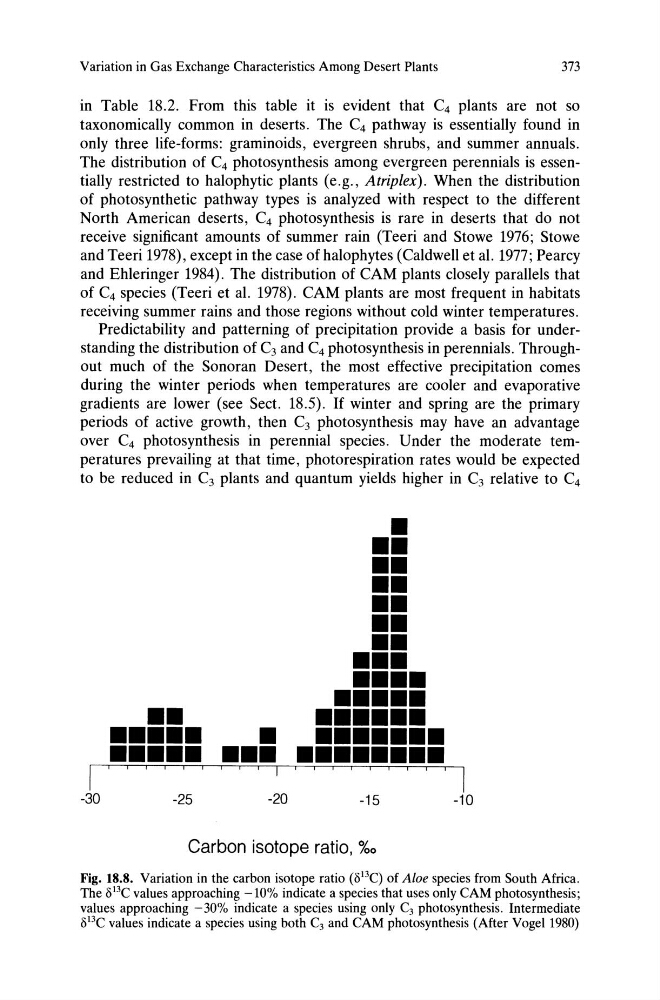
Fig. 18.8. Variation in the carbon isotope ratio (ol3C) of Aloe species from South Africa.
The Ol3C values approaching -10% indicate a species that uses only CAM photosynthesis;
values approaching -30% indicate a species using only C3 photosynthesis. Intermediate
Ol3C values indicate a species using both C3 and CAM photosynthesis (After Vogel 1980)
373
in Table 18.2. From this table it is evident that C4 plants are not so
taxonomically common in deserts. The C4 pathway is essentially found in
only three life-forms: graminoids, evergreen shrubs, and summer annuals.
The distribution of C4 photosynthesis among evergreen perennials is essentially restricted to halophytic plants (e.g., Atriplex). When the distribution
of photosynthetic pathway types is analyzed with respect to the different
North American deserts, C4 photosynthesis is rare in deserts that do not
receive significant amounts of summer rain (Teeri and Stowe 1976; Stowe
and Teeri 1978), except in the case of halophytes (Caldwell et al. 1977; Pearcy
and Ehleringer 1984). The distribution of CAM plants closely parallels that
of C4 species (Teeri et al. 1978). CAM plants are most frequent in habitats
receiving summer rains and those regions without cold winter temperatures.
Predictability and patterning of precipitation provide a basis for understanding the distribution of C3 and C4 photosynthesis in perennials. Throughout much of the Sonoran Desert, the most effective precipitation comes
during the winter periods when temperatures are cooler and evaporative
gradients are lower (see Sect. 18.5). If winter and spring are the primary
periods of active growth, then C3 photosynthesis may have an advantage
over C4 photosynthesis in perennial species. Under the moderate temperatures prevailing at that time, photorespiration rates would be expected
to be reduced in C3 plants and quantum yields higher in C 3 relative to C 4
I
-30
••
••••• •••••
i
j
I
I
-25
•
• ••
,
i
i
-20
•
••
•• ••
••
•• ••
••• ••••
•••••
• •••••
• ••••••
• •••••••
I
I
I
I
I
I
I
-15
-10
Carbon isotope ratio, %0
Fig. 18.8. Variation in the carbon isotope ratio (ol3C) of Aloe species from South Africa.
The Ol3C values approaching -10% indicate a species that uses only CAM photosynthesis;
values approaching -30% indicate a species using only C3 photosynthesis. Intermediate
Ol3C values indicate a species using both C3 and CAM photosynthesis (After Vogel 1980)