

372
1.R. Ehleringer
1975, 1978; Smith and Nobel 1986). The extremely high water-use efficiency
of the CAM pathway may be of advantage during drought periods, when
carbon gain by other pathways approaches zero. However, it is unclear
whether or not the low photosynthetic-capacity constraints of CAM plants
during wetter periods of the year offsets its advantage during drought. It
may be that CAM plants exhibit an advantage only if competition for light is
insufficient to exclude these plants during the wetter periods. Consistent
with this is the observation of an increase in the frequency of CAM plants
along gradients of decreasing precipitation in coastal regions of southern
California and northern Chile (Mooney et al. 1974).
Following the initial observations by Bender (1968) that photosynthetic
pathways could be distinguished on the basis of their carbon isotope ratio
(013e), there was an extensive attempt to survey the world's flora to determine the ecological and taxonomic distribution of photosynthetic pathway
types. Over the past 20 years, these efforts resulted in the development of a
relatively complete picture of the distribution of photosynthetic pathway
types in arid zones (summarized in Ehleringer 1989, and Ehleringer and
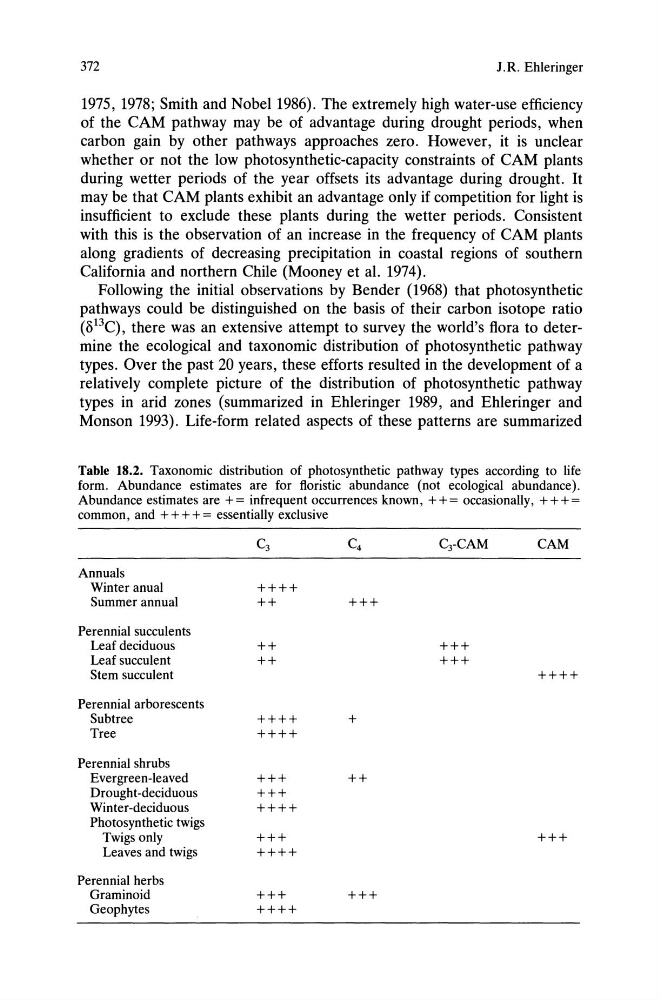
Monson 1993). Life-form related aspects of these patterns are summarized
Table 18.2. Taxonomic distribution of photosynthetic pathway types according to life
form. Abundance estimates are for floristic abundance (not ecological abundance).
Abundance estimates are += infrequent occurrences known, ++= occasionally, +++=
common, and + + + + = essentially exclusive
Annuals
Winter anual
Summer annual
Perennial succulents
Leaf deciduous
Leaf succulent
Stem succulent
Perennial arborescents
Subtree
Tree
Perennial shrubs
Evergreen-leaved
Drought -deciduous
Winter-deciduous
Photosynthetic twigs
Twigs only
Leaves and twigs
Perennial herbs
Graminoid
Geophytes
++++
++
++
++
++++
++++
+++
+++
++++
+++
++++
+++
++++
+++
+
++
+++
+++
+++
CAM
++++
+++
1.R. Ehleringer
1975, 1978; Smith and Nobel 1986). The extremely high water-use efficiency
of the CAM pathway may be of advantage during drought periods, when
carbon gain by other pathways approaches zero. However, it is unclear
whether or not the low photosynthetic-capacity constraints of CAM plants
during wetter periods of the year offsets its advantage during drought. It
may be that CAM plants exhibit an advantage only if competition for light is
insufficient to exclude these plants during the wetter periods. Consistent
with this is the observation of an increase in the frequency of CAM plants
along gradients of decreasing precipitation in coastal regions of southern
California and northern Chile (Mooney et al. 1974).
Following the initial observations by Bender (1968) that photosynthetic
pathways could be distinguished on the basis of their carbon isotope ratio
(013e), there was an extensive attempt to survey the world's flora to determine the ecological and taxonomic distribution of photosynthetic pathway
types. Over the past 20 years, these efforts resulted in the development of a
relatively complete picture of the distribution of photosynthetic pathway
types in arid zones (summarized in Ehleringer 1989, and Ehleringer and
Monson 1993). Life-form related aspects of these patterns are summarized
Table 18.2. Taxonomic distribution of photosynthetic pathway types according to life
form. Abundance estimates are for floristic abundance (not ecological abundance).
Abundance estimates are += infrequent occurrences known, ++= occasionally, +++=
common, and + + + + = essentially exclusive
Annuals
Winter anual
Summer annual
Perennial succulents
Leaf deciduous
Leaf succulent
Stem succulent
Perennial arborescents
Subtree
Tree
Perennial shrubs
Evergreen-leaved
Drought -deciduous
Winter-deciduous
Photosynthetic twigs
Twigs only
Leaves and twigs
Perennial herbs
Graminoid
Geophytes
++++
++
++
++
++++
++++
+++
+++
++++
+++
++++
+++
++++
+++
+
++
+++
+++
+++
CAM
++++
+++