

The Consequences of Sunflecks for Photosynthesis
351
plicable to any response that causes a change in P/Pa, such as occurs during
sunflecks (Pearcy 1987).
We examined the relationship between 8 13 C and the direct PFD received
by a plant with the objective of using the differences in isotopic discrimination as an integrative measure of the importance of sunflecks to carbon gain
in different microsites. Farquhar et al. (1982) showed that the 8 13 C of the
plant tissue is related to P/Pa following the relationship:
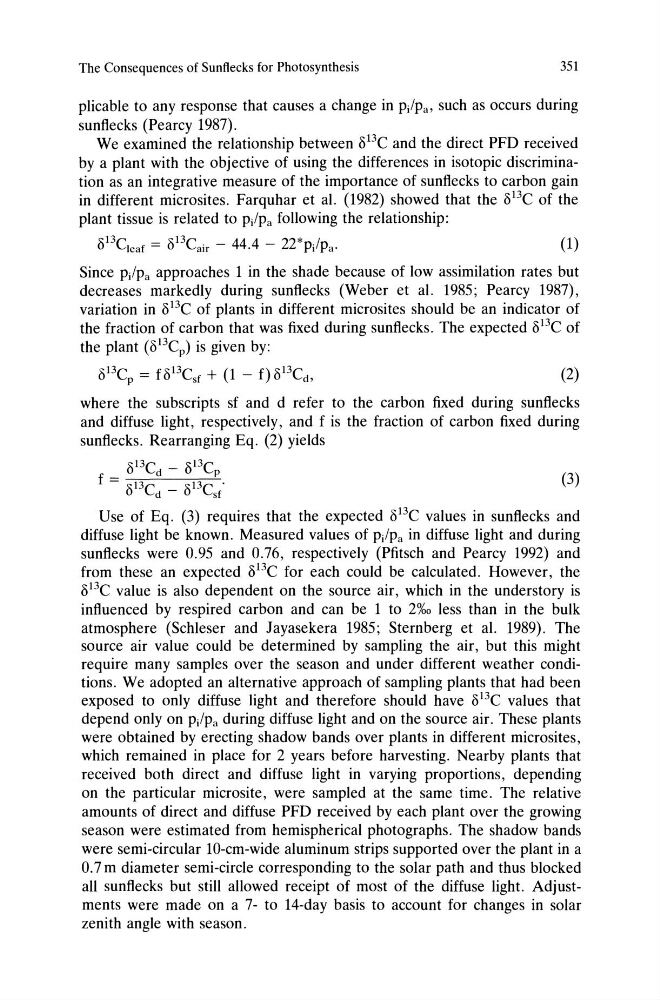
(1)
Since P/Pa approaches 1 in the shade because of low assimilation rates but
decreases markedly during sunflecks (Weber et al. 1985; Pearcy 1987),
variation in 8 13 C of plants in different microsites should be an indicator of
the fraction of carbon that was fixed during sunflecks. The expected 8 13 C of
the plant (813C p ) is given by:
813C = f s: 13 C + (1 - f) 8 13 C
p
U
sf
d,
(2)
where the subscripts sf and d refer to the carbon fixed during sunflecks
and diffuse light, respectively, and f is the fraction of carbon fixed during
sunflecks. Rearranging Eq. (2) yields
8 13 C d - 813C p
f = 813C d _ 813C sf .
(3)
Use of Eq. (3) requires that the expected 8 13 C values in sunflecks and
diffuse light be known. Measured values of P/Pa in diffuse light and during
sunflecks were 0.95 and 0.76, respectively (Pfitsch and Pearcy 1992) and
from these an expected 8 13 C for each could be calculated. However, the
8 13 C value is also dependent on the source air, which in the understory is
influenced by respired carbon and can be 1 to 2%0 less than in the bulk
atmosphere (Schleser and Jayasekera 1985; Sternberg et al. 1989). The
source air value could be determined by sampling the air, but this might
require many samples over the season and under different weather conditions. We adopted an alternative approach of sampling plants that had been
exposed to only diffuse light and therefore should have 8l3C values that
depend only on P/Pa during diffuse light and on the source air. These plants
were obtained by erecting shadow bands over plants in different microsites,
which remained in place for 2 years before harvesting. Nearby plants that
received both direct and diffuse light in varying proportions, depending
on the particular microsite, were sampled at the same time. The relative
amounts of direct and diffuse PFD received by each plant over the growing
season were estimated from hemispherical photographs. The shadow bands
were semi-circular lO-cm-wide aluminum strips supported over the plant in a
0.7 m diameter semi-circle corresponding to the solar path and thus blocked
all sun flecks but still allowed receipt of most of the diffuse light. Adjustments were made on a 7- to 14-day basis to account for changes in solar
zenith angle with season.
351
plicable to any response that causes a change in P/Pa, such as occurs during
sunflecks (Pearcy 1987).
We examined the relationship between 8 13 C and the direct PFD received
by a plant with the objective of using the differences in isotopic discrimination as an integrative measure of the importance of sunflecks to carbon gain
in different microsites. Farquhar et al. (1982) showed that the 8 13 C of the
plant tissue is related to P/Pa following the relationship:
(1)
Since P/Pa approaches 1 in the shade because of low assimilation rates but
decreases markedly during sunflecks (Weber et al. 1985; Pearcy 1987),
variation in 8 13 C of plants in different microsites should be an indicator of
the fraction of carbon that was fixed during sunflecks. The expected 8 13 C of
the plant (813C p ) is given by:
813C = f s: 13 C + (1 - f) 8 13 C
p
U
sf
d,
(2)
where the subscripts sf and d refer to the carbon fixed during sunflecks
and diffuse light, respectively, and f is the fraction of carbon fixed during
sunflecks. Rearranging Eq. (2) yields
8 13 C d - 813C p
f = 813C d _ 813C sf .
(3)
Use of Eq. (3) requires that the expected 8 13 C values in sunflecks and
diffuse light be known. Measured values of P/Pa in diffuse light and during
sunflecks were 0.95 and 0.76, respectively (Pfitsch and Pearcy 1992) and
from these an expected 8 13 C for each could be calculated. However, the
8 13 C value is also dependent on the source air, which in the understory is
influenced by respired carbon and can be 1 to 2%0 less than in the bulk
atmosphere (Schleser and Jayasekera 1985; Sternberg et al. 1989). The
source air value could be determined by sampling the air, but this might
require many samples over the season and under different weather conditions. We adopted an alternative approach of sampling plants that had been
exposed to only diffuse light and therefore should have 8l3C values that
depend only on P/Pa during diffuse light and on the source air. These plants
were obtained by erecting shadow bands over plants in different microsites,
which remained in place for 2 years before harvesting. Nearby plants that
received both direct and diffuse light in varying proportions, depending
on the particular microsite, were sampled at the same time. The relative
amounts of direct and diffuse PFD received by each plant over the growing
season were estimated from hemispherical photographs. The shadow bands
were semi-circular lO-cm-wide aluminum strips supported over the plant in a
0.7 m diameter semi-circle corresponding to the solar path and thus blocked
all sun flecks but still allowed receipt of most of the diffuse light. Adjustments were made on a 7- to 14-day basis to account for changes in solar
zenith angle with season.