

334
T.G.A. Green and O.L. Lange
light utilization efficiency (Sect. 16.2.4). The A are similar to phanerogams
on a chlorophyll basis, indicating that any limitation is not in the metabolic processes of photosynthesis. Neither is R a suitable explanation (Sect.
16.2.3). Alternative explanations for the consistently low, and similar, A for
both lichens and bryophytes are now required.
One possible explanation for low A is one based on the morphology of
the plants. Raven (1977) demonstrated theoretically that solid, photosynthetic tissues could never achieve the photosynthetic rates of ventilated
tissues; a factor of 10-20% was suggested. This work has been amplified by
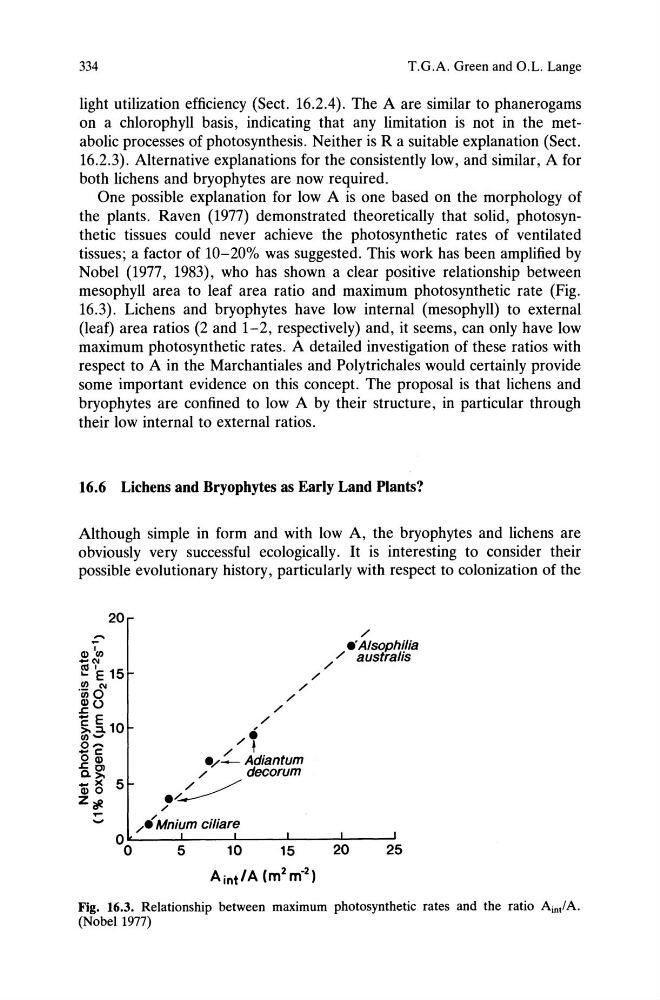
Nobel (1977, 1983), who has shown a clear positive relationship between
mesophyll area to leaf area ratio and maximum photosynthetic rate (Fig.
16.3). Lichens and bryophytes have low internal (mesophyll) to external
(leaf) area ratios (2 and 1-2, respectively) and, it seems, can only have low
maximum photosynthetic rates. A detailed investigation of these ratios with
respect to A in the Marchantiales and Polytrichales would certainly provide
some important evidence on this concept. The proposal is that lichens and
bryophytes are confined to low A by their structure, in particular through
their low internal to external ratios.
16.6 Lichens and Bryophytes as Early Land Plants?
Although simple in form and with low A, the bryophytes and lichens are
obviously very successful ecologically. It is interesting to consider their
possible evolutionary history, particularly with respect to colonization of the
20
/
/
/
/
/'
/
+
e/- Adiantum
/
decorum
e~
/
/e Mnium ciliare
/
/
e-Alsophilia
/ / australis
O~ __ - L ____ ~ __ ~~ __ - L _ _ ~
o
5
10
15
20
25
Fig. 16.3. Relationship between maximum photosynthetic rates and the ratio AiD'! A.
(Nobel 1977)
T.G.A. Green and O.L. Lange
light utilization efficiency (Sect. 16.2.4). The A are similar to phanerogams
on a chlorophyll basis, indicating that any limitation is not in the metabolic processes of photosynthesis. Neither is R a suitable explanation (Sect.
16.2.3). Alternative explanations for the consistently low, and similar, A for
both lichens and bryophytes are now required.
One possible explanation for low A is one based on the morphology of
the plants. Raven (1977) demonstrated theoretically that solid, photosynthetic tissues could never achieve the photosynthetic rates of ventilated
tissues; a factor of 10-20% was suggested. This work has been amplified by
Nobel (1977, 1983), who has shown a clear positive relationship between
mesophyll area to leaf area ratio and maximum photosynthetic rate (Fig.
16.3). Lichens and bryophytes have low internal (mesophyll) to external
(leaf) area ratios (2 and 1-2, respectively) and, it seems, can only have low
maximum photosynthetic rates. A detailed investigation of these ratios with
respect to A in the Marchantiales and Polytrichales would certainly provide
some important evidence on this concept. The proposal is that lichens and
bryophytes are confined to low A by their structure, in particular through
their low internal to external ratios.
16.6 Lichens and Bryophytes as Early Land Plants?
Although simple in form and with low A, the bryophytes and lichens are
obviously very successful ecologically. It is interesting to consider their
possible evolutionary history, particularly with respect to colonization of the
20
/
/
/
/
/'
/
+
e/- Adiantum
/
decorum
e~
/
/e Mnium ciliare
/
/
e-Alsophilia
/ / australis
O~ __ - L ____ ~ __ ~~ __ - L _ _ ~
o
5
10
15
20
25
Fig. 16.3. Relationship between maximum photosynthetic rates and the ratio AiD'! A.
(Nobel 1977)