

Photosynthesis in Poi kilo hydric Plants: A Comparison of Lichens and Bryophytes
333
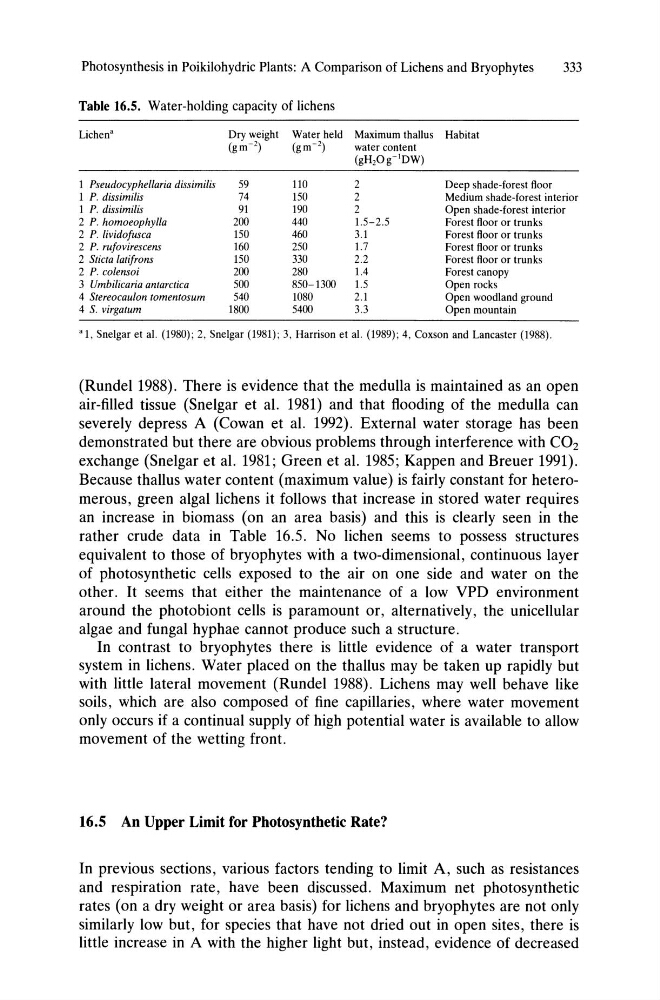
Table 16.5. Water-holding capacity of lichens
Lichen'
Dry weight Water held Maximum thallus Habitat
(gm-2)
(g m- 2 )
water content
(gH20 g-IDW)
1 Pseudocyphellaria dissimilis
59
110
2
Deep shade-forest floor
1 P. dissimilis
74
150
2
Medium shade-forest interior
1 P. dissimilis
91
190
2
Open shade-forest interior
2 P. homoeophylla
200
440
1.5-2.5
Forest floor or trunks
2 P. lividofusca
150
460
3.1
Forest floor or trunks
2 P. rufovirescens
160
250
1.7
Forest floor or trunks
2 Sticta latifrons
150
330
2.2
Forest floor or trunks
2 P. colensoi
200
280
1.4
Forest canopy
3 Umbilicaria antarctica
500
850-1300
1.5
Open rocks
4 Stereocaulon tomentosum
540
1080
2.1
Open woodland ground
4 S. virgatum
1800
5400
3.3
Open mountain
'I, Snelgar et al. (1980); 2, Snelgar (1981); 3, Harrison et al. (1989); 4, Coxson and Lancaster (1988).
(Runde I 1988). There is evidence that the medulla is maintained as an open
air-filled tissue (Snelgar et al. 1981) and that flooding of the medulla can
severely depress A (Cowan et al. 1992). External water storage has been
demonstrated but there are obvious problems through interference with CO 2
exchange (Snelgar et al. 1981; Green et al. 1985; Kappen and Breuer 1991).
Because thallus water content (maximum value) is fairly constant for heteromerous, green algal lichens it follows that increase in stored water requires
an increase in biomass (on an area basis) and this is clearly seen in the
rather crude data in Table 16.5. No lichen seems to possess structures
equivalent to those of bryophytes with a two-dimensional, continuous layer
of photosynthetic cells exposed to the air on one side and water on the
other. It seems that either the maintenance of a low VPD environment
around the photobiont cells is paramount or, alternatively, the unicellular
algae and fungal hyphae cannot produce such a structure.
In contrast to bryophytes there is little evidence of a water transport
system in lichens. Water placed on the thallus may be taken up rapidly but
with little lateral movement (Rundel 1988). Lichens may well behave like
soils, which are also composed of fine capillaries, where water movement
only occurs if a continual supply of high potential water is available to allow
movement of the wetting front.
16.5 An Upper Limit for Photosynthetic Rate?
In previous sections, various factors tending to limit A, such as resistances
and respiration rate, have been discussed. Maximum net photosynthetic
rates (on a dry weight or area basis) for lichens and bryophytes are not only
similarly low but, for species that have not dried out in open sites, there is
little increase in A with the higher light but, instead, evidence of decreased
333
Table 16.5. Water-holding capacity of lichens
Lichen'
Dry weight Water held Maximum thallus Habitat
(gm-2)
(g m- 2 )
water content
(gH20 g-IDW)
1 Pseudocyphellaria dissimilis
59
110
2
Deep shade-forest floor
1 P. dissimilis
74
150
2
Medium shade-forest interior
1 P. dissimilis
91
190
2
Open shade-forest interior
2 P. homoeophylla
200
440
1.5-2.5
Forest floor or trunks
2 P. lividofusca
150
460
3.1
Forest floor or trunks
2 P. rufovirescens
160
250
1.7
Forest floor or trunks
2 Sticta latifrons
150
330
2.2
Forest floor or trunks
2 P. colensoi
200
280
1.4
Forest canopy
3 Umbilicaria antarctica
500
850-1300
1.5
Open rocks
4 Stereocaulon tomentosum
540
1080
2.1
Open woodland ground
4 S. virgatum
1800
5400
3.3
Open mountain
'I, Snelgar et al. (1980); 2, Snelgar (1981); 3, Harrison et al. (1989); 4, Coxson and Lancaster (1988).
(Runde I 1988). There is evidence that the medulla is maintained as an open
air-filled tissue (Snelgar et al. 1981) and that flooding of the medulla can
severely depress A (Cowan et al. 1992). External water storage has been
demonstrated but there are obvious problems through interference with CO 2
exchange (Snelgar et al. 1981; Green et al. 1985; Kappen and Breuer 1991).
Because thallus water content (maximum value) is fairly constant for heteromerous, green algal lichens it follows that increase in stored water requires
an increase in biomass (on an area basis) and this is clearly seen in the
rather crude data in Table 16.5. No lichen seems to possess structures
equivalent to those of bryophytes with a two-dimensional, continuous layer
of photosynthetic cells exposed to the air on one side and water on the
other. It seems that either the maintenance of a low VPD environment
around the photobiont cells is paramount or, alternatively, the unicellular
algae and fungal hyphae cannot produce such a structure.
In contrast to bryophytes there is little evidence of a water transport
system in lichens. Water placed on the thallus may be taken up rapidly but
with little lateral movement (Rundel 1988). Lichens may well behave like
soils, which are also composed of fine capillaries, where water movement
only occurs if a continual supply of high potential water is available to allow
movement of the wetting front.
16.5 An Upper Limit for Photosynthetic Rate?
In previous sections, various factors tending to limit A, such as resistances
and respiration rate, have been discussed. Maximum net photosynthetic
rates (on a dry weight or area basis) for lichens and bryophytes are not only
similarly low but, for species that have not dried out in open sites, there is
little increase in A with the higher light but, instead, evidence of decreased