

Photosynthesis in Poikilohydric Plants: A Comparison of Lichens and Bryophytes
321
of bryophytes and lichens for purposes of comparison. Dry weight is the
most common basis but only because of ease of use. The choice of the basis
for A can affect interpretation of results: large differences in A on a dry
weight basis for different sizes of Umbilicaria thalli disappear when
expressed on an area basis (Larson 1979, 1984).
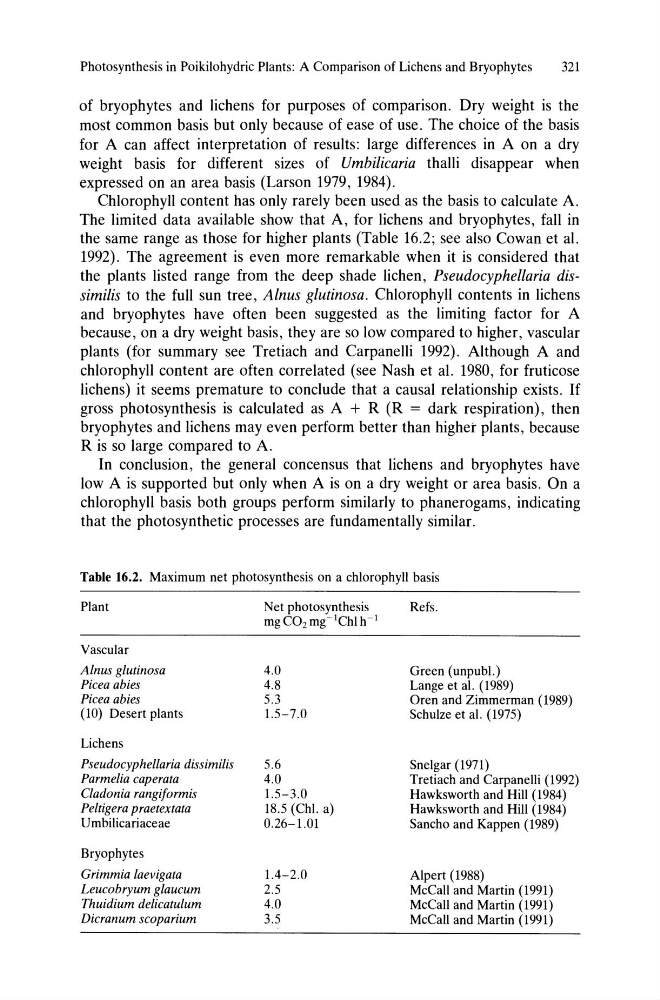
Chlorophyll content has only rarely been used as the basis to calculate A.
The limited data available show that A, for lichens and bryophytes, fall in
the same range as those for higher plants (Table 16.2; see also Cowan et al.
1992). The agreement is even more remarkable when it is considered that
the plants listed range from the deep shade lichen, Pseudocyphellaria dissimilis to the full sun tree, Alnus glutinosa. Chlorophyll contents in lichens
and bryophytes have often been suggested as the limiting factor for A
because, on a dry weight basis, they are so low compared to higher, vascular
plants (for summary see Tretiach and Carpanelli 1992). Although A and
chlorophyll content are often correlated (see Nash et al. 1980, for fruticose
lichens) it seems premature to conclude that a causal relationship exists. If
gross photosynthesis is calculated as A + R (R = dark respiration), then
bryophytes and lichens may even perform better than higher plants, because
R is so large compared to A.
In conclusion, the general concensus that lichens and bryophytes have
low A is supported but only when A is on a dry weight or area basis. On a
chlorophyll basis both groups perform similarly to phanerogams, indicating
that the photosynthetic processes are fundamentally similar.
Table 16.2. Maximum net photosynthesis on a chlorophyll basis
Plant
Net photosynthesis
mg C0 2 mg- 1 Chl h- 1
Refs.
Vascular
Alnus glutinosa
4.0
Green (unpubl.)
Picea abies
4.8
Lange et al. (1989)
Picea abies
5.3
Oren and Zimmerman (1989)
(10) Desert plants
1.5-7.0
Schulze et al. (1975)
Lichens
Pseudocyphellaria dissimilis
5.6
Snelgar (1971)
Parmelia caperata
4.0
Tretiach and Carpanelli (1992)
Cladonia rangiformis
1.5-3.0
Hawksworth and Hill (1984)
Peltigera praetextata
18.5 (ChI. a)
Hawksworth and Hill (1984)
Umbilicariaceae
0.26-1.01
Sancho and Kappen (1989)
Bryophytes
Grimmia laevigata
1.4-2.0
Alpert (1988)
Leucobryum glaucum
2.5
McCall and Martin (1991)
Thuidium delicatulum
4.0
McCall and Martin (1991)
Dicranum scoparium
3.5
McCall and Martin (1991)
321
of bryophytes and lichens for purposes of comparison. Dry weight is the
most common basis but only because of ease of use. The choice of the basis
for A can affect interpretation of results: large differences in A on a dry
weight basis for different sizes of Umbilicaria thalli disappear when
expressed on an area basis (Larson 1979, 1984).
Chlorophyll content has only rarely been used as the basis to calculate A.
The limited data available show that A, for lichens and bryophytes, fall in
the same range as those for higher plants (Table 16.2; see also Cowan et al.
1992). The agreement is even more remarkable when it is considered that
the plants listed range from the deep shade lichen, Pseudocyphellaria dissimilis to the full sun tree, Alnus glutinosa. Chlorophyll contents in lichens
and bryophytes have often been suggested as the limiting factor for A
because, on a dry weight basis, they are so low compared to higher, vascular
plants (for summary see Tretiach and Carpanelli 1992). Although A and
chlorophyll content are often correlated (see Nash et al. 1980, for fruticose
lichens) it seems premature to conclude that a causal relationship exists. If
gross photosynthesis is calculated as A + R (R = dark respiration), then
bryophytes and lichens may even perform better than higher plants, because
R is so large compared to A.
In conclusion, the general concensus that lichens and bryophytes have
low A is supported but only when A is on a dry weight or area basis. On a
chlorophyll basis both groups perform similarly to phanerogams, indicating
that the photosynthetic processes are fundamentally similar.
Table 16.2. Maximum net photosynthesis on a chlorophyll basis
Plant
Net photosynthesis
mg C0 2 mg- 1 Chl h- 1
Refs.
Vascular
Alnus glutinosa
4.0
Green (unpubl.)
Picea abies
4.8
Lange et al. (1989)
Picea abies
5.3
Oren and Zimmerman (1989)
(10) Desert plants
1.5-7.0
Schulze et al. (1975)
Lichens
Pseudocyphellaria dissimilis
5.6
Snelgar (1971)
Parmelia caperata
4.0
Tretiach and Carpanelli (1992)
Cladonia rangiformis
1.5-3.0
Hawksworth and Hill (1984)
Peltigera praetextata
18.5 (ChI. a)
Hawksworth and Hill (1984)
Umbilicariaceae
0.26-1.01
Sancho and Kappen (1989)
Bryophytes
Grimmia laevigata
1.4-2.0
Alpert (1988)
Leucobryum glaucum
2.5
McCall and Martin (1991)
Thuidium delicatulum
4.0
McCall and Martin (1991)
Dicranum scoparium
3.5
McCall and Martin (1991)