

Photosynthesis in Aquatic Plants
301
becoming secondarily terrestrial (e.g., Isoetes (= Stylites) andicola, Isoetes
andina, Isoetes triquetra): Raven et al. (1988); see Fig. 15.1. All (secondarily)
aquatic bryophytes and pteridophytes, and many (secondarily) aquatic
flowering plants are from freshwaters.
This taxonomically and evolutionarily based scheme (Fig. 15.1) can be
complemented by one based on life forms. These life forms (sensu Raunkaier
1934) are, for aquatic plants, those of Luther (1947; ct. Den Hartog and
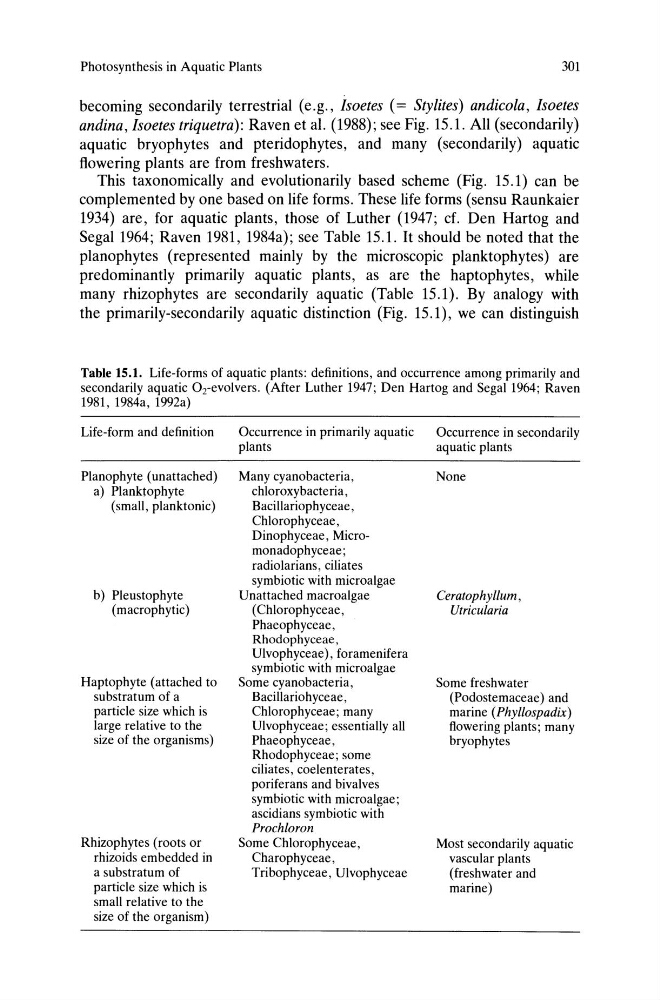
Segal 1964; Raven 1981, 1984a); see Table 15.1. It should be noted that the
planophytes (represented mainly by the microscopic planktophytes) are
predominantly primarily aquatic plants, as are the haptophytes, while
many rhizophytes are secondarily aquatic (Table 15.1). By analogy with
the primarily-secondarily aquatic distinction (Fig. 15.1), we can distinguish
Table 15.1. Life-forms of aquatic plants: definitions, and occurrence among primarily and
secondarily aquatic Orevolvers. (After Luther 1947; Den Hartog and Segal 1964; Raven
1981, 1984a, 1992a)
Life-form and definition
Planophyte (unattached)
a) Planktophyte
(small, planktonic)
b) Pleustophyte
(macrophytic)
Haptophyte (attached to
substratum of a
particle size which is
large relative to the
size of the organisms)
Rhizophytes (roots or
rhizoids embedded in
a substratum of
particle size which is
small relative to the
size of the organism)
Occurrence in primarily aquatic
plants
Many cyanobacteria,
chloroxybacteria,
Bacillariophyceae,
Chlorophyceae,
Dinophyceae, Micromonadophyceae;
radiolarians, ciliates
symbiotic with micro algae
Unattached macro algae
(Chlorophyceae,
Phaeophyceae,
Rhodophyceae,
Ulvophyceae), foramenifera
symbiotic with microalgae
Some cyanobacteria,
Bacillariohyceae,
Chlorophyceae; many
Ulvophyceae; essentially all
Phaeophyceae,
Rhodophyceae; some
ciliates, coelenterates,
poriferans and bivalves
symbiotic with microalgae;
ascidians symbiotic with
Prochloron
Some Chlorophyceae,
Charophyceae,
Tribophyceae, Ulvophyceae
Occurrence in secondarily
aquatic plants
None
Ceratophyllum,
Utricularia
Some freshwater
(Podostemaceae) and
marine (Phyllospadix)
flowering plants; many
bryophytes
Most secondarily aquatic
vascular plants
(freshwater and
marine)
301
becoming secondarily terrestrial (e.g., Isoetes (= Stylites) andicola, Isoetes
andina, Isoetes triquetra): Raven et al. (1988); see Fig. 15.1. All (secondarily)
aquatic bryophytes and pteridophytes, and many (secondarily) aquatic
flowering plants are from freshwaters.
This taxonomically and evolutionarily based scheme (Fig. 15.1) can be
complemented by one based on life forms. These life forms (sensu Raunkaier
1934) are, for aquatic plants, those of Luther (1947; ct. Den Hartog and
Segal 1964; Raven 1981, 1984a); see Table 15.1. It should be noted that the
planophytes (represented mainly by the microscopic planktophytes) are
predominantly primarily aquatic plants, as are the haptophytes, while
many rhizophytes are secondarily aquatic (Table 15.1). By analogy with
the primarily-secondarily aquatic distinction (Fig. 15.1), we can distinguish
Table 15.1. Life-forms of aquatic plants: definitions, and occurrence among primarily and
secondarily aquatic Orevolvers. (After Luther 1947; Den Hartog and Segal 1964; Raven
1981, 1984a, 1992a)
Life-form and definition
Planophyte (unattached)
a) Planktophyte
(small, planktonic)
b) Pleustophyte
(macrophytic)
Haptophyte (attached to
substratum of a
particle size which is
large relative to the
size of the organisms)
Rhizophytes (roots or
rhizoids embedded in
a substratum of
particle size which is
small relative to the
size of the organism)
Occurrence in primarily aquatic
plants
Many cyanobacteria,
chloroxybacteria,
Bacillariophyceae,
Chlorophyceae,
Dinophyceae, Micromonadophyceae;
radiolarians, ciliates
symbiotic with micro algae
Unattached macro algae
(Chlorophyceae,
Phaeophyceae,
Rhodophyceae,
Ulvophyceae), foramenifera
symbiotic with microalgae
Some cyanobacteria,
Bacillariohyceae,
Chlorophyceae; many
Ulvophyceae; essentially all
Phaeophyceae,
Rhodophyceae; some
ciliates, coelenterates,
poriferans and bivalves
symbiotic with microalgae;
ascidians symbiotic with
Prochloron
Some Chlorophyceae,
Charophyceae,
Tribophyceae, Ulvophyceae
Occurrence in secondarily
aquatic plants
None
Ceratophyllum,
Utricularia
Some freshwater
(Podostemaceae) and
marine (Phyllospadix)
flowering plants; many
bryophytes
Most secondarily aquatic
vascular plants
(freshwater and
marine)