

300
Terrestrial
Aquatic
High Salinity
Low Salinity
HALOPHYTIC
GL YCOPHYTIC
-<
TRACHEOPHYTES
TRACHEOPHYTES
I
AND
I
BRYOPHYTES
_ _ _ -+-~ __ j_-~AE
I
If'
Bryophytes
Tracheophytes ~ Tracheophytes
I
Y
Marine Algae ~ _ _ _ _:::. Freshwater Algae
J.A. Raven
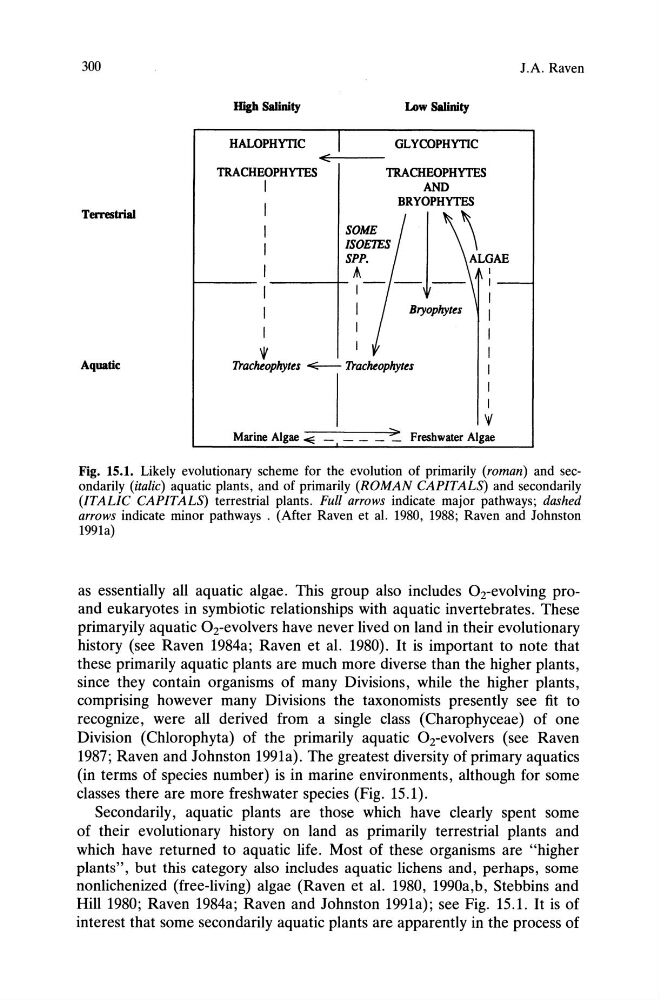
Fig. 15.1. Likely evolutionary scheme for the evolution of primarily (roman) and secondarily (italic) aquatic plants, and of primarily (ROMAN CAPITALS) and secondarily
(ITALIC CAPITALS) terrestrial plants. Full arrows indicate major pathways; dashed
arrows indicate minor pathways . (After Raven et al. 1980, 1988; Raven and Johnston
1991a)
as essentially all aquatic algae. This group also includes Oz-evolving proand eukaryotes in symbiotic relationships with aquatic invertebrates. These
primaryily aquatic Oz-evolvers have never lived on land in their evolutionary
history (see Raven 1984a; Raven et al. 1980). It is important to note that
these primarily aquatic plants are much more diverse than the higher plants,
since they contain organisms of many Divisions, while the higher plants,
comprising however many Divisions the taxonomists presently see fit to
recognize, were all derived from a single class (Charophyceae) of one
Division (Chlorophyta) of the primarily aquatic Oz-evolvers (see Raven
1987; Raven and Johnston 1991a). The greatest diversity of primary aquatics
(in terms of species number) is in marine environments, although for some
classes there are more freshwater species (Fig. 15.1).
Secondarily, aquatic plants are those which have clearly spent some
of their evolutionary history on land as primarily terrestrial plants and
which have returned to aquatic life. Most of these organisms are "higher
plants", but this category also includes aquatic lichens and, perhaps, some
nonlichenized (free-living) algae (Raven et al. 1980, 1990a,b, Stebbins and
Hill 1980; Raven 1984a; Raven and Johnston 1991a); see Fig. 15.1. It is of
interest that some secondarily aquatic plants are apparently in the process of
Terrestrial
Aquatic
High Salinity
Low Salinity
HALOPHYTIC
GL YCOPHYTIC
-<
TRACHEOPHYTES
TRACHEOPHYTES
I
AND
I
BRYOPHYTES
_ _ _ -+-~ __ j_-~AE
I
If'
Bryophytes
Tracheophytes ~ Tracheophytes
I
Y
Marine Algae ~ _ _ _ _:::. Freshwater Algae
J.A. Raven
Fig. 15.1. Likely evolutionary scheme for the evolution of primarily (roman) and secondarily (italic) aquatic plants, and of primarily (ROMAN CAPITALS) and secondarily
(ITALIC CAPITALS) terrestrial plants. Full arrows indicate major pathways; dashed
arrows indicate minor pathways . (After Raven et al. 1980, 1988; Raven and Johnston
1991a)
as essentially all aquatic algae. This group also includes Oz-evolving proand eukaryotes in symbiotic relationships with aquatic invertebrates. These
primaryily aquatic Oz-evolvers have never lived on land in their evolutionary
history (see Raven 1984a; Raven et al. 1980). It is important to note that
these primarily aquatic plants are much more diverse than the higher plants,
since they contain organisms of many Divisions, while the higher plants,
comprising however many Divisions the taxonomists presently see fit to
recognize, were all derived from a single class (Charophyceae) of one
Division (Chlorophyta) of the primarily aquatic Oz-evolvers (see Raven
1987; Raven and Johnston 1991a). The greatest diversity of primary aquatics
(in terms of species number) is in marine environments, although for some
classes there are more freshwater species (Fig. 15.1).
Secondarily, aquatic plants are those which have clearly spent some
of their evolutionary history on land as primarily terrestrial plants and
which have returned to aquatic life. Most of these organisms are "higher
plants", but this category also includes aquatic lichens and, perhaps, some
nonlichenized (free-living) algae (Raven et al. 1980, 1990a,b, Stebbins and
Hill 1980; Raven 1984a; Raven and Johnston 1991a); see Fig. 15.1. It is of
interest that some secondarily aquatic plants are apparently in the process of