

272
W. Larcher
frost hardening as winter approaches, but also a changeover from a freezingsensitive to a freezing-tolerant state of the cells. An example is shown
in Fig. 13.4: the course of freezing of unhardened l-year-old leaves of
Rhododendron ferrugineum from the alpine tree line is compared with
that of frost-hardy leaves in January. The freezing curve, measured by
differential thermal analysis, shows the threshold supercooling temperature
before ice nucleation in the leaf, the freezing exotherm, and the extent
of mesophyll damage during the progress of freezing. In early summer the
leaf already suffers considerable damage during the fastest phase of ice
formation (peak of exotherm) and when freezing is complete it is dead,
whereas in winter the mesophyll is still alive at the end of the phase of
ice spread. This indicates that leaves that were freezing-sensitive in June
became freezing-tolerant in January. The same result is obtained by a
noninvasive method, from the sequence of the fluorescence transients, of
which Fig. 13.4 shows only those that are characteristic for optimal temperatures ("control"), for the supercooled state, for frozen leaves, and for
recovered and killed leaves after thawing. Since the fluorescence measurements during the process of freezing are all carried out on the same site on
the leaf, the transients of any single series are comparable.
3. Investigation of freezing processes under field conditions. To date, our
knowledge of the process of freezing, of specific threshold freezing temperatures, of functional types of freezing resistance and of frost hardening rests
almost solely upon artificial laboratory tests. Hence it is understandable that
agronomists, forestry researchers, and ecologists repeatedly and justifiably
Lobelia telekii
Dendrosenecio brassica
-B.1°C/6h
-4.5°C/7h
-2.4°C/Bh
11°C/9h
16°C/10h
9.9°C/ 12h ~--.--,.----l
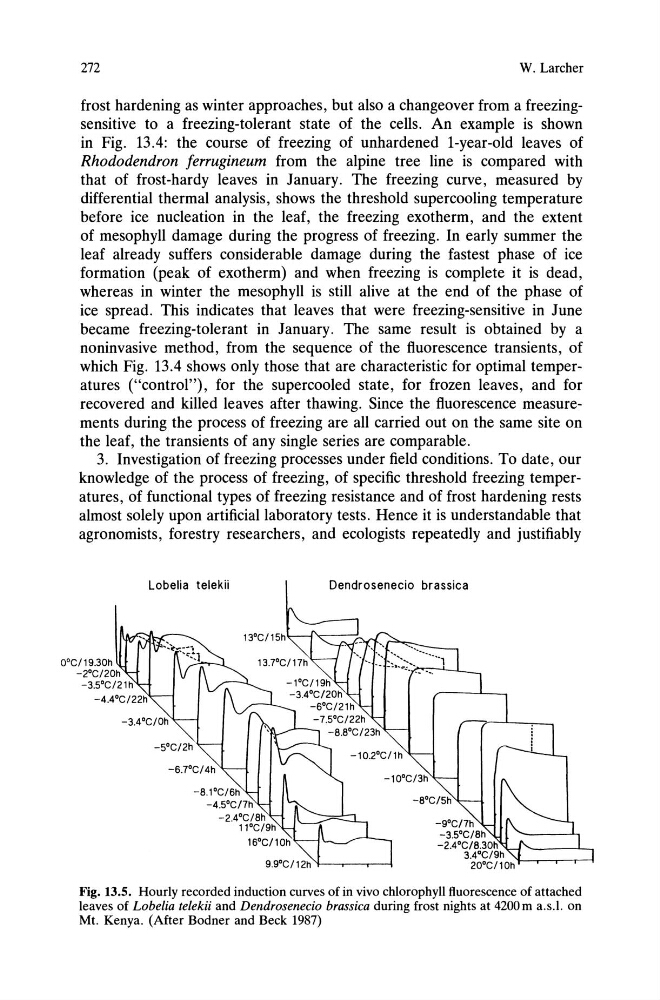
Fig. 13.5. Hourly recorded induction curves of in vivo chlorophyll fluorescence of attached
leaves of Lobelia telekii and Dendrosenecio brassica during frost nights at 4200m a.s.l. on
Mt. Kenya. (After Bodner and Beck 1987)
W. Larcher
frost hardening as winter approaches, but also a changeover from a freezingsensitive to a freezing-tolerant state of the cells. An example is shown
in Fig. 13.4: the course of freezing of unhardened l-year-old leaves of
Rhododendron ferrugineum from the alpine tree line is compared with
that of frost-hardy leaves in January. The freezing curve, measured by
differential thermal analysis, shows the threshold supercooling temperature
before ice nucleation in the leaf, the freezing exotherm, and the extent
of mesophyll damage during the progress of freezing. In early summer the
leaf already suffers considerable damage during the fastest phase of ice
formation (peak of exotherm) and when freezing is complete it is dead,
whereas in winter the mesophyll is still alive at the end of the phase of
ice spread. This indicates that leaves that were freezing-sensitive in June
became freezing-tolerant in January. The same result is obtained by a
noninvasive method, from the sequence of the fluorescence transients, of
which Fig. 13.4 shows only those that are characteristic for optimal temperatures ("control"), for the supercooled state, for frozen leaves, and for
recovered and killed leaves after thawing. Since the fluorescence measurements during the process of freezing are all carried out on the same site on
the leaf, the transients of any single series are comparable.
3. Investigation of freezing processes under field conditions. To date, our
knowledge of the process of freezing, of specific threshold freezing temperatures, of functional types of freezing resistance and of frost hardening rests
almost solely upon artificial laboratory tests. Hence it is understandable that
agronomists, forestry researchers, and ecologists repeatedly and justifiably
Lobelia telekii
Dendrosenecio brassica
-B.1°C/6h
-4.5°C/7h
-2.4°C/Bh
11°C/9h
16°C/10h
9.9°C/ 12h ~--.--,.----l
Fig. 13.5. Hourly recorded induction curves of in vivo chlorophyll fluorescence of attached
leaves of Lobelia telekii and Dendrosenecio brassica during frost nights at 4200m a.s.l. on
Mt. Kenya. (After Bodner and Beck 1987)