

Photosynthesis as a Tool for Indicating Temperature Stress Events
263
100
100
Q)
P N
Fv
I
+-'
7
I
ra
I
....
0"
E
"0
6
\
::3
\
E
+-'
til
\
a.
5 e
\
0
:J
\'\
.....
Q)
0 50
4~
'"
'\
~
Q)
'\
c
Q)
3
'\
0
\
.:x
l.L
ra
'\
+-'
a.
2
'\
::3
'\
N
0
Tc
0
01..-.
e 0
.... ra ....
....
Q)
e
.t: 0
...
()
Q) 'U
....
..... Q)
ra CI)
CI)
50
,.. Q)
u.. ...
....
.....
CI)
0
I
e
>- 0
.... e
Q)
> .....
0
0
()
~
Q)
ex: .....
0
0
25
30
35
40
45
50
55
Temperature [OC]
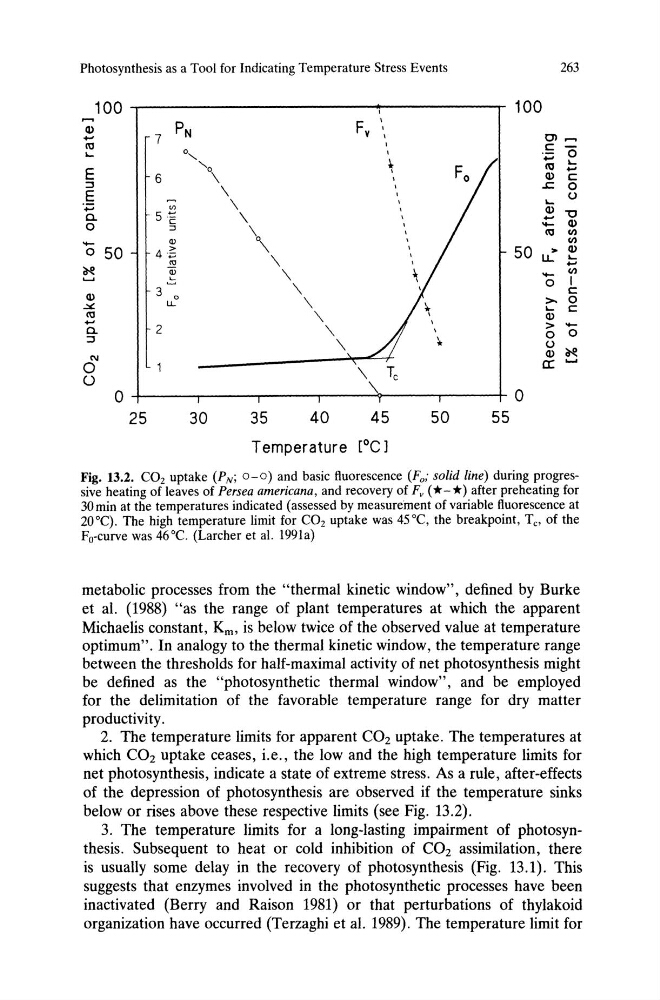
Fig. 13.2. CO 2 uptake (P N ; 0-0) and basic fluorescence (Fo; solid line) during progressive heating of leaves of Persea americana, and recovery of Fv (* - *) after preheating for
30 min at the temperatures indicated (assessed by measurement of variable fluorescence at
20°C). The high temperature limit for CO2 uptake was 45°C, the breakpoint, To of the
Fo-curve was 46°C. (Larcher et al. 1991a)
metabolic processes from the "thermal kinetic window", defined by Burke
et al. (1988) "as the range of plant temperatures at which the apparent
Michaelis constant, Km , is below twice of the observed value at temperature
optimum". In analogy to the thermal kinetic window, the temperature range
between the thresholds for half-maximal activity of net photosynthesis might
be defined as the "photosynthetic thermal window", and be employed
for the delimitation of the favorable temperature range for dry matter
productivity.
2. The temperature limits for apparent CO2 uptake. The temperatures at
which CO2 uptake ceases, i.e., the low and the high temperature limits for
net photosynthesis, indicate a state of extreme stress. As a rule, after-effects
of the depression of photosynthesis are observed if the temperature sinks
below or rises above these respective limits (see Fig. 13.2).
3. The temperature limits for a long-lasting impairment of photosynthesis. Subsequent to heat or cold inhibition of CO2 assimilation, there
is usually some delay in the recovery of photosynthesis (Fig. 13.1). This
suggests that enzymes involved in the photosynthetic processes have been
inactivated (Berry and Raison 1981) or that perturbations of thylakoid
organization have occurred (Terzaghi et al. 1989). The temperature limit for
263
100
100
Q)
P N
Fv
I
+-'
7
I
ra
I
....
0"
E
"0
6
\
::3
\
E
+-'
til
\
a.
5 e
\
0
:J
\'\
.....
Q)
0 50
4~
'"
'\
~
Q)
'\
c
Q)
3
'\
0
\
.:x
l.L
ra
'\
+-'
a.
2
'\
::3
'\
N
0
Tc
0
01..-.
e 0
.... ra ....
....
Q)
e
.t: 0
...
()
Q) 'U
....
..... Q)
ra CI)
CI)
50
,.. Q)
u.. ...
....
.....
CI)
0
I
e
>- 0
.... e
Q)
> .....
0
0
()
~
Q)
ex: .....
0
0
25
30
35
40
45
50
55
Temperature [OC]
Fig. 13.2. CO 2 uptake (P N ; 0-0) and basic fluorescence (Fo; solid line) during progressive heating of leaves of Persea americana, and recovery of Fv (* - *) after preheating for
30 min at the temperatures indicated (assessed by measurement of variable fluorescence at
20°C). The high temperature limit for CO2 uptake was 45°C, the breakpoint, To of the
Fo-curve was 46°C. (Larcher et al. 1991a)
metabolic processes from the "thermal kinetic window", defined by Burke
et al. (1988) "as the range of plant temperatures at which the apparent
Michaelis constant, Km , is below twice of the observed value at temperature
optimum". In analogy to the thermal kinetic window, the temperature range
between the thresholds for half-maximal activity of net photosynthesis might
be defined as the "photosynthetic thermal window", and be employed
for the delimitation of the favorable temperature range for dry matter
productivity.
2. The temperature limits for apparent CO2 uptake. The temperatures at
which CO2 uptake ceases, i.e., the low and the high temperature limits for
net photosynthesis, indicate a state of extreme stress. As a rule, after-effects
of the depression of photosynthesis are observed if the temperature sinks
below or rises above these respective limits (see Fig. 13.2).
3. The temperature limits for a long-lasting impairment of photosynthesis. Subsequent to heat or cold inhibition of CO2 assimilation, there
is usually some delay in the recovery of photosynthesis (Fig. 13.1). This
suggests that enzymes involved in the photosynthetic processes have been
inactivated (Berry and Raison 1981) or that perturbations of thylakoid
organization have occurred (Terzaghi et al. 1989). The temperature limit for