

262
W. Larcher
range, the photosynthetic function returns to the previous level of activity.
Exposure to more extreme temperatures results in perturbations that are not
immediately reversible upon return to 9ptimal conditions. After-effects of
temperature stress indicate serious structural and functional impairments
that can only be restored to normal by repair processes. For a comprehensive analysis of temperature stress events, the response of the plant must be
recorded not only after its exposure to extreme temperatures (which is
easier to measure), but also during the strain: only in this way can readily
reversible deviations from normal be distinguished from irreparable pathological impairments.
The following threshold values can be employed for the characterization
of progressive temperature stress:
1. The temperature at which the activity of a vital function drops below
half its maximal value (A5o), For CO2 uptake, this temperature is easily
determined. If the CO 2 uptake sinks frequently or for longer periods of time
to below 50% of its optimal value, the cumulative carbon assimilation is
severely reduced; the photosynthetic function, however, is merely reduced
reversibly. A biochemical criterion that correlates with a decrease in the
production yield of agricultural crops is the deviation of key enzymes for
I/)
I/)
Q)
L...
....
I/)
L...
1 00 -r-----+-"I!I--1i~/---:---,
t
I
I
~ 50
V
co
Q)
OJ
c:
co
.£:.
U
X
Q)
I/)
co
OJ
N
o
I
t
o 4 - - - - - - - - - - 1
o - 30 4-......-..--r-r--r--r--r-'T"""'"T"""""'I
100
50
~----~-±--+O
\ - - - - - r - - - r - - - - t - -30
-10
-5
035
40
45
50
Stress temperature [OC]
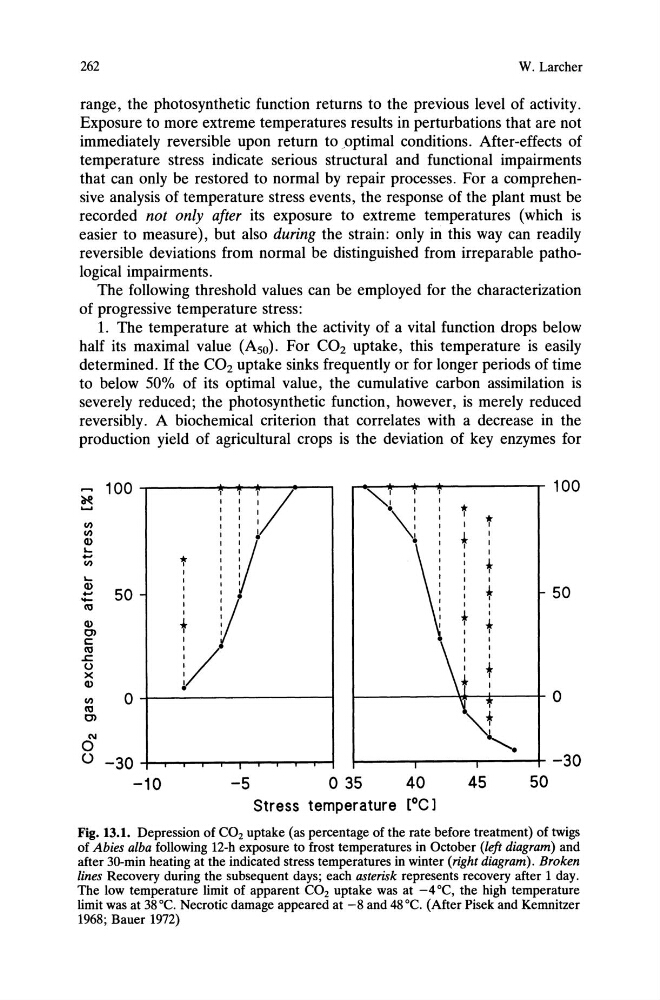
Fig. 13.1. Depression of CO2 uptake (as percentage of the rate before treatment) of twigs
of Abies alba following 12-h exposure to frost temperatures in October (left diagram) and
after 30-min heating at the indicated stress temperatures in winter (right diagram). Broken
lines Recovery during the subsequent days; each asterisk represents recovery after 1 day.
The low temperature limit of apparent CO2 uptake was at -4°C, the high temperature
limit was at 38°C. Necrotic damage appeared at -8 and 48°C. (After Pisek and Kemnitzer
1968; Bauer 1972)
W. Larcher
range, the photosynthetic function returns to the previous level of activity.
Exposure to more extreme temperatures results in perturbations that are not
immediately reversible upon return to 9ptimal conditions. After-effects of
temperature stress indicate serious structural and functional impairments
that can only be restored to normal by repair processes. For a comprehensive analysis of temperature stress events, the response of the plant must be
recorded not only after its exposure to extreme temperatures (which is
easier to measure), but also during the strain: only in this way can readily
reversible deviations from normal be distinguished from irreparable pathological impairments.
The following threshold values can be employed for the characterization
of progressive temperature stress:
1. The temperature at which the activity of a vital function drops below
half its maximal value (A5o), For CO2 uptake, this temperature is easily
determined. If the CO 2 uptake sinks frequently or for longer periods of time
to below 50% of its optimal value, the cumulative carbon assimilation is
severely reduced; the photosynthetic function, however, is merely reduced
reversibly. A biochemical criterion that correlates with a decrease in the
production yield of agricultural crops is the deviation of key enzymes for
I/)
I/)
Q)
L...
....
I/)
L...
1 00 -r-----+-"I!I--1i~/---:---,
t
I
I
~ 50
V
co
Q)
OJ
c:
co
.£:.
U
X
Q)
I/)
co
OJ
N
o
I
t
o 4 - - - - - - - - - - 1
o - 30 4-......-..--r-r--r--r--r-'T"""'"T"""""'I
100
50
~----~-±--+O
\ - - - - - r - - - r - - - - t - -30
-10
-5
035
40
45
50
Stress temperature [OC]
Fig. 13.1. Depression of CO2 uptake (as percentage of the rate before treatment) of twigs
of Abies alba following 12-h exposure to frost temperatures in October (left diagram) and
after 30-min heating at the indicated stress temperatures in winter (right diagram). Broken
lines Recovery during the subsequent days; each asterisk represents recovery after 1 day.
The low temperature limit of apparent CO2 uptake was at -4°C, the high temperature
limit was at 38°C. Necrotic damage appeared at -8 and 48°C. (After Pisek and Kemnitzer
1968; Bauer 1972)