

250
M.e. Ball and 1.B. Passioura
xylem decrease hyperbolically with increase in volume flux such that the flux
of salt to the leaves does not increase with increase in transpiration rates
(Fig. 12.1); indeed, the salt flux to leaves can even decrease at very high
rates of water loss (Munns 1985; Ball 1988b). Constancy in salt flux contributes to maintenance of sustainable ion concentrations in leaves. Failure
to maintain such ion concentrations would cause premature death of old
leaves, and eventually affect growth of new leaves (Munns and Termaat
1986). The evidence on balance implies a high degree of control of salt
(a)
(b)
Feeding and
drinking
roots
Ground surface
/- -
- - } 100r=~=1r=~~~==~~=u~~~~==-- 150mm
Concentration at
soil surface is
maintained at that
/
of sea water (Co)
~a~is ~arr:d - - t
in flow of water Excluded salt
to feeding root diffuses back
(vC)
+ t
to surface
(OdC/dz)
I
Salt is excluded by the root
as water is taken up
,
Cable roots
Anchoring roots
(c)
Salt concentration (C)
Co
C1
I
Rate of
/ . uptake
- ~ At any given depth
.c the downward flux of
~ salt by convection,vC,
o equals the upward flux
of salt by diffusion
(OdC/dz)
of water is
proportional
to (Cl-C)
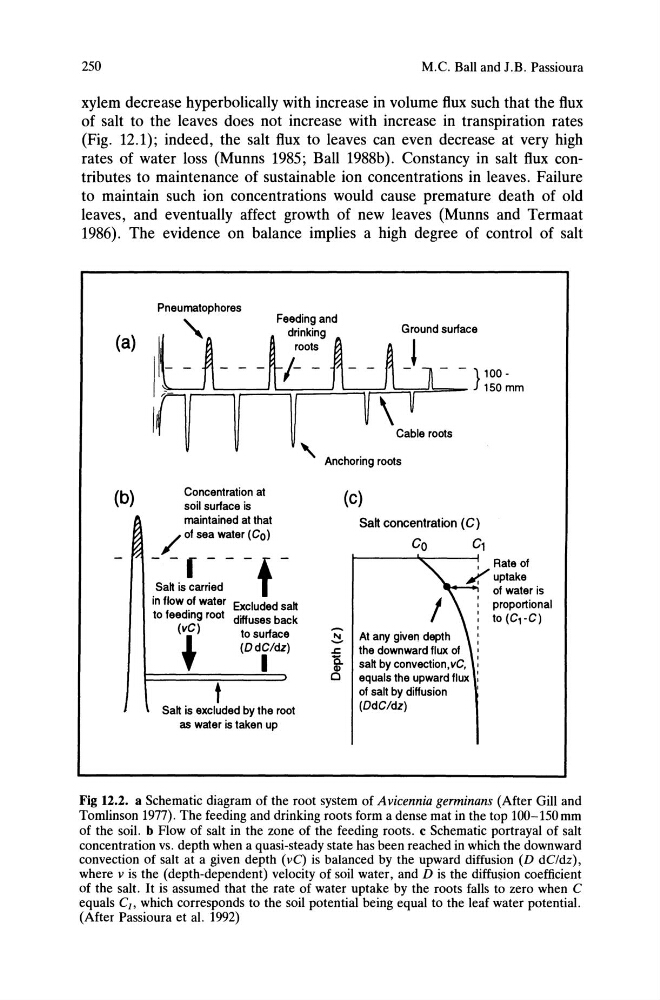
Fig 12.2. a Schematic diagram of the root system of Avicennia germinans (After Gill and
Tomlinson 1977). The feeding and drinking roots form a dense mat in the top 100-150 mm
of the soil. b Flow of salt in the zone of the feeding roots. c Schematic portrayal of salt
concentration vs. depth when a quasi-steady state has been reached in which the downward
convection of salt at a given depth (vC) is balanced by the upward diffusion (D dC/dz),
where v is the (depth-dependent) velocity of soil water, and D is the diffusion coefficient
of the salt. It is assumed that the rate of water uptake by the roots falls to zero when C
equals C], which corresponds to the soil potential being equal to the leaf water potential.
(After Passioura et al. 1992)
M.e. Ball and 1.B. Passioura
xylem decrease hyperbolically with increase in volume flux such that the flux
of salt to the leaves does not increase with increase in transpiration rates
(Fig. 12.1); indeed, the salt flux to leaves can even decrease at very high
rates of water loss (Munns 1985; Ball 1988b). Constancy in salt flux contributes to maintenance of sustainable ion concentrations in leaves. Failure
to maintain such ion concentrations would cause premature death of old
leaves, and eventually affect growth of new leaves (Munns and Termaat
1986). The evidence on balance implies a high degree of control of salt
(a)
(b)
Feeding and
drinking
roots
Ground surface
/- -
- - } 100r=~=1r=~~~==~~=u~~~~==-- 150mm
Concentration at
soil surface is
maintained at that
/
of sea water (Co)
~a~is ~arr:d - - t
in flow of water Excluded salt
to feeding root diffuses back
(vC)
+ t
to surface
(OdC/dz)
I
Salt is excluded by the root
as water is taken up
,
Cable roots
Anchoring roots
(c)
Salt concentration (C)
Co
C1
I
Rate of
/ . uptake
- ~ At any given depth
.c the downward flux of
~ salt by convection,vC,
o equals the upward flux
of salt by diffusion
(OdC/dz)
of water is
proportional
to (Cl-C)
Fig 12.2. a Schematic diagram of the root system of Avicennia germinans (After Gill and
Tomlinson 1977). The feeding and drinking roots form a dense mat in the top 100-150 mm
of the soil. b Flow of salt in the zone of the feeding roots. c Schematic portrayal of salt
concentration vs. depth when a quasi-steady state has been reached in which the downward
convection of salt at a given depth (vC) is balanced by the upward diffusion (D dC/dz),
where v is the (depth-dependent) velocity of soil water, and D is the diffusion coefficient
of the salt. It is assumed that the rate of water uptake by the roots falls to zero when C
equals C], which corresponds to the soil potential being equal to the leaf water potential.
(After Passioura et al. 1992)