

Carbon Gain in Relation to Water Use: Photosynthesis in Mangroves
249
(Sperry and Tyree 1988). A low stomatal conductance may have evolved
that keeps the water potential above a value that is on the verge of inducing
substantial embolism (Tyree and Sperry 1988; Jones and Sutherland 1991).
Sperry et al. (1988), working with Rhizophora mangle, showed that the
stems lost little hydraulic conductivity at xylem pressures less than -6 MPa,
but that the loss of conductivity was complete at a xylem pressure of
-7MPa.
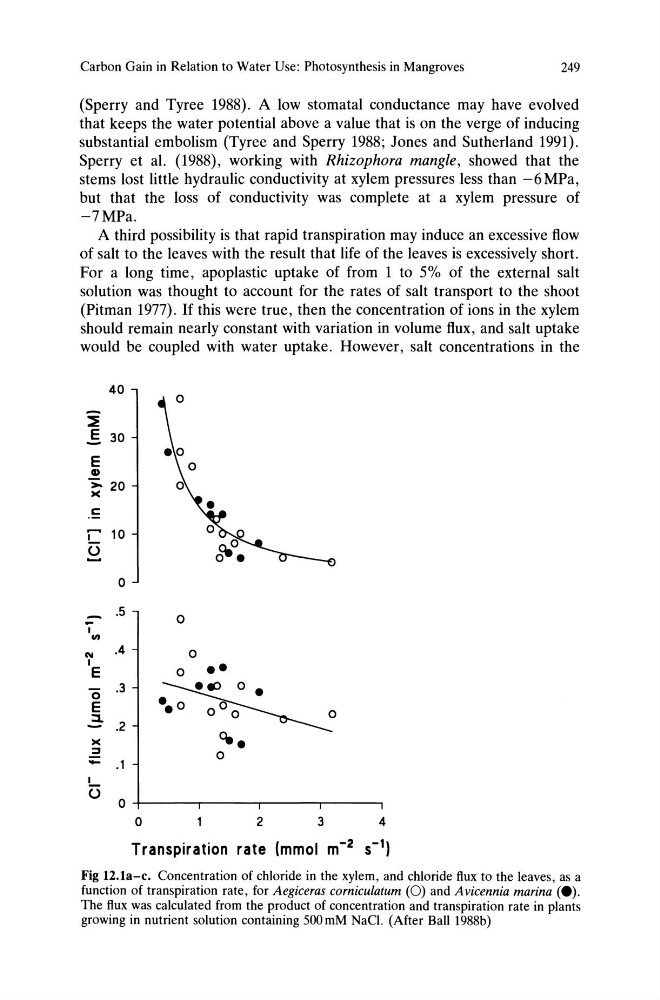
A third possibility is that rapid transpiration may induce an excessive flow
of salt to the leaves with the result that life of the leaves is excessively short.
For a long time, apoplastic uptake of from 1 to 5% of the external salt
solution was thought to account for the rates of salt transport to the shoot
(Pitman 1977). If this were true, then the concentration of ions in the xylem
should remain nearly constant with variation in volume flux, and salt uptake
would be coupled with water uptake. However, salt concentrations in the
40
~
E 30
E
CD
>. 20
)(
c
C 10
U
0
.5
0
I '"
N
.4
0
I E
0
0
.3
E
::l. .2
-
)(
~.
::::I
0
- .1
L
U
0
0
2
3
4
T
. .
rate Immol m- 2 S-')
ransplratlon
Fig 12.1a-c. Concentration of chloride in the xylem, and chloride flux to the leaves, as a
function of transpiration rate, for Aegiceras corniculatum (0) and Avicennia marina (e).
The flux was calculated from the product of concentration and transpiration rate in plants
growing in nutrient solution containing 500mM NaCI. (After Ball 1988b)
249
(Sperry and Tyree 1988). A low stomatal conductance may have evolved
that keeps the water potential above a value that is on the verge of inducing
substantial embolism (Tyree and Sperry 1988; Jones and Sutherland 1991).
Sperry et al. (1988), working with Rhizophora mangle, showed that the
stems lost little hydraulic conductivity at xylem pressures less than -6 MPa,
but that the loss of conductivity was complete at a xylem pressure of
-7MPa.
A third possibility is that rapid transpiration may induce an excessive flow
of salt to the leaves with the result that life of the leaves is excessively short.
For a long time, apoplastic uptake of from 1 to 5% of the external salt
solution was thought to account for the rates of salt transport to the shoot
(Pitman 1977). If this were true, then the concentration of ions in the xylem
should remain nearly constant with variation in volume flux, and salt uptake
would be coupled with water uptake. However, salt concentrations in the
40
~
E 30
E
CD
>. 20
)(
c
C 10
U
0
.5
0
I '"
N
.4
0
I E
0
0
.3
E
::l. .2
-
)(
~.
::::I
0
- .1
L
U
0
0
2
3
4
T
. .
rate Immol m- 2 S-')
ransplratlon
Fig 12.1a-c. Concentration of chloride in the xylem, and chloride flux to the leaves, as a
function of transpiration rate, for Aegiceras corniculatum (0) and Avicennia marina (e).
The flux was calculated from the product of concentration and transpiration rate in plants
growing in nutrient solution containing 500mM NaCI. (After Ball 1988b)