

As to the Mode of Action of the Guard Cells in Dry Air
225
What now happens when the pore opens a little, and narrow vaults are
formed by the divergence of the wall members A-B? It will be assumed that
the paradermal walls at the poles of the guard cells and the common walls of
the guard cells impede the movement very little, if at all, at first. This is
reasonable, since one can imagine that the apices of the pore are pressed
polewards in the Spannungsphase, i.e., in the phase in which the pore
is closed and the pressure is less than that required to initiate opening.
Therefore, the action of the polar walls in likened to that of springs, S
in Fig. 10.7, in which the tensions are negligible within a small range of
extensions but increase rapidly beyond. For small apertures, then, the
components of force directed parallel to the major axis of the pore are
predominantly due to the pressure, P, acting on the vault members A-B.
The moments of these forces about the points B increase disproportionally
with increase in the angle of bending and the width of the pore. If the
pressure sufficient to initiate opening were maintained, the pore would
continue to widen until restrained by the tension developed in S. Greater
apertures would require increase in P.
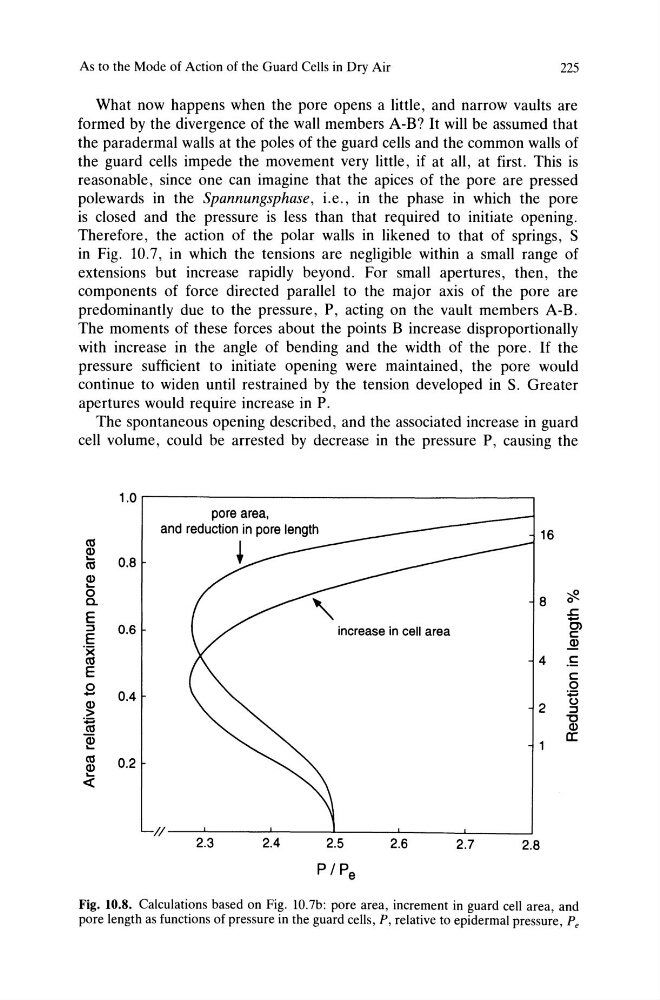
The spontaneous opening described, and the associated increase in guard
cell volume, could be arrested by decrease in the pressure P, causing the
1.0
cu Q)
.... 0.8
cu
Q)
....
0
0.
E
:J
0.6
E
·x
cu
E
0
- 0.4
Q)
>
:;::::;
cu
Q)
....
cu 0.2
Q)
....
«
pore area,
and reduction in pore length
16
+
8
increase in cell area
4
2
~
_ _ ~L-_ ___ - L ____ ~ ______ ~ ____ ~ ______ ~
2.3
2.4
2.5
P / P e
2.6
2.7
2.8
cfl.
~
- C) c:
~
.E
c:
0
:;::::;
()
:J
1:1
Q)
a::
Fig. 10.S. Calculations based on Fig. 1O.7b: pore area, increment in guard cell area, and
pore length as functions of pressure in the guard cells, P, relative to epidermal pressure, P e
225
What now happens when the pore opens a little, and narrow vaults are
formed by the divergence of the wall members A-B? It will be assumed that
the paradermal walls at the poles of the guard cells and the common walls of
the guard cells impede the movement very little, if at all, at first. This is
reasonable, since one can imagine that the apices of the pore are pressed
polewards in the Spannungsphase, i.e., in the phase in which the pore
is closed and the pressure is less than that required to initiate opening.
Therefore, the action of the polar walls in likened to that of springs, S
in Fig. 10.7, in which the tensions are negligible within a small range of
extensions but increase rapidly beyond. For small apertures, then, the
components of force directed parallel to the major axis of the pore are
predominantly due to the pressure, P, acting on the vault members A-B.
The moments of these forces about the points B increase disproportionally
with increase in the angle of bending and the width of the pore. If the
pressure sufficient to initiate opening were maintained, the pore would
continue to widen until restrained by the tension developed in S. Greater
apertures would require increase in P.
The spontaneous opening described, and the associated increase in guard
cell volume, could be arrested by decrease in the pressure P, causing the
1.0
cu Q)
.... 0.8
cu
Q)
....
0
0.
E
:J
0.6
E
·x
cu
E
0
- 0.4
Q)
>
:;::::;
cu
Q)
....
cu 0.2
Q)
....
«
pore area,
and reduction in pore length
16
+
8
increase in cell area
4
2
~
_ _ ~L-_ ___ - L ____ ~ ______ ~ ____ ~ ______ ~
2.3
2.4
2.5
P / P e
2.6
2.7
2.8
cfl.
~
- C) c:
~
.E
c:
0
:;::::;
()
:J
1:1
Q)
a::
Fig. 10.S. Calculations based on Fig. 1O.7b: pore area, increment in guard cell area, and
pore length as functions of pressure in the guard cells, P, relative to epidermal pressure, P e