

Gas Exchange and Growth
173
Another complication that may arise in the relation between growth and
gas exchange results from the effects of soil temperature on roots. Even
if photosynthetic capacity does not change, root temperature may affect
carbon partitioning coefficient to roots (changing root/shoot ratio and therefore F), root maintenance respiration, and water and nutrient absorption.
All of these may directly or indirectly influence A and foliage growth.
8.9 Conclusions
Even though often equated, growth and net CO2 fixation involve quite
different processes and time scales and very seldom are leaf photosynthetic
rates (on an area basis) correlated with Rw. Furthermore, growth rates can
vary severalfold between plants (e.g., 40x in data collated by Poorter 1989),
whereas leaf photosynthetic rates (on an area basis) normally vary less (lOx
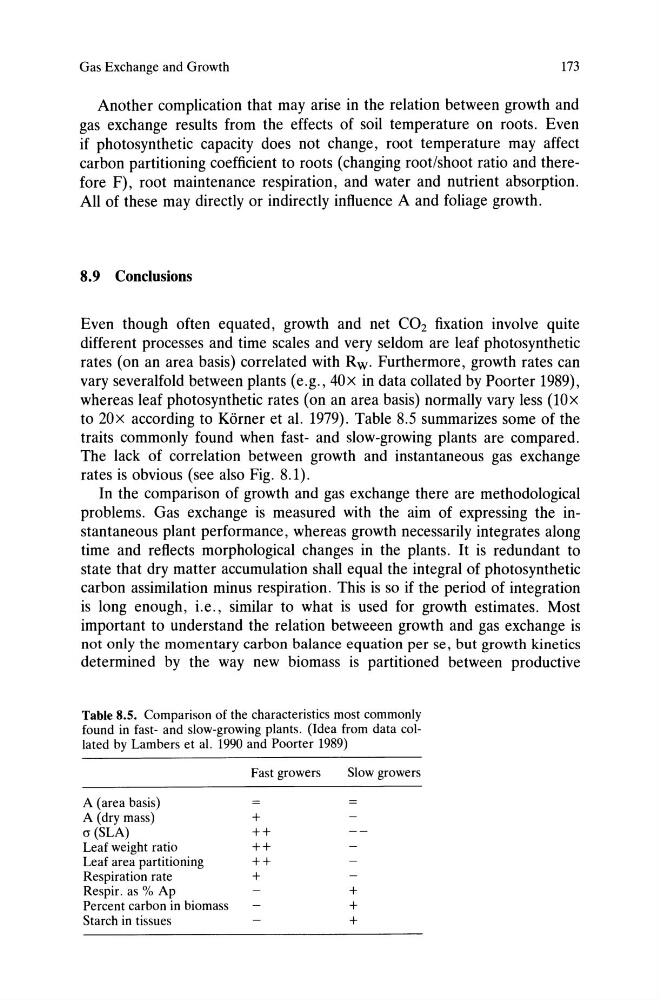
to 20x according to Korner et al. 1979). Table 8.5 summarizes some of the
traits commonly found when fast- and slow-growing plants are compared.
The lack of correlation between growth and instantaneous gas exchange
rates is obvious (see also Fig. 8.1).
In the comparison of growth and gas exchange there are methodological
problems. Gas exchange is measured with the aim of expressing the instantaneous plant performance, whereas growth necessarily integrates along
time and reflects morphological changes in the plants. It is redundant to
state that dry matter accumulation shall equal the integral of photosynthetic
carbon assimilation minus respiration. This is so if the period of integration
is long enough, i.e., similar to what is used for growth estimates. Most
important to understand the relation betweeen growth and gas exchange is
not only the momentary carbon balance equation per se, but growth kinetics
determined by the way new biomass is partitioned between productive
Table 8.5. Comparison of the characteristics most commonly
found in fast- and slow-growing plants. (Idea from data collated by Lambers et al. 1990 and Poorter 1989)
Fast growers
A (area basis)
A (dry mass)
+
IT (SLA)
++
Leaf weight ratio
+ +
Leaf area partitioning
+ +
Respiration rate
+
Respir. as % Ap
Percent carbon in biomass
Starch in tissues
Slow growers
+
+
+
173
Another complication that may arise in the relation between growth and
gas exchange results from the effects of soil temperature on roots. Even
if photosynthetic capacity does not change, root temperature may affect
carbon partitioning coefficient to roots (changing root/shoot ratio and therefore F), root maintenance respiration, and water and nutrient absorption.
All of these may directly or indirectly influence A and foliage growth.
8.9 Conclusions
Even though often equated, growth and net CO2 fixation involve quite
different processes and time scales and very seldom are leaf photosynthetic
rates (on an area basis) correlated with Rw. Furthermore, growth rates can
vary severalfold between plants (e.g., 40x in data collated by Poorter 1989),
whereas leaf photosynthetic rates (on an area basis) normally vary less (lOx
to 20x according to Korner et al. 1979). Table 8.5 summarizes some of the
traits commonly found when fast- and slow-growing plants are compared.
The lack of correlation between growth and instantaneous gas exchange
rates is obvious (see also Fig. 8.1).
In the comparison of growth and gas exchange there are methodological
problems. Gas exchange is measured with the aim of expressing the instantaneous plant performance, whereas growth necessarily integrates along
time and reflects morphological changes in the plants. It is redundant to
state that dry matter accumulation shall equal the integral of photosynthetic
carbon assimilation minus respiration. This is so if the period of integration
is long enough, i.e., similar to what is used for growth estimates. Most
important to understand the relation betweeen growth and gas exchange is
not only the momentary carbon balance equation per se, but growth kinetics
determined by the way new biomass is partitioned between productive
Table 8.5. Comparison of the characteristics most commonly
found in fast- and slow-growing plants. (Idea from data collated by Lambers et al. 1990 and Poorter 1989)
Fast growers
A (area basis)
A (dry mass)
+
IT (SLA)
++
Leaf weight ratio
+ +
Leaf area partitioning
+ +
Respiration rate
+
Respir. as % Ap
Percent carbon in biomass
Starch in tissues
Slow growers
+
+
+