

172
J.S. Pereira
..... March 26 -+- Jan. 11 .. Aug. 9 ... Sept. 15
1
....
E
OL-~--~--~--~--~~--~--~--~~
o
10
20
30
40
50
Temperature (oC)
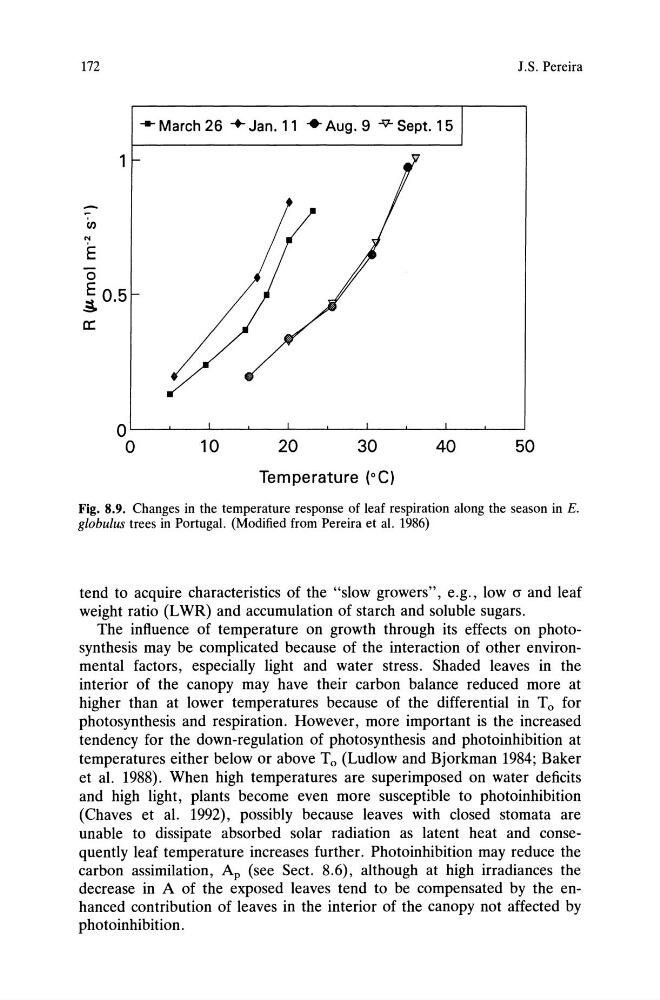
Fig. 8.9. Changes in the temperature response of leaf respiration along the season in E.
globulus trees in Portugal. (Modified from Pereira et al. 1986)
tend to acquire characteristics of the "slow growers", e.g., low 0' and leaf
weight ratio (L WR) and accumulation of starch and soluble sugars.
The influence of temperature on growth through its effects on photosynthesis may be complicated because of the interaction of other environmental factors, especially light and water stress. Shaded leaves in the
interior of the canopy may have their carbon balance reduced more at
higher than at lower temperatures because of the differential in To for
photosynthesis and respiration. However, more important is the increased
tendency for the down-regulation of photosynthesis and photoinhibition at
temperatures either below or above To (Ludlow and Bjorkman 1984; Baker
et al. 1988). When high temperatures are superimposed on water deficits
and high light, plants become even more susceptible to photoinhibition
(Chaves et al. 1992), possibly because leaves with closed stomata are
unable to dissipate absorbed solar radiation as latent heat and consequently leaf temperature increases further. Photoinhibition may reduce the
carbon assimilation, Ap (see Sect. 8.6), although at high irradiances the
decrease in A of the exposed leaves tend to be compensated by the enhanced contribution of leaves in the interior of the canopy not affected by
photoinhibition.
J.S. Pereira
..... March 26 -+- Jan. 11 .. Aug. 9 ... Sept. 15
1
....
E
OL-~--~--~--~--~~--~--~--~~
o
10
20
30
40
50
Temperature (oC)
Fig. 8.9. Changes in the temperature response of leaf respiration along the season in E.
globulus trees in Portugal. (Modified from Pereira et al. 1986)
tend to acquire characteristics of the "slow growers", e.g., low 0' and leaf
weight ratio (L WR) and accumulation of starch and soluble sugars.
The influence of temperature on growth through its effects on photosynthesis may be complicated because of the interaction of other environmental factors, especially light and water stress. Shaded leaves in the
interior of the canopy may have their carbon balance reduced more at
higher than at lower temperatures because of the differential in To for
photosynthesis and respiration. However, more important is the increased
tendency for the down-regulation of photosynthesis and photoinhibition at
temperatures either below or above To (Ludlow and Bjorkman 1984; Baker
et al. 1988). When high temperatures are superimposed on water deficits
and high light, plants become even more susceptible to photoinhibition
(Chaves et al. 1992), possibly because leaves with closed stomata are
unable to dissipate absorbed solar radiation as latent heat and consequently leaf temperature increases further. Photoinhibition may reduce the
carbon assimilation, Ap (see Sect. 8.6), although at high irradiances the
decrease in A of the exposed leaves tend to be compensated by the enhanced contribution of leaves in the interior of the canopy not affected by
photoinhibition.