

Gas Exchange and Growth
165
7
E. g/obu/us
....... vc ~ DG -0- SM
~
6
C)
~
C)
w 5
~
::>
~
4
3L---~----~----~----~----~--~
40
60
80
100
Biomass (g plant -1)
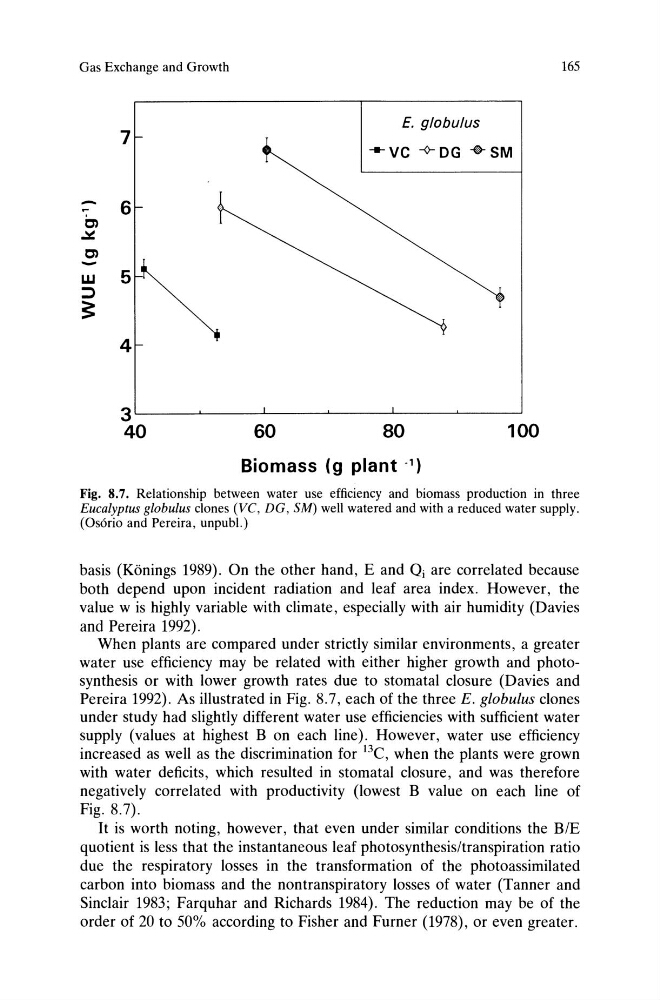
Fig. 8.7. Relationship between water use efficiency and biomass production in three
Eucalyptus globulus clones (VC, DG, SM) well watered and with a reduced water supply.
(Osorio and Pereira, unpubl.)
basis (Konings 1989). On the other hand, E and OJ are correlated because
both depend upon incident radiation and leaf area index. However, the
value w is highly variable with climate, especially with air humidity (Davies
and Pereira 1992).
When plants are compared under strictly similar environments, a greater
water use efficiency may be related with either higher growth and photosynthesis or with lower growth rates due to stomatal closure (Davies and
Pereira 1992). As illustrated in Fig. 8.7, each of the three E. globulus clones
under study had slightly different water use efficiencies with sufficient water
supply (values at highest B on each line). However, water use efficiency
increased as well as the discrimination for J3C, when the plants were grown
with water deficits, which resulted in stomatal closure, and was therefore
negatively correlated with productivity (lowest B value on each line of
Fig. 8.7).
It is worth noting, however, that even under similar conditions the B/E
quotient is less that the instantaneous leaf photosynthesis/transpiration ratio
due the respiratory losses in the transformation of the photo assimilated
carbon into biomass and the nontranspiratory losses of water (Tanner and
Sinclair 1983; Farquhar and Richards 1984). The reduction may be of the
order of 20 to 50% according to Fisher and Furner (1978), or even greater.
165
7
E. g/obu/us
....... vc ~ DG -0- SM
~
6
C)
~
C)
w 5
~
::>
~
4
3L---~----~----~----~----~--~
40
60
80
100
Biomass (g plant -1)
Fig. 8.7. Relationship between water use efficiency and biomass production in three
Eucalyptus globulus clones (VC, DG, SM) well watered and with a reduced water supply.
(Osorio and Pereira, unpubl.)
basis (Konings 1989). On the other hand, E and OJ are correlated because
both depend upon incident radiation and leaf area index. However, the
value w is highly variable with climate, especially with air humidity (Davies
and Pereira 1992).
When plants are compared under strictly similar environments, a greater
water use efficiency may be related with either higher growth and photosynthesis or with lower growth rates due to stomatal closure (Davies and
Pereira 1992). As illustrated in Fig. 8.7, each of the three E. globulus clones
under study had slightly different water use efficiencies with sufficient water
supply (values at highest B on each line). However, water use efficiency
increased as well as the discrimination for J3C, when the plants were grown
with water deficits, which resulted in stomatal closure, and was therefore
negatively correlated with productivity (lowest B value on each line of
Fig. 8.7).
It is worth noting, however, that even under similar conditions the B/E
quotient is less that the instantaneous leaf photosynthesis/transpiration ratio
due the respiratory losses in the transformation of the photo assimilated
carbon into biomass and the nontranspiratory losses of water (Tanner and
Sinclair 1983; Farquhar and Richards 1984). The reduction may be of the
order of 20 to 50% according to Fisher and Furner (1978), or even greater.