

Photosynthesis, Storage, and Allocation
'" '"
' "
1.0
E 0.9
C
' "
a. 0.8
iii
§
o 0.7
c
.Q 0.6
j
8 0.5
~
(/) 0.4
Stanford
Raphanus
6.
V
6.V O
0
0
A
m
6.
0
6. a
00
o 0
0
0
0
0
B
V
«J)
0
o 5 10 15 20 25 30 0.0 1.0 2.0 3.0 4.0 5.0
Photosynthesis, mmol CO 2 9 s " d"
N0 3 - uptake rate, mmol 9(' d"
141
C
f®
~O 8
0
C
o 5 10 15 20 25
Shoot activitylroot activity
mol C 9 s " d" I mol N 9,-' d"
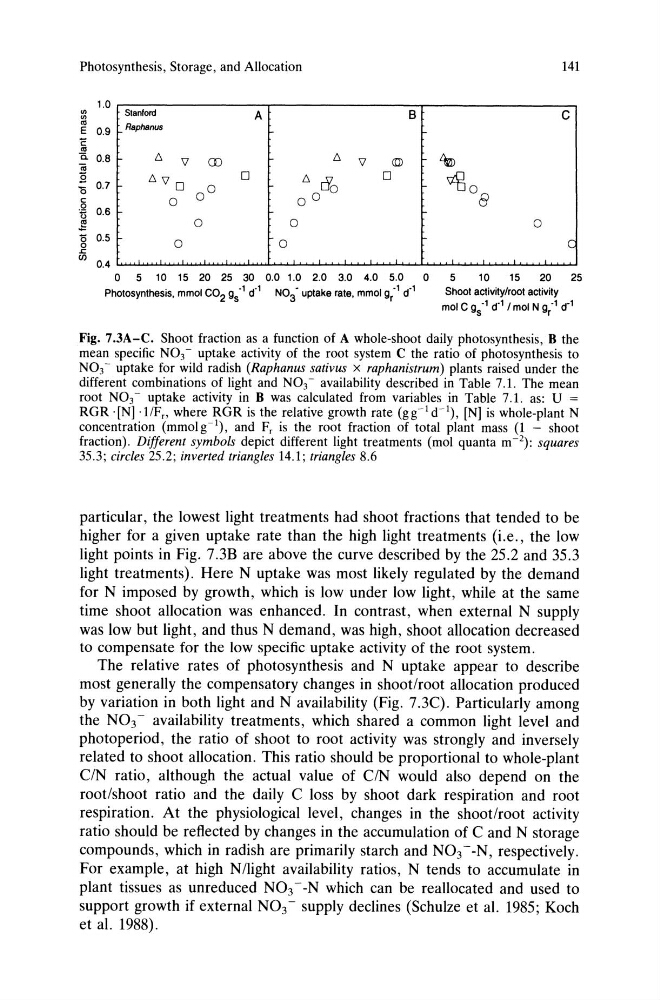
Fig. 7.3A-C. Shoot fraction as a function of A whole-shoot daily photosynthesis, B the
mean specific N03 - uptake activity of the root system C the ratio of photosynthesis to
N03 - uptake for wild radish (Raphanus sativus x raphanistrum) plants raised under the
different combinations of light and N03 - availability described in Table 7.1. The mean
root N03 - uptake activity in B was calculated from variables in Table 7.1. as: U =
RGR ·[NJ·1/F" where RGR is the relative growth rate (gg-ld- 1 ), [NJ is whole-plant N
concentration (mmolg- 1 ), and Fr is the root fraction of total plant mass (1 - shoot
fraction). Different symbols depict different light treatments (mol quanta m- 2 ): squares
35.3; circles 25.2; inverted triangles 14.1; triangles 8.6
particular, the lowest light treatments had shoot fractions that tended to be
higher for a given uptake rate than the high light treatments (i.e., the low
light points in Fig. 7.3B are above the curve described by the 25.2 and 35.3
light treatments). Here N uptake was most likely regulated by the demand
for N imposed by growth, which is low under low light, while at the same
time shoot allocation was enhanced. In contrast, when external N supply
was low but light, and thus N demand, was high, shoot allocation decreased
to compensate for the low specific uptake activity of the root system.
The relative rates of photosynthesis and N uptake appear to describe
most generally the compensatory changes in shoot/root allocation produced
by variation in both light and N availability (Fig. 7.3C). Particularly among
the N03 - availability treatments, which shared a common light level and
photoperiod, the ratio of shoot to root activity was strongly and inversely
related to shoot allocation. This ratio should be proportional to whole-plant
C/N ratio, although the actual value of C/N would also depend on the
root/shoot ratio and the daily C loss by shoot dark respiration and root
respiration. At the physiological level, changes in the shoot/root activity
ratio should be reflected by changes in the accumulation of C and N storage
compounds, which in radish are primarily starch and N0 3 --N, respectively.
For example, at high N/light availability ratios, N tends to accumulate in
plant tissues as unreduced N03 - -N which can be reallocated and used to
support growth if external N03 - supply declines (Schulze et al. 1985; Koch
et al. 1988).
'" '"
' "
1.0
E 0.9
C
' "
a. 0.8
iii
§
o 0.7
c
.Q 0.6
j
8 0.5
~
(/) 0.4
Stanford
Raphanus
6.
V
6.V O
0
0
A
m
6.
0
6. a
00
o 0
0
0
0
0
B
V
«J)
0
o 5 10 15 20 25 30 0.0 1.0 2.0 3.0 4.0 5.0
Photosynthesis, mmol CO 2 9 s " d"
N0 3 - uptake rate, mmol 9(' d"
141
C
f®
~O 8
0
C
o 5 10 15 20 25
Shoot activitylroot activity
mol C 9 s " d" I mol N 9,-' d"
Fig. 7.3A-C. Shoot fraction as a function of A whole-shoot daily photosynthesis, B the
mean specific N03 - uptake activity of the root system C the ratio of photosynthesis to
N03 - uptake for wild radish (Raphanus sativus x raphanistrum) plants raised under the
different combinations of light and N03 - availability described in Table 7.1. The mean
root N03 - uptake activity in B was calculated from variables in Table 7.1. as: U =
RGR ·[NJ·1/F" where RGR is the relative growth rate (gg-ld- 1 ), [NJ is whole-plant N
concentration (mmolg- 1 ), and Fr is the root fraction of total plant mass (1 - shoot
fraction). Different symbols depict different light treatments (mol quanta m- 2 ): squares
35.3; circles 25.2; inverted triangles 14.1; triangles 8.6
particular, the lowest light treatments had shoot fractions that tended to be
higher for a given uptake rate than the high light treatments (i.e., the low
light points in Fig. 7.3B are above the curve described by the 25.2 and 35.3
light treatments). Here N uptake was most likely regulated by the demand
for N imposed by growth, which is low under low light, while at the same
time shoot allocation was enhanced. In contrast, when external N supply
was low but light, and thus N demand, was high, shoot allocation decreased
to compensate for the low specific uptake activity of the root system.
The relative rates of photosynthesis and N uptake appear to describe
most generally the compensatory changes in shoot/root allocation produced
by variation in both light and N availability (Fig. 7.3C). Particularly among
the N03 - availability treatments, which shared a common light level and
photoperiod, the ratio of shoot to root activity was strongly and inversely
related to shoot allocation. This ratio should be proportional to whole-plant
C/N ratio, although the actual value of C/N would also depend on the
root/shoot ratio and the daily C loss by shoot dark respiration and root
respiration. At the physiological level, changes in the shoot/root activity
ratio should be reflected by changes in the accumulation of C and N storage
compounds, which in radish are primarily starch and N0 3 --N, respectively.
For example, at high N/light availability ratios, N tends to accumulate in
plant tissues as unreduced N03 - -N which can be reallocated and used to
support growth if external N03 - supply declines (Schulze et al. 1985; Koch
et al. 1988).