

Assimilatory Starch for Growth in Arabidopsis thaliana Wild-Type
129
might explain why plants growing in low N still tend to overinvest in shoot
growth.
6.5 The Carbon Balance
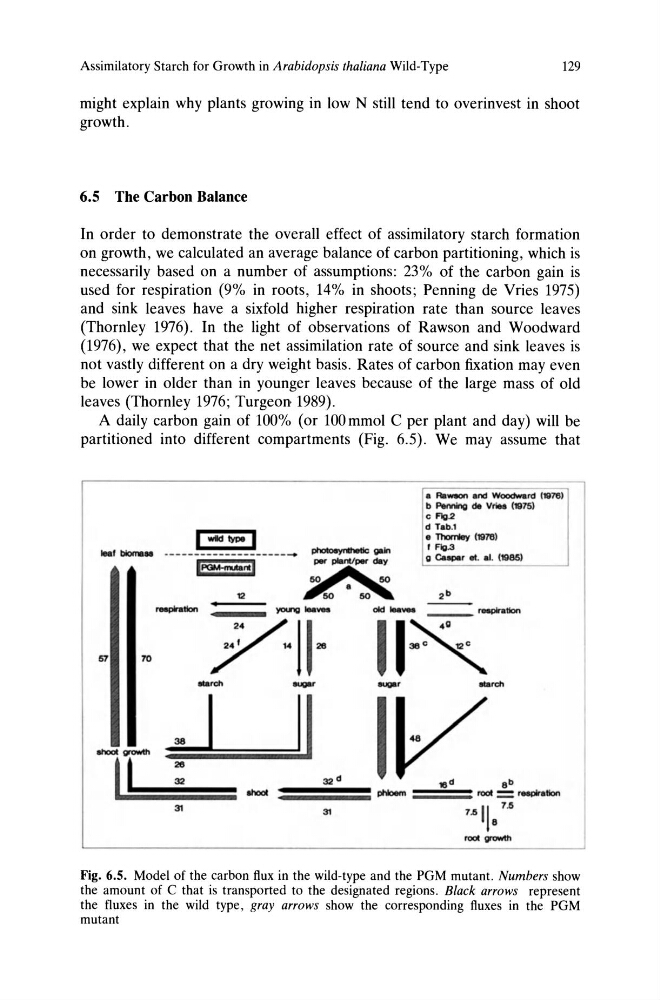
In order to demonstrate the overall effect of assimilatory starch formation
on growth, we calculated an average balance of carbon partitioning, which is
necessarily based on a number of assumptions: 23% of the carbon gain is
used for respiration (9% in roots, 14% in shoots; Penning de Vries 1975)
and sink leaves have a sixfold higher respiration rate than source leaves
(Thornley 1976). In the light of observations of Rawson and Woodward
(1976), we expect that the net assimilation rate of source and sink leaves is
not vastly different on a dry weight basis. Rates of carbon fixation may even
be lower in older than in younger leaves because of the large mass of old
leaves (Thornley 1976; Turgeon 1989).
A daily carbon gain of 100% (or 100 mmol C per plant and day) will be
partitioned into different compartments (Fig. 6.5). We may assume that
~
70
lr
I wId~ 1
._------------------ -
....... " .. -
galn
IPOM-Manli
~ pet plarUpet doll'
60
a
60
12
60
60
reep(rallon
)I
• AII_ and Woodward (1876)
b PeronIng dol VriM (1875)
e F1g.2
d Tab.1
• ThorTWy (1876)
I Flg.3
g ~r aI. al. (18851
reep(rallon
Y II· II~
otarch
_r _r
otarch
38
I II IV
28
32
32 d
18 d
sb
II'IOCt
."....
root = rwpIr.tion
31
31
7.5 lis 7.5
roo! growth
Fig. 6.5. Model of the carbon flux in the wild-type and the PGM mutant. Numbers show
the amount of C that is transported to the designated regions. Black arrows represent
the fluxes in the wild type, gray arrows show the corresponding fluxes in the PGM
mutant
129
might explain why plants growing in low N still tend to overinvest in shoot
growth.
6.5 The Carbon Balance
In order to demonstrate the overall effect of assimilatory starch formation
on growth, we calculated an average balance of carbon partitioning, which is
necessarily based on a number of assumptions: 23% of the carbon gain is
used for respiration (9% in roots, 14% in shoots; Penning de Vries 1975)
and sink leaves have a sixfold higher respiration rate than source leaves
(Thornley 1976). In the light of observations of Rawson and Woodward
(1976), we expect that the net assimilation rate of source and sink leaves is
not vastly different on a dry weight basis. Rates of carbon fixation may even
be lower in older than in younger leaves because of the large mass of old
leaves (Thornley 1976; Turgeon 1989).
A daily carbon gain of 100% (or 100 mmol C per plant and day) will be
partitioned into different compartments (Fig. 6.5). We may assume that
~
70
lr
I wId~ 1
._------------------ -
....... " .. -
galn
IPOM-Manli
~ pet plarUpet doll'
60
a
60
12
60
60
reep(rallon
)I
• AII_ and Woodward (1876)
b PeronIng dol VriM (1875)
e F1g.2
d Tab.1
• ThorTWy (1876)
I Flg.3
g ~r aI. al. (18851
reep(rallon
Y II· II~
otarch
_r _r
otarch
38
I II IV
28
32
32 d
18 d
sb
II'IOCt
."....
root = rwpIr.tion
31
31
7.5 lis 7.5
roo! growth
Fig. 6.5. Model of the carbon flux in the wild-type and the PGM mutant. Numbers show
the amount of C that is transported to the designated regions. Black arrows represent
the fluxes in the wild type, gray arrows show the corresponding fluxes in the PGM
mutant