

114
~ 120
.c
:2
U 100
Ol
E
-
8 80
"0
E
.=; 60
~ 40
'" ~
(5
20
.c Q.
Euglena
-r---__ I---_ pH2
pH 1
10 20 30 40 50 60 70 80 90 100
incubation time [min]
H. Pfanz
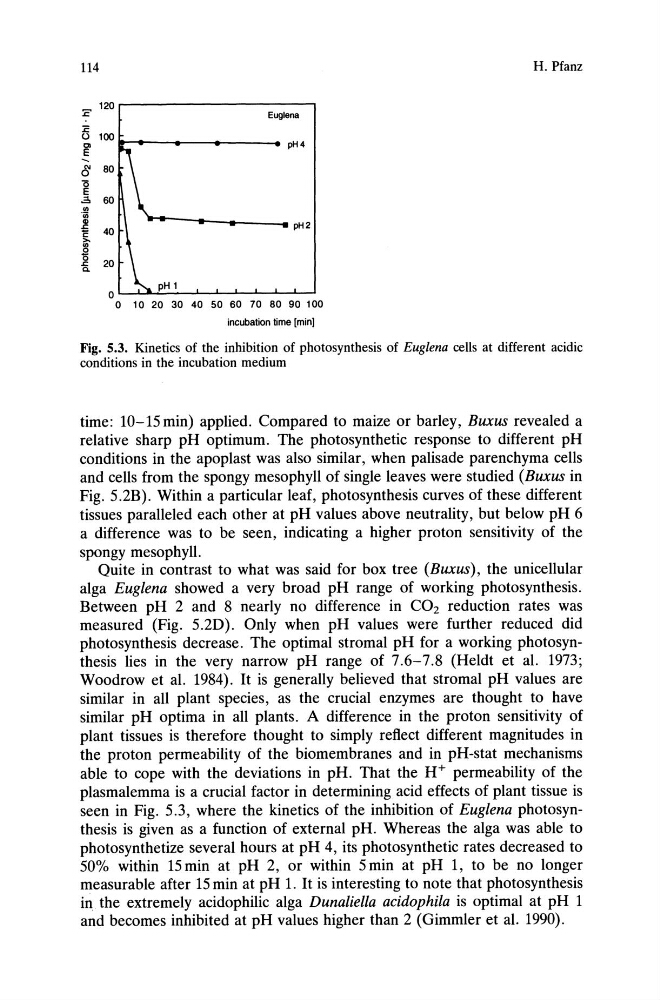
Fig. 5.3. Kinetics of the inhibition of photosynthesis of Euglena cells at different acidic
conditions in the incubation medium
time: 10-15 min) applied. Compared to maize or barley, Buxus revealed a
relative sharp pH optimum. The photosynthetic response to different pH
conditions in the apoplast was also similar, when palisade parenchyma cells
and cells from the spongy mesophyll of single leaves were studied (Buxus in
Fig. 5.2B). Within a particular leaf, photosynthesis curves of these different
tissues paralleled each other at pH values above neutrality, but below pH 6
a difference was to be seen, indicating a higher proton sensitivity of the
spongy mesophyll.
Quite in contrast to what was said for box tree (Buxus), the unicellular
alga Euglena showed a very broad pH range of working photosynthesis.
Between pH 2 and 8 nearly no difference in CO 2 reduction rates was
measured (Fig. 5.2D). Only when pH values were further reduced did
photosynthesis decrease. The optimal stromal pH for a working photosynthesis lies in the very narrow pH range of 7.6-7.8 (Heldt et al. 1973;
Woodrow et al. 1984). It is generally believed that stromal pH values are
similar in all plant species, as the crucial enzymes are thought to have
similar pH optima in all plants. A difference in the proton sensitivity of
plant tissues is therefore thought to simply reflect different magnitudes in
the proton permeability of the biomembranes and in pH-stat mechanisms
able to cope with the deviations in pH. That the H+ permeability of the
plasmalemma is a crucial factor in determining acid effects of plant tissue is
seen in Fig. 5.3, where the kinetics of the inhibition of Euglena photosynthesis is given as a function of external pH. Whereas the alga was able to
photosynthetize several hours at pH 4, its photosynthetic rates decreased to
50% within 15 min at pH 2, or within 5 min at pH 1, to be no longer
measurable after 15 min at pH 1. It is interesting to note that photosynthesis
in the extremely acidophilic alga Dunaliella acidophila is optimal at pH 1
and becomes inhibited at pH values higher than 2 (Gimmler et al. 1990).
~ 120
.c
:2
U 100
Ol
E
-
8 80
"0
E
.=; 60
~ 40
'" ~
(5
20
.c Q.
Euglena
-r---__ I---_ pH2
pH 1
10 20 30 40 50 60 70 80 90 100
incubation time [min]
H. Pfanz
Fig. 5.3. Kinetics of the inhibition of photosynthesis of Euglena cells at different acidic
conditions in the incubation medium
time: 10-15 min) applied. Compared to maize or barley, Buxus revealed a
relative sharp pH optimum. The photosynthetic response to different pH
conditions in the apoplast was also similar, when palisade parenchyma cells
and cells from the spongy mesophyll of single leaves were studied (Buxus in
Fig. 5.2B). Within a particular leaf, photosynthesis curves of these different
tissues paralleled each other at pH values above neutrality, but below pH 6
a difference was to be seen, indicating a higher proton sensitivity of the
spongy mesophyll.
Quite in contrast to what was said for box tree (Buxus), the unicellular
alga Euglena showed a very broad pH range of working photosynthesis.
Between pH 2 and 8 nearly no difference in CO 2 reduction rates was
measured (Fig. 5.2D). Only when pH values were further reduced did
photosynthesis decrease. The optimal stromal pH for a working photosynthesis lies in the very narrow pH range of 7.6-7.8 (Heldt et al. 1973;
Woodrow et al. 1984). It is generally believed that stromal pH values are
similar in all plant species, as the crucial enzymes are thought to have
similar pH optima in all plants. A difference in the proton sensitivity of
plant tissues is therefore thought to simply reflect different magnitudes in
the proton permeability of the biomembranes and in pH-stat mechanisms
able to cope with the deviations in pH. That the H+ permeability of the
plasmalemma is a crucial factor in determining acid effects of plant tissue is
seen in Fig. 5.3, where the kinetics of the inhibition of Euglena photosynthesis is given as a function of external pH. Whereas the alga was able to
photosynthetize several hours at pH 4, its photosynthetic rates decreased to
50% within 15 min at pH 2, or within 5 min at pH 1, to be no longer
measurable after 15 min at pH 1. It is interesting to note that photosynthesis
in the extremely acidophilic alga Dunaliella acidophila is optimal at pH 1
and becomes inhibited at pH values higher than 2 (Gimmler et al. 1990).