

Apoplastic & Symplastic Proton Concentrations & Their Significance for Metabolism 109
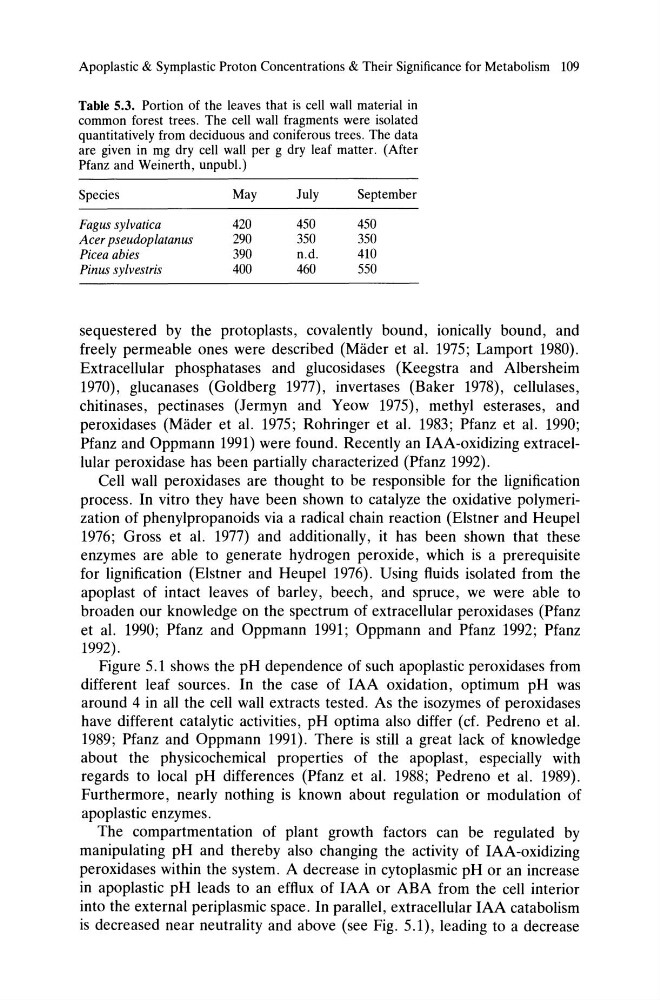
Table 5.3. Portion of the leaves that is cell wall material in
common forest trees. The cell wall fragments were isolated
quantitatively from deciduous and coniferous trees. The data
are given in mg dry cell wall per g dry leaf matter. (After
Pfanz and Weinerth, unpub!.)
Species
May
July
September
Fagus sylvatica
420
450
450
Acer pseudoplatanus
290
350
350
Picea abies
390
n.d.
410
Pinus sylvestris
400
460
550
sequestered by the pro top lasts , covalently bound, ionic ally bound, and
freely permeable ones were described (Miider et al. 1975; Lamport 1980).
Extracellular phosphatases and glucosidases (Keegstra and Albersheim
1970), glucanases (Goldberg 1977), invertases (Baker 1978), cellulases,
chitinases, pectinases (Jermyn and Yeow 1975), methyl esterases, and
peroxidases (Miider et al. 1975; Rohringer et al. 1983; Pfanz et al. 1990;
Pfanz and Oppmann 1991) were found. Recently an IAA-oxidizing extracellular peroxidase has been partially characterized (Pfanz 1992).
Cell wall peroxidases are thought to be responsible for the lignification
process. In vitro they have been shown to catalyze the oxidative polymerization of phenylpropanoids via a radical chain reaction (Elstner and Heupel
1976; Gross et al. 1977) and additionally, it has been shown that these
enzymes are able to generate hydrogen peroxide, which is a prerequisite
for lignification (Elstner and Heupel 1976). Using fluids isolated from the
apoplast of intact leaves of barley, beech, and spruce, we were able to
broaden our knowledge on the spectrum of extracellular peroxidases (Pfanz
et al. 1990; Pfanz and Oppmann 1991; Oppmann and Pfanz 1992; Pfanz
1992).
Figure 5.1 shows the pH dependence of such apoplastic peroxidases from
different leaf sources. In the case of IAA oxidation, optimum pH was
around 4 in all the cell wall extracts tested. As the isozymes of peroxidases
have different catalytic activities, pH optima also differ (d. Pedreno et al.
1989; Pfanz and Oppmann 1991). There is still a great lack of knowledge
about the physicochemical properties of the apoplast, especially with
regards to local pH differences (Pfanz et al. 1988; Pedreno et al. 1989).
Furthermore, nearly nothing is known about regulation or modulation of
apoplastic enzymes.
The compartmentation of plant growth factors can be regulated by
manipulating pH and thereby also changing the activity of IAA-oxidizing
peroxidases within the system. A decrease in cytoplasmic pH or an increase
in apoplastic pH leads to an efflux of IAA or ABA from the cell interior
into the external periplasmic space. In parallel, extracellular IAA catabolism
is decreased near neutrality and above (see Fig. 5.1), leading to a decrease
Table 5.3. Portion of the leaves that is cell wall material in
common forest trees. The cell wall fragments were isolated
quantitatively from deciduous and coniferous trees. The data
are given in mg dry cell wall per g dry leaf matter. (After
Pfanz and Weinerth, unpub!.)
Species
May
July
September
Fagus sylvatica
420
450
450
Acer pseudoplatanus
290
350
350
Picea abies
390
n.d.
410
Pinus sylvestris
400
460
550
sequestered by the pro top lasts , covalently bound, ionic ally bound, and
freely permeable ones were described (Miider et al. 1975; Lamport 1980).
Extracellular phosphatases and glucosidases (Keegstra and Albersheim
1970), glucanases (Goldberg 1977), invertases (Baker 1978), cellulases,
chitinases, pectinases (Jermyn and Yeow 1975), methyl esterases, and
peroxidases (Miider et al. 1975; Rohringer et al. 1983; Pfanz et al. 1990;
Pfanz and Oppmann 1991) were found. Recently an IAA-oxidizing extracellular peroxidase has been partially characterized (Pfanz 1992).
Cell wall peroxidases are thought to be responsible for the lignification
process. In vitro they have been shown to catalyze the oxidative polymerization of phenylpropanoids via a radical chain reaction (Elstner and Heupel
1976; Gross et al. 1977) and additionally, it has been shown that these
enzymes are able to generate hydrogen peroxide, which is a prerequisite
for lignification (Elstner and Heupel 1976). Using fluids isolated from the
apoplast of intact leaves of barley, beech, and spruce, we were able to
broaden our knowledge on the spectrum of extracellular peroxidases (Pfanz
et al. 1990; Pfanz and Oppmann 1991; Oppmann and Pfanz 1992; Pfanz
1992).
Figure 5.1 shows the pH dependence of such apoplastic peroxidases from
different leaf sources. In the case of IAA oxidation, optimum pH was
around 4 in all the cell wall extracts tested. As the isozymes of peroxidases
have different catalytic activities, pH optima also differ (d. Pedreno et al.
1989; Pfanz and Oppmann 1991). There is still a great lack of knowledge
about the physicochemical properties of the apoplast, especially with
regards to local pH differences (Pfanz et al. 1988; Pedreno et al. 1989).
Furthermore, nearly nothing is known about regulation or modulation of
apoplastic enzymes.
The compartmentation of plant growth factors can be regulated by
manipulating pH and thereby also changing the activity of IAA-oxidizing
peroxidases within the system. A decrease in cytoplasmic pH or an increase
in apoplastic pH leads to an efflux of IAA or ABA from the cell interior
into the external periplasmic space. In parallel, extracellular IAA catabolism
is decreased near neutrality and above (see Fig. 5.1), leading to a decrease