

108
Table 5.2. Intercellular air space (lAS) and cell wall volume
(CWV) of leaves from different plant species. lAS. was
determined by infiltrating water into fully water-saturated,
pre-weighed leaves and final re-weighing. Cell wall volume
was calculated through microscopical analyses. Data are
expressed per fresh weight (FM). (After Pfanz 1987)
Species
Spinacia oleracea
Citrus limon
Hordeum vulgare
Taxus baccata
77
175
81
100
lAS III g-l FM
680
550
300
345
H. Pfanz
microbial attack (Esquerre-Tugaye and Lamport 1979), atmospheric air
pollutants (Pfanz et al. 1990; Pfanz and Oppmann 1991) or even heavy
metals (Verkleij and Schat 1989), and therefore is an ideal site for stress
recognition and for detoxification. (3) If not transported through the symplast (via plasmodesmata), compounds excreted or taken up into a cell
inevitably have to pass through the aqueous phase of the cell wall. This
includes nutrients as well as toxic compounds. (4) The extracellular proton
concentration modifies the ionic state of dissociable acids or bases and
thus determines permeability and availability of solutes. Photosynthetic gas
exchange or uptake and release of gaseous air pollutants also proceed via
this water phase.
5.3.1.2 Cytomorphological Parameters
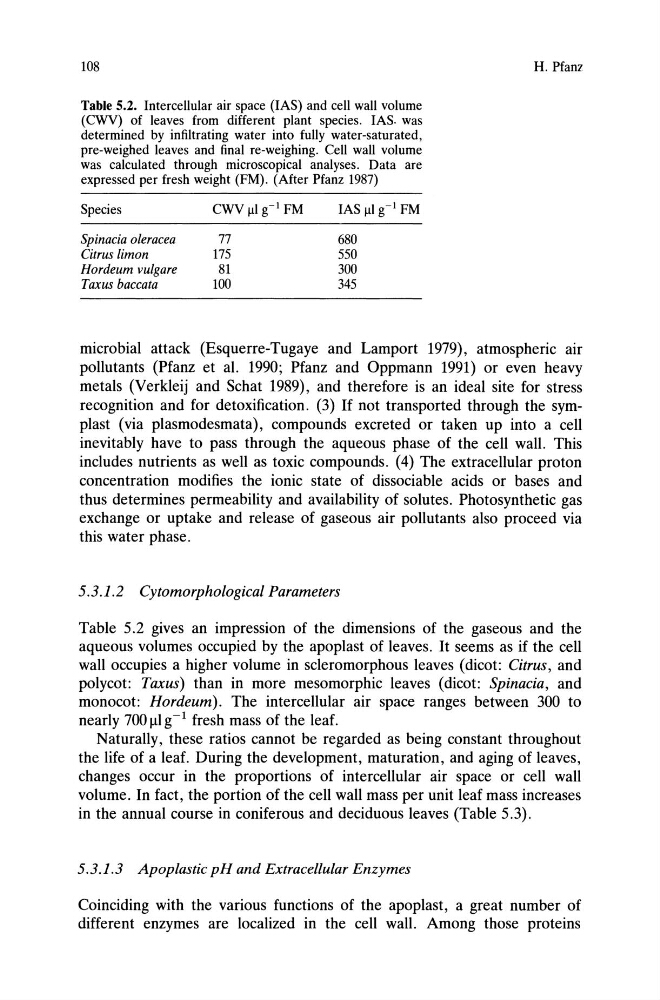
Table 5.2 gives an impression of the dimensions of the gaseous and the
aqueous volumes occupied by the apoplast of leaves. It seems as if the cell
wall occupies a higher volume in scleromorphous leaves (dicot: Citrus, and
polycot: Taxus) than in more mesomorphic leaves (dicot: Spinacia, and
monocot: Hordeum). The intercellular air space ranges between 300 to
nearly 700 III g -1 fresh mass of the leaf.
Naturally, these ratios cannot be regarded as being constant throughout
the life of a leaf. During the development, maturation, and aging of leaves,
changes occur in the proportions of intercellular air space or cell wall
volume. In fact, the portion of the cell wall mass per unit leaf mass increases
in the annual course in coniferous and deciduous leaves (Table 5.3).
5.3.1.3 Apoplastic pH and Extracellular Enzymes
Coinciding with the various functions of the apoplast, a great number of
different enzymes are localized in the cell wall. Among those proteins
Table 5.2. Intercellular air space (lAS) and cell wall volume
(CWV) of leaves from different plant species. lAS. was
determined by infiltrating water into fully water-saturated,
pre-weighed leaves and final re-weighing. Cell wall volume
was calculated through microscopical analyses. Data are
expressed per fresh weight (FM). (After Pfanz 1987)
Species
Spinacia oleracea
Citrus limon
Hordeum vulgare
Taxus baccata
77
175
81
100
lAS III g-l FM
680
550
300
345
H. Pfanz
microbial attack (Esquerre-Tugaye and Lamport 1979), atmospheric air
pollutants (Pfanz et al. 1990; Pfanz and Oppmann 1991) or even heavy
metals (Verkleij and Schat 1989), and therefore is an ideal site for stress
recognition and for detoxification. (3) If not transported through the symplast (via plasmodesmata), compounds excreted or taken up into a cell
inevitably have to pass through the aqueous phase of the cell wall. This
includes nutrients as well as toxic compounds. (4) The extracellular proton
concentration modifies the ionic state of dissociable acids or bases and
thus determines permeability and availability of solutes. Photosynthetic gas
exchange or uptake and release of gaseous air pollutants also proceed via
this water phase.
5.3.1.2 Cytomorphological Parameters
Table 5.2 gives an impression of the dimensions of the gaseous and the
aqueous volumes occupied by the apoplast of leaves. It seems as if the cell
wall occupies a higher volume in scleromorphous leaves (dicot: Citrus, and
polycot: Taxus) than in more mesomorphic leaves (dicot: Spinacia, and
monocot: Hordeum). The intercellular air space ranges between 300 to
nearly 700 III g -1 fresh mass of the leaf.
Naturally, these ratios cannot be regarded as being constant throughout
the life of a leaf. During the development, maturation, and aging of leaves,
changes occur in the proportions of intercellular air space or cell wall
volume. In fact, the portion of the cell wall mass per unit leaf mass increases
in the annual course in coniferous and deciduous leaves (Table 5.3).
5.3.1.3 Apoplastic pH and Extracellular Enzymes
Coinciding with the various functions of the apoplast, a great number of
different enzymes are localized in the cell wall. Among those proteins