

Chapter 17 . Classification of Fish Stock-Recruitment Relationships 333
can be easily made with corresponding modifications to the fuzzy membership
functions, fuzzy decision rules, and the fuzzy reasoning.
17.2.2.1
Fuzzy Membership Function (FMF)
Corresponding to the traditional treatment for the environmental variables in the
SR analyses, only SST is used as fuzzy input and the stock spawner biomass (S)
and recruitment (R) are kept as crisp variables.
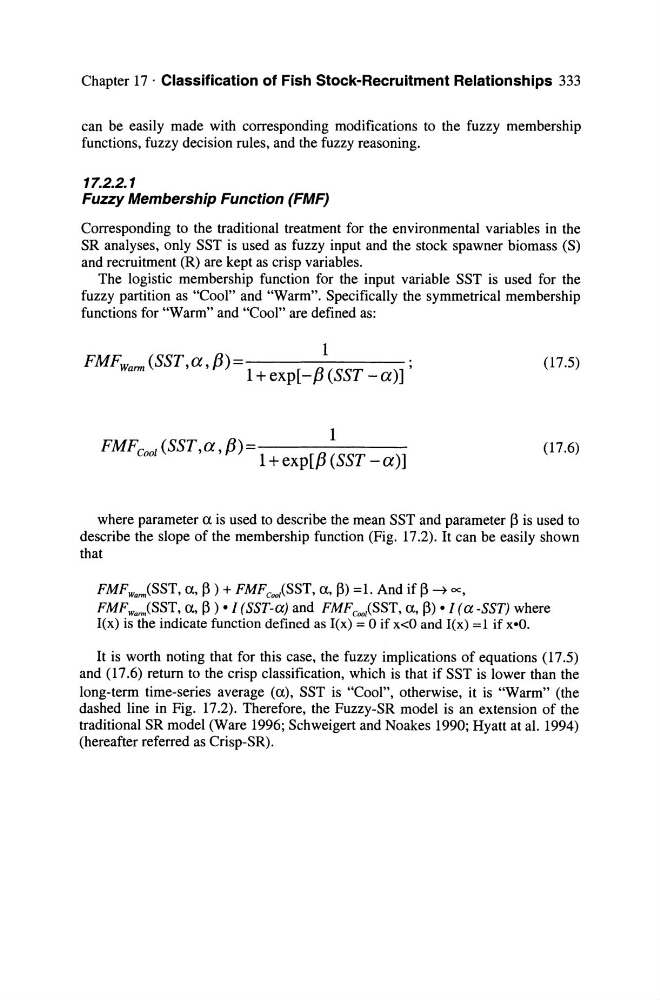
The logistic membership function for the input variable SST is used for the
fuzzy partition as "Cool" and "Warm". Specifically the symmetrical membership
functions for "Warm" and "Cool" are defined as:
FMP,
(SST a ß)= _ _ _ l _ _ _
Wann
"
1+ exp[-ß (SST-a)]
(17.5)
FMF (SST a ß)= _ _ _ l _ _ _
Cool
"
1 + exp[ß (SST - a)]
(17.6)
where parameter a is used to describe the mean SST and parameter ß is used to
describe the slope of the membership function (Fig. 17.2). It can be easily shown
that
FMFWarm(SST, a, ß) + FMFcoolSST, a, ß) =1. And if ß ~ oe,
FMF wann(SST, a, ß ) • I (SST-a) and FMFcoo/(SST, a, ß) • I (a -SST) where
I(x) is the indicate function defined as lex) = 0 if x
and (17.6) return to the crisp classification, which is that if SST is lower than the
long-term time-series average (a), SST is "Cool", otherwise, it is "Warm" (the
dashed line in Fig. 17.2). Therefore, the Fuzzy-SR model is an extension of the
traditional SR model (Ware 1996; Schweigert and Noakes 1990; Hyatt at al. 1994)
(hereafter referred as Crisp-SR).
can be easily made with corresponding modifications to the fuzzy membership
functions, fuzzy decision rules, and the fuzzy reasoning.
17.2.2.1
Fuzzy Membership Function (FMF)
Corresponding to the traditional treatment for the environmental variables in the
SR analyses, only SST is used as fuzzy input and the stock spawner biomass (S)
and recruitment (R) are kept as crisp variables.
The logistic membership function for the input variable SST is used for the
fuzzy partition as "Cool" and "Warm". Specifically the symmetrical membership
functions for "Warm" and "Cool" are defined as:
FMP,
(SST a ß)= _ _ _ l _ _ _
Wann
"
1+ exp[-ß (SST-a)]
(17.5)
FMF (SST a ß)= _ _ _ l _ _ _
Cool
"
1 + exp[ß (SST - a)]
(17.6)
where parameter a is used to describe the mean SST and parameter ß is used to
describe the slope of the membership function (Fig. 17.2). It can be easily shown
that
FMFWarm(SST, a, ß) + FMFcoolSST, a, ß) =1. And if ß ~ oe,
FMF wann(SST, a, ß ) • I (SST-a) and FMFcoo/(SST, a, ß) • I (a -SST) where
I(x) is the indicate function defined as lex) = 0 if x
and (17.6) return to the crisp classification, which is that if SST is lower than the
long-term time-series average (a), SST is "Cool", otherwise, it is "Warm" (the
dashed line in Fig. 17.2). Therefore, the Fuzzy-SR model is an extension of the
traditional SR model (Ware 1996; Schweigert and Noakes 1990; Hyatt at al. 1994)
(hereafter referred as Crisp-SR).