

330
D.G.Chen
the traditional approaches. In both examples, the annual mean sea-surface
temperature (SST) is incorporated as an environmental intervention.
17.2
Fuzzy Stock-Recruitment Model
17.2.1
Traditional Stock-Recruitment Model
SR analysis begins with the assumption of a functional relationship, denoted by
F(e), between spawners and recruitment:
R,= F(S" B)
(17.1)
where R t and St are the corresponding recruits and spawners at brood year t (t=l,
A, n), e is a vector of parameters associated with this relationship and usually e is
associated with the fishery management policy. The Ricker model (1975)
(hereafter referred to as Ricker-SR) is the most commonly used form in the
fisheries literature:
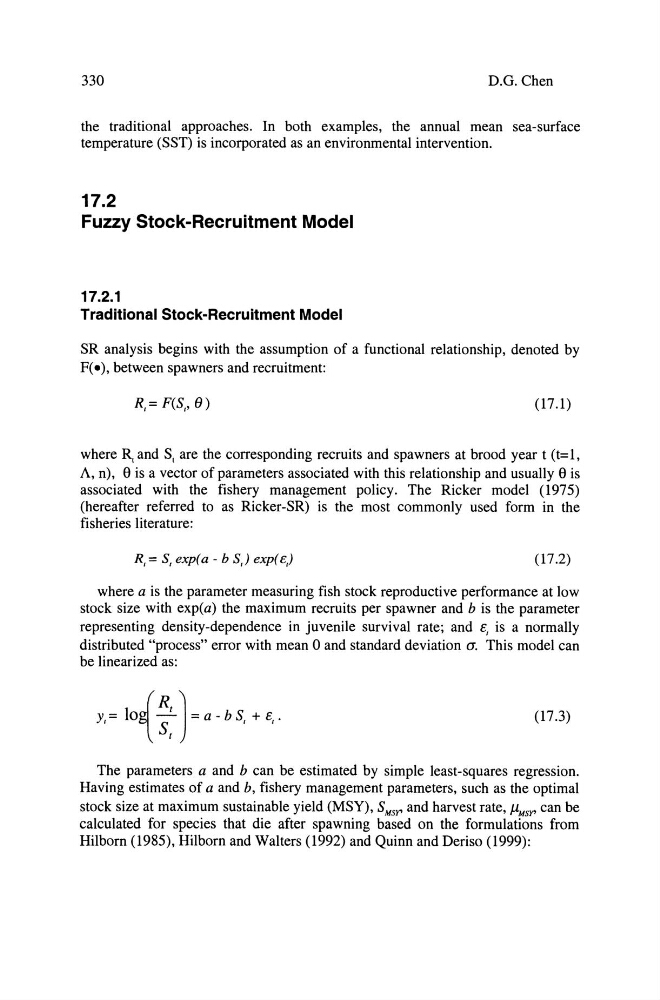
R, = S, exp( a - b S,J exp( e)
(17.2)
where a is the parameter measuring fish stock reproductive performance at low
stock size with exp(a) the maximum recruits per spawner and b is the parameter
representing density-dependence in juvenile survival rate; and E, is a normally
distributed "process" error with mean 0 and standard deviation 0'. This model can
be linearized as:
y, = IO{ ~: ) = a - b S, + E,
(17.3)
The parameters a and b can be estimated by simple least-squares regression.
Having estimates of a and b, fishery management parameters, such as the optimal
stock size at maximum sustainable yield (MSY), SMSY' and harvest rate, PMSY' can be
calculated for species that die after spawning based on the formulations from
Hilbom (1985), Hilbom and Walters (1992) and Quinn and Deriso (1999):
D.G.Chen
the traditional approaches. In both examples, the annual mean sea-surface
temperature (SST) is incorporated as an environmental intervention.
17.2
Fuzzy Stock-Recruitment Model
17.2.1
Traditional Stock-Recruitment Model
SR analysis begins with the assumption of a functional relationship, denoted by
F(e), between spawners and recruitment:
R,= F(S" B)
(17.1)
where R t and St are the corresponding recruits and spawners at brood year t (t=l,
A, n), e is a vector of parameters associated with this relationship and usually e is
associated with the fishery management policy. The Ricker model (1975)
(hereafter referred to as Ricker-SR) is the most commonly used form in the
fisheries literature:
R, = S, exp( a - b S,J exp( e)
(17.2)
where a is the parameter measuring fish stock reproductive performance at low
stock size with exp(a) the maximum recruits per spawner and b is the parameter
representing density-dependence in juvenile survival rate; and E, is a normally
distributed "process" error with mean 0 and standard deviation 0'. This model can
be linearized as:
y, = IO{ ~: ) = a - b S, + E,
(17.3)
The parameters a and b can be estimated by simple least-squares regression.
Having estimates of a and b, fishery management parameters, such as the optimal
stock size at maximum sustainable yield (MSY), SMSY' and harvest rate, PMSY' can be
calculated for species that die after spawning based on the formulations from
Hilbom (1985), Hilbom and Walters (1992) and Quinn and Deriso (1999):