

304
J. Bobbin . F. Recknagel
Evolutionary analysis of Kasumigaura
Predicted and actual chlorophyll-a level
.... AclJal
-
p,_
t i I i I I r I I I I I I I I 11 i i I I i i 11 i i i , r i 11 I I I I I 1 li , I I I I , I I I i i I I I '1 I I f I I I i
o 1~ 300 0 1~ 300 0 1~ 300 0 1~ 300 0 1~ 300 0 1~ 300 0 1~ 300 0 1~ 300
1984
1985
1987
11/88
1981l
1990
1991
1992
Predicted and actual chlorophyll-a level using input set 1
Ac-.aJ
-
Pre
~ I
..
I
0
0
~
1()()
1~
200
250
300
350
0
~
1()()
1~
200
2~
300
350
1986
1993
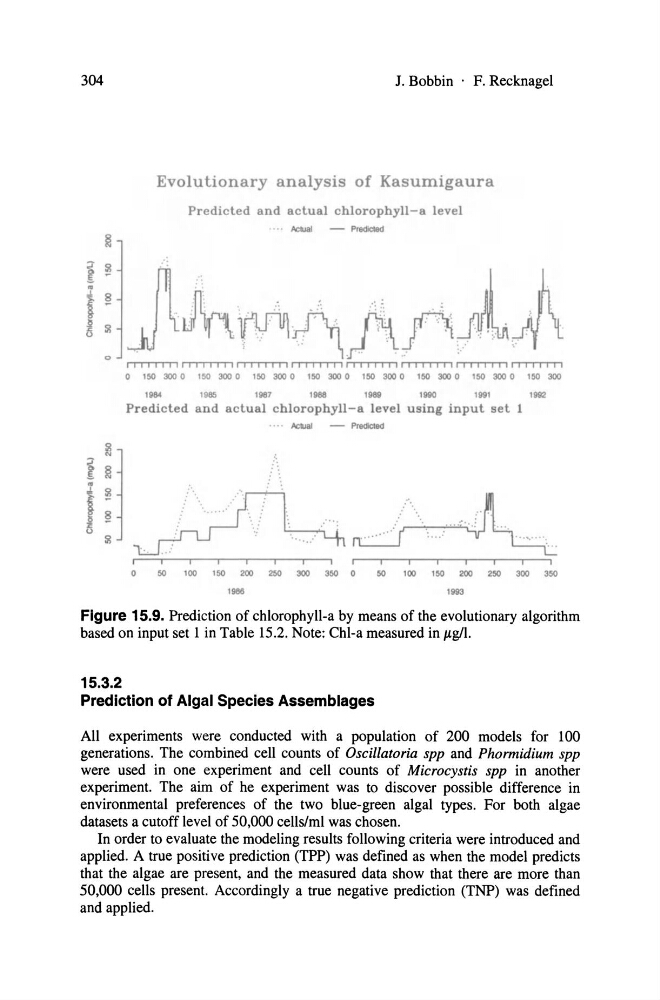
Figure 15.9. Prediction of chlorophyll-a by means of the evolutionary algorithm
based on input set 1 in Table 15.2. Note: Chl-a measured in /Lgll.
15.3.2
Predlction of Aigal Species Assemblages
All experiments were conducted with a population of 200 models for 100
generations. The combined cell counts of Oscillatoria spp and Phormidium spp
were used in one experiment and cell counts of Microcystis spp in another
experiment. The aim of he experiment was to disco ver possible difference in
environmental preferences of the two blue-green algal types. For both algae
datasets a cutoff level of 50,000 cells/ml was chosen.
In order to evaluate the modeling results following criteria were introduced and
applied. A true positive prediction (TPP) was defined as when the model predicts
that the algae are present, and the measured data show that there are more than
50,000 cells present. Accordingly a true negative prediction (TNP) was defined
and applied.
J. Bobbin . F. Recknagel
Evolutionary analysis of Kasumigaura
Predicted and actual chlorophyll-a level
.... AclJal
-
p,_
t i I i I I r I I I I I I I I 11 i i I I i i 11 i i i , r i 11 I I I I I 1 li , I I I I , I I I i i I I I '1 I I f I I I i
o 1~ 300 0 1~ 300 0 1~ 300 0 1~ 300 0 1~ 300 0 1~ 300 0 1~ 300 0 1~ 300
1984
1985
1987
11/88
1981l
1990
1991
1992
Predicted and actual chlorophyll-a level using input set 1
Ac-.aJ
-
Pre
~ I
..
I
0
0
~
1()()
1~
200
250
300
350
0
~
1()()
1~
200
2~
300
350
1986
1993
Figure 15.9. Prediction of chlorophyll-a by means of the evolutionary algorithm
based on input set 1 in Table 15.2. Note: Chl-a measured in /Lgll.
15.3.2
Predlction of Aigal Species Assemblages
All experiments were conducted with a population of 200 models for 100
generations. The combined cell counts of Oscillatoria spp and Phormidium spp
were used in one experiment and cell counts of Microcystis spp in another
experiment. The aim of he experiment was to disco ver possible difference in
environmental preferences of the two blue-green algal types. For both algae
datasets a cutoff level of 50,000 cells/ml was chosen.
In order to evaluate the modeling results following criteria were introduced and
applied. A true positive prediction (TPP) was defined as when the model predicts
that the algae are present, and the measured data show that there are more than
50,000 cells present. Accordingly a true negative prediction (TNP) was defined
and applied.