

298
1. Bobbin . F. Recknagel
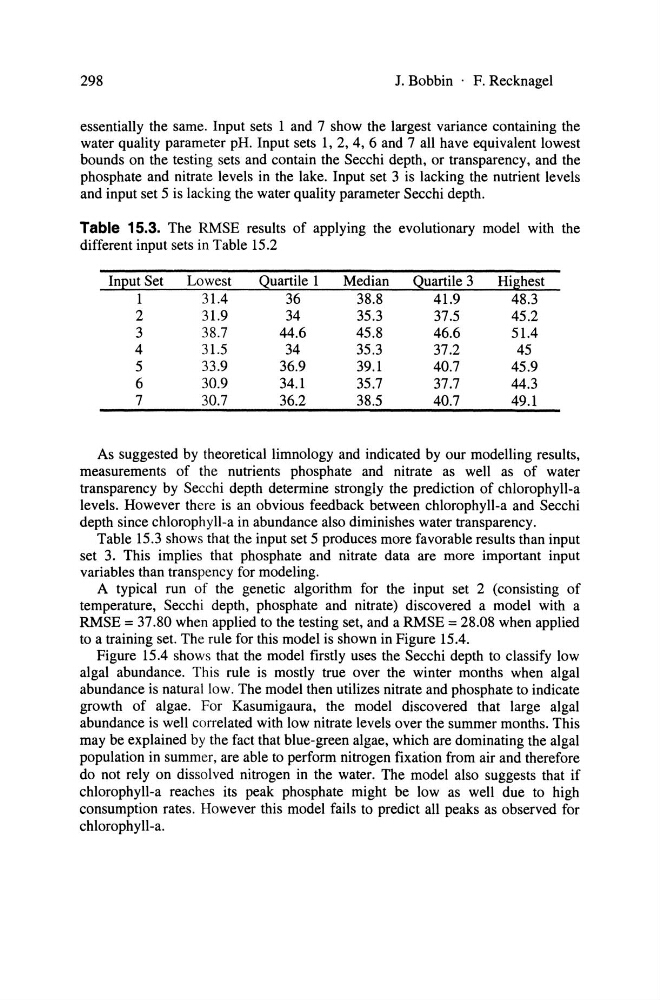
essentially the same. Input sets 1 and 7 show the largest variance containing the
water quality parameter pH. Input sets 1,2,4,6 and 7 all have equivalent lowest
bounds on the testing sets and contain the Secchi depth, or transparency, and the
phosphate and nitrate levels in the lake. Input set 3 is lacking the nutrient levels
and input set 5 is lacking the water quality parameter Secchi depth.
labia 15.3. The RMSE results of applying the evolutionary model with the
different input sets in Table 15.2
InEut Set
Lowest
Quartile 1
Median
Quartile 3
Highest
1
31.4
36
38.8
41.9
48.3
2
31.9
34
35.3
37.5
45.2
3
38.7
44.6
45.8
46.6
51.4
4
31.5
34
35.3
37.2
45
5
33.9
36.9
39.1
40.7
45.9
6
30.9
34.1
35.7
37.7
44.3
7
30.7
36.2
38.5
40.7
49.1
As suggested by theoretical limnology and indicated by our modelling results,
measurements of the nutrients phosphate and nitrate as weil as of water
transparency by Secchi depth determine strongly the prediction of chlorophyll-a
levels. However there is an obvious feedback between chlorophyll-a and Secchi
depth since chlorophyll-a in abundance also diminishes water transparency.
Table 15.3 shows that the input set 5 produces more favorable results than input
set 3. This implies that phosphate and nitrate data are more important input
variables than transpency for modeling.
A typical run of the genetic algorithm for the input set 2 (consisting of
temperature, Secchi depth, phosphate and nitrate) discovered a model with a
RMSE = 37.80 when applied to the testing set, and a RMSE = 28.08 when applied
to a training set. The rule for this model is shown in Figure 15.4.
Figure 15.4 shows that the model firstly uses the Secchi depth to classify low
algal abundance. This rule is mostly true over the winter months when algal
abundance is naturallow. The model then utilizes nitrate and phosphate to indicate
growth of algae. For Kasumigaura, the model discovered that large algal
abundance is weIl correlated with low nitrate levels over the summer months. This
may be explained by the fact that blue-green algae, wh ich are dominating the algal
population in summer, are able to perform nitrogen fixation from air and therefore
do not rely on dissolved nitrogen in the water. The model also suggests that if
chlorophyll-a reaches its peak phosphate might be low as well due to high
consumption rates. However this model fails to predict all peaks as observed for
chlorophyll-a.
1. Bobbin . F. Recknagel
essentially the same. Input sets 1 and 7 show the largest variance containing the
water quality parameter pH. Input sets 1,2,4,6 and 7 all have equivalent lowest
bounds on the testing sets and contain the Secchi depth, or transparency, and the
phosphate and nitrate levels in the lake. Input set 3 is lacking the nutrient levels
and input set 5 is lacking the water quality parameter Secchi depth.
labia 15.3. The RMSE results of applying the evolutionary model with the
different input sets in Table 15.2
InEut Set
Lowest
Quartile 1
Median
Quartile 3
Highest
1
31.4
36
38.8
41.9
48.3
2
31.9
34
35.3
37.5
45.2
3
38.7
44.6
45.8
46.6
51.4
4
31.5
34
35.3
37.2
45
5
33.9
36.9
39.1
40.7
45.9
6
30.9
34.1
35.7
37.7
44.3
7
30.7
36.2
38.5
40.7
49.1
As suggested by theoretical limnology and indicated by our modelling results,
measurements of the nutrients phosphate and nitrate as weil as of water
transparency by Secchi depth determine strongly the prediction of chlorophyll-a
levels. However there is an obvious feedback between chlorophyll-a and Secchi
depth since chlorophyll-a in abundance also diminishes water transparency.
Table 15.3 shows that the input set 5 produces more favorable results than input
set 3. This implies that phosphate and nitrate data are more important input
variables than transpency for modeling.
A typical run of the genetic algorithm for the input set 2 (consisting of
temperature, Secchi depth, phosphate and nitrate) discovered a model with a
RMSE = 37.80 when applied to the testing set, and a RMSE = 28.08 when applied
to a training set. The rule for this model is shown in Figure 15.4.
Figure 15.4 shows that the model firstly uses the Secchi depth to classify low
algal abundance. This rule is mostly true over the winter months when algal
abundance is naturallow. The model then utilizes nitrate and phosphate to indicate
growth of algae. For Kasumigaura, the model discovered that large algal
abundance is weIl correlated with low nitrate levels over the summer months. This
may be explained by the fact that blue-green algae, wh ich are dominating the algal
population in summer, are able to perform nitrogen fixation from air and therefore
do not rely on dissolved nitrogen in the water. The model also suggests that if
chlorophyll-a reaches its peak phosphate might be low as well due to high
consumption rates. However this model fails to predict all peaks as observed for
chlorophyll-a.