

Chapter 15 . Evolved Predictive Rules for Algal Dynamics
297
Several runs with different input sets were conducted. Each input set consisted of
different lake water quality parameters. The input sets used are summarized in
Table 15.2.
Table 15.2. Input sets used for 120 runs with the evolutionary algorithm
Input
Lake Data
Set
~
e
W
i!!
<0
;:)
0(/)
<:
<0
Q)
~
8
Cl::
1
Water Temperature, Secchi Depth, P04, N03, N03IP04 ratio,
Dissolved Oxygen, pR, Solar Radiation
2
Water Temperature, Secchi Depth, P04 and N03concentration
3
Water Temperature, Secchi Depth, N03:P04 ratio
4
Water Temperature, Secchi Depth, P04 and N03 concentration,
N03:P04 ratio
5
Water Temperature, Solar Radiation, P04 and N03 concentration
6
Water Temperature, Secchi Depth, Solar Radiation, P04 and N03
concentration
7
Water Temperature, Secchi Depth, P04, N03, pR
Results of the evolutionary algorithm
0 Error from training set • Error trom testlng set
0
IJ')
0
,
IJ')
0
~.
0 8
o -r ,
~
-r
,
0
,
,
8 '
0 @
,
g :
-r
'I
,
-r
,
0
0
,
-' - g
, ,
.1
.,..
~I
~
, ,
,
0
g '
~I
E?*
IJ')
B~
,
:1
C")
,
-',
8'
,
-', -'0
-'C"l
2
3
4
5
6
7
Input Set
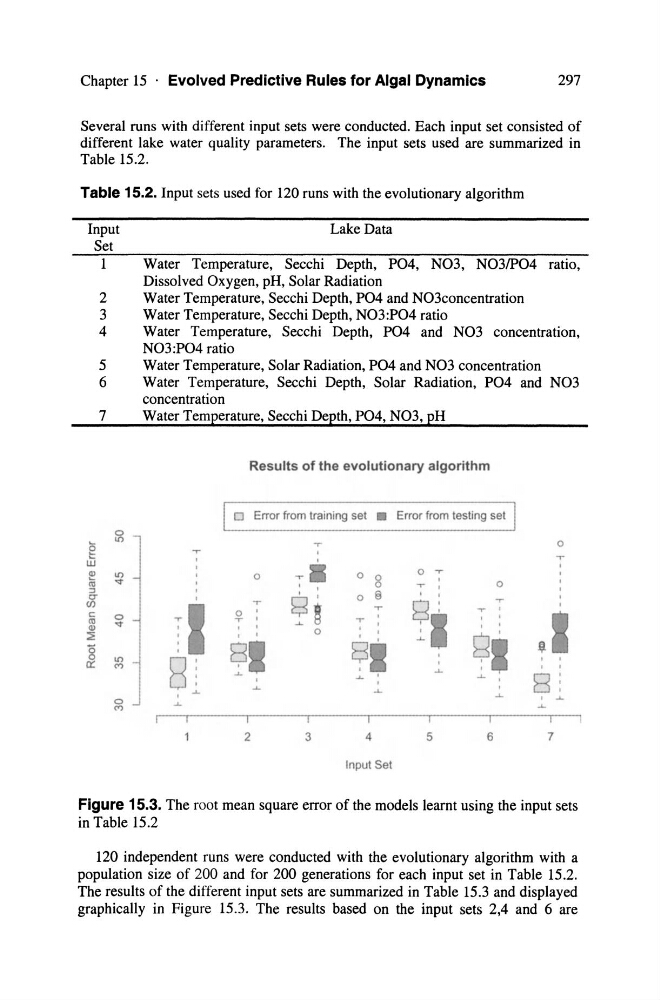
Figure 15.3. The root mean square error of the models leamt using the input sets
in Table 15.2
120 independent runs were conducted with the evolutionary algorithm with a
population size of 200 and for 200 generations for each input set in Table 15.2.
The results of the different input sets are surnmarized in Table 15.3 and displayed
graphically in Figure 15.3. The results based on the input sets 2,4 and 6 are
297
Several runs with different input sets were conducted. Each input set consisted of
different lake water quality parameters. The input sets used are summarized in
Table 15.2.
Table 15.2. Input sets used for 120 runs with the evolutionary algorithm
Input
Lake Data
Set
~
e
W
i!!
<0
;:)
0(/)
<:
<0
Q)
~
8
Cl::
1
Water Temperature, Secchi Depth, P04, N03, N03IP04 ratio,
Dissolved Oxygen, pR, Solar Radiation
2
Water Temperature, Secchi Depth, P04 and N03concentration
3
Water Temperature, Secchi Depth, N03:P04 ratio
4
Water Temperature, Secchi Depth, P04 and N03 concentration,
N03:P04 ratio
5
Water Temperature, Solar Radiation, P04 and N03 concentration
6
Water Temperature, Secchi Depth, Solar Radiation, P04 and N03
concentration
7
Water Temperature, Secchi Depth, P04, N03, pR
Results of the evolutionary algorithm
0 Error from training set • Error trom testlng set
0
IJ')
0
,
IJ')
0
~.
0 8
o -r ,
~
-r
,
0
,
,
8 '
0 @
,
g :
-r
'I
,
-r
,
0
0
,
-' - g
, ,
.1
.,..
~I
~
, ,
,
0
g '
~I
E?*
IJ')
B~
,
:1
C")
,
-',
8'
,
-', -'0
-'C"l
2
3
4
5
6
7
Input Set
Figure 15.3. The root mean square error of the models leamt using the input sets
in Table 15.2
120 independent runs were conducted with the evolutionary algorithm with a
population size of 200 and for 200 generations for each input set in Table 15.2.
The results of the different input sets are surnmarized in Table 15.3 and displayed
graphically in Figure 15.3. The results based on the input sets 2,4 and 6 are