

Chapter 15 . Evolved Predictive Rules for Aigal Dynamics
295
where OUTPUT m is a choice of model that is a function of the attributes to fit the
current environment. The conducted experiments were limited to considering
presence or absence of chlorophyll a or particular algal species, Le.
OUTPUT m E {PRESENT, ABSENT} m = 1,2. The classifiers are combined into
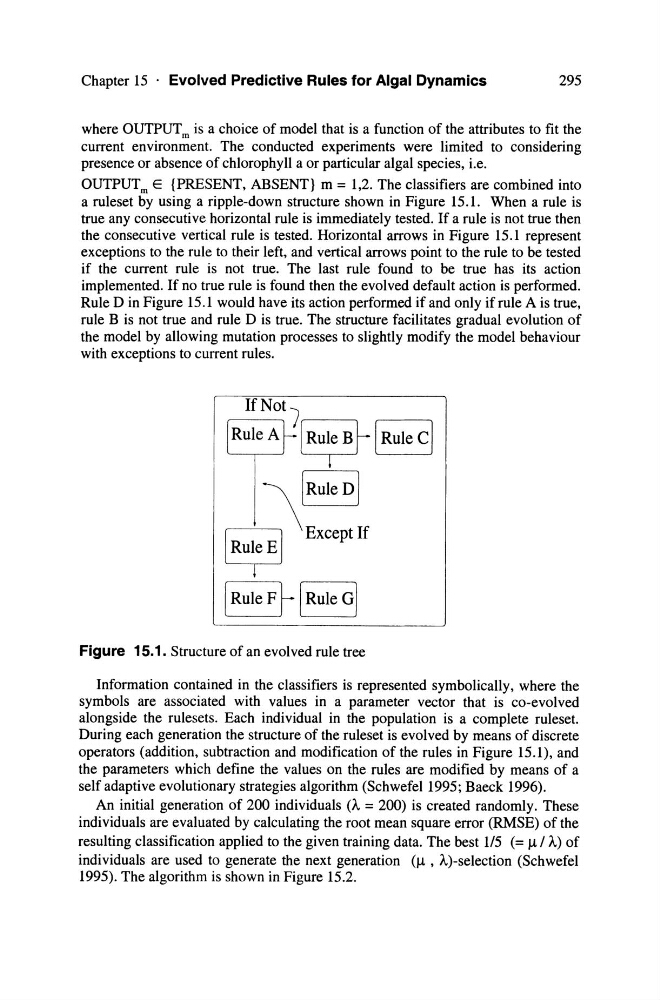
a ruleset by using a ripple-down structure shown in Figure 15.1. When a rule is
true any consecutive horizontal rule is immediately tested. If a rule is not true then
the consecutive vertical rule is tested. Horizontal arrows in Figure 15.1 represent
exceptions to the rule to their left, and vertical arrows point to the rule to be tested
if the current rule is not true. The last rule found to be true has its action
implemented. If no true rule is found then the evolved default action is performed.
Rule D in Figure 15.1 would have its action performed if and only if rule A is true,
rule B is not true and rule D is true. The structure facilitates gradual evolution of
the model by allowing mutation processes to slightly modify the model behaviour
with exceptions to current rules.
IfNot 7
[RuleA [RUltBH Rulecl
~RUleDI
~
ExceptIf
~
[ Rule F r [ Rule GI
Figure 15.1. Structure of an evolved rule tree
Information contained in the classifiers is represented symbolically, where the
symbols are associated with values in a parameter vector that is co-evolved
alongside the rulesets. Each individual in the population is a complete ruleset.
During each generation the structure of the ruleset is evolved by means of discrete
operators (addition, subtraction and modification of the rules in Figure 15.1), and
the parameters which define the values on the rules are modified by means of a
self adaptive evolutionary strategies algorithm (Schwefel 1995; Baeck 1996).
An initial generation of 200 individuals (I. = 200) is created randomly. These
individuals are evaluated by calculating the root mean square error (RMSE) of the
resulting classification applied to the given training data. The best 1/5 (= f.! /1.) of
individuals are used to generate the next generation (f.!, A)-selection (Schwefel
1995). The algorithm is shown in Figure 15.2.
295
where OUTPUT m is a choice of model that is a function of the attributes to fit the
current environment. The conducted experiments were limited to considering
presence or absence of chlorophyll a or particular algal species, Le.
OUTPUT m E {PRESENT, ABSENT} m = 1,2. The classifiers are combined into
a ruleset by using a ripple-down structure shown in Figure 15.1. When a rule is
true any consecutive horizontal rule is immediately tested. If a rule is not true then
the consecutive vertical rule is tested. Horizontal arrows in Figure 15.1 represent
exceptions to the rule to their left, and vertical arrows point to the rule to be tested
if the current rule is not true. The last rule found to be true has its action
implemented. If no true rule is found then the evolved default action is performed.
Rule D in Figure 15.1 would have its action performed if and only if rule A is true,
rule B is not true and rule D is true. The structure facilitates gradual evolution of
the model by allowing mutation processes to slightly modify the model behaviour
with exceptions to current rules.
IfNot 7
[RuleA [RUltBH Rulecl
~RUleDI
~
ExceptIf
~
[ Rule F r [ Rule GI
Figure 15.1. Structure of an evolved rule tree
Information contained in the classifiers is represented symbolically, where the
symbols are associated with values in a parameter vector that is co-evolved
alongside the rulesets. Each individual in the population is a complete ruleset.
During each generation the structure of the ruleset is evolved by means of discrete
operators (addition, subtraction and modification of the rules in Figure 15.1), and
the parameters which define the values on the rules are modified by means of a
self adaptive evolutionary strategies algorithm (Schwefel 1995; Baeck 1996).
An initial generation of 200 individuals (I. = 200) is created randomly. These
individuals are evaluated by calculating the root mean square error (RMSE) of the
resulting classification applied to the given training data. The best 1/5 (= f.! /1.) of
individuals are used to generate the next generation (f.!, A)-selection (Schwefel
1995). The algorithm is shown in Figure 15.2.