

200
K.-S. Jeong . F. Recknagel . G.-J. Joo
t. RNN are applicable to time-series modelling and forecasting (Connors et aI.
1994).
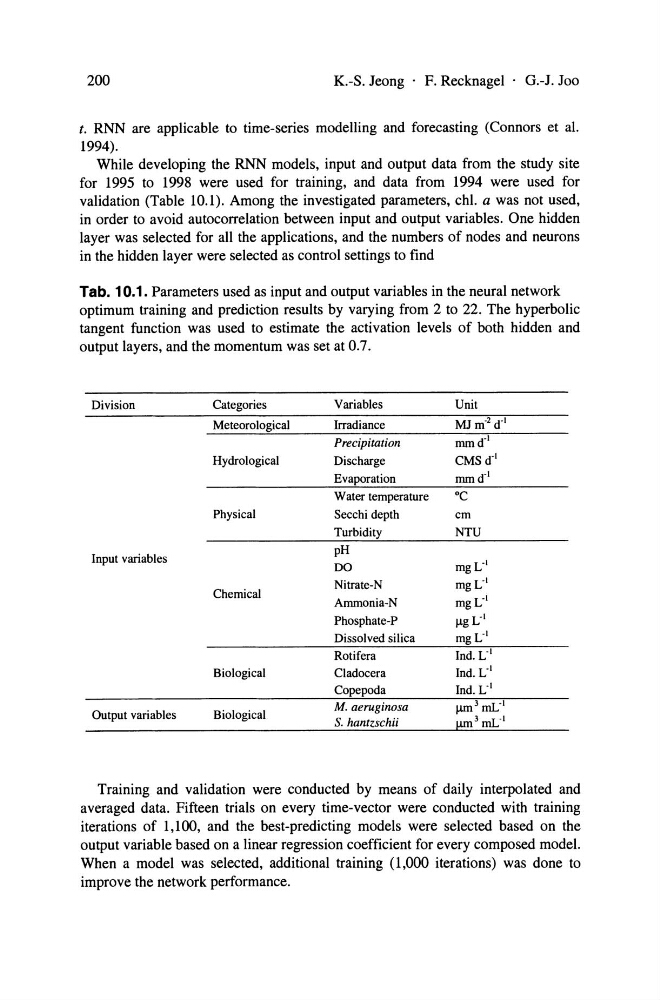
While developing the RNN models, input and output data from the study site
for 1995 to 1998 were used for training, and data from 1994 were used for
validation (Table 10.1). Among the investigated parameters, chI. a was not used,
in order to avoid autocorrelation between input and output variables. One hidden
layer was selected for all the applications, and the numbers of nodes and neurons
in the hidden layer were selected as control settings to find
Tab. 10.1. Parameters used as input and output variables in the neural network
optimum training and prediction results by varying from 2 to 22. The hyperbolic
tangent function was used to estimate the activation levels of both hidden and
output layers, and the momentum was set at 0.7.
Division
Categories
Variables
Unit
MeteorologicaI
Irradiance
MJm- 2 d- 1
Precipitation
mmd- 1
Hydrological
Discharge
CMSd- 1
Evaporation
mmd- 1
Water temperature
°C
Physical
Secchi depth
cm
Turbidity
NTU
Input variables
pH
DO
mgL- 1
Chemical
Nitrate-N
mgL- 1
Ammonia-N
mgL- 1
Phosphate-P
Ilg L- 1
Dissolved silica
mgL- 1
Rotifera
Ind. L- 1
Biological
Cladocera
Ind. L- 1
Copepoda
Ind.L- 1
Output variables
Biological
M. aeruginosa
1J.ffi 3 mL- 1
S. hantzschii
Ilffi 3 mL- 1
Training and validation were conducted by means of daily interpolated and
averaged data. Fifteen trials on every time-vector were conducted with training
iterations of 1,100, and the best-predicting models were selected based on the
output variable based on a linear regression coefficient for every composed model.
When a model was selected, additional training 0,000 iterations) was done to
improve the network performance.
K.-S. Jeong . F. Recknagel . G.-J. Joo
t. RNN are applicable to time-series modelling and forecasting (Connors et aI.
1994).
While developing the RNN models, input and output data from the study site
for 1995 to 1998 were used for training, and data from 1994 were used for
validation (Table 10.1). Among the investigated parameters, chI. a was not used,
in order to avoid autocorrelation between input and output variables. One hidden
layer was selected for all the applications, and the numbers of nodes and neurons
in the hidden layer were selected as control settings to find
Tab. 10.1. Parameters used as input and output variables in the neural network
optimum training and prediction results by varying from 2 to 22. The hyperbolic
tangent function was used to estimate the activation levels of both hidden and
output layers, and the momentum was set at 0.7.
Division
Categories
Variables
Unit
MeteorologicaI
Irradiance
MJm- 2 d- 1
Precipitation
mmd- 1
Hydrological
Discharge
CMSd- 1
Evaporation
mmd- 1
Water temperature
°C
Physical
Secchi depth
cm
Turbidity
NTU
Input variables
pH
DO
mgL- 1
Chemical
Nitrate-N
mgL- 1
Ammonia-N
mgL- 1
Phosphate-P
Ilg L- 1
Dissolved silica
mgL- 1
Rotifera
Ind. L- 1
Biological
Cladocera
Ind. L- 1
Copepoda
Ind.L- 1
Output variables
Biological
M. aeruginosa
1J.ffi 3 mL- 1
S. hantzschii
Ilffi 3 mL- 1
Training and validation were conducted by means of daily interpolated and
averaged data. Fifteen trials on every time-vector were conducted with training
iterations of 1,100, and the best-predicting models were selected based on the
output variable based on a linear regression coefficient for every composed model.
When a model was selected, additional training 0,000 iterations) was done to
improve the network performance.