

Chapter 10 . Aigal Species Succession in Rivers
199
10.3.2
Modelling the Phytoplankton Dynamics
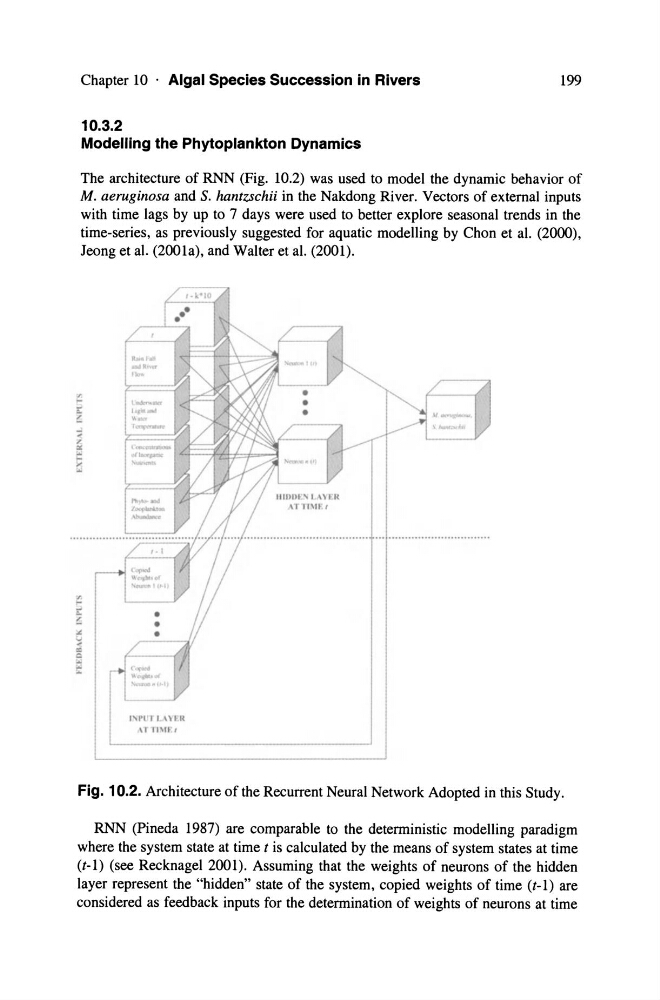
The architecture of RNN (Fig. 10.2) was used to model the dynamic behavior of
M. aeruginosa and S. hantzschii in the Nakdong River. Vectors of external inputs
with time lags by up to 7 days were used to beUer explore seasonal trends in the
time-series, as previously suggested for aquatic modelling by Chon et al. (2000),
Jeong et al. (2001a), and Walter et al. (2001).
I"Pl' II\\H-l
\1 "'IP,
Fig. 10.2. Architecture of the Recurrent Neural Network Adopted in this Study.
RNN (Pineda 1987) are comparable to the deterministic modelling paradigm
where the system state at time t is calculated by the means of system states at time
(t-I) (see Recknagel 2001). Assuming that the weights of neurons of the hidden
layer represent the "hidden" state of the system, copied weights of time (t-1) are
considered as feedback inputs for the determination of weights of neurons at time
199
10.3.2
Modelling the Phytoplankton Dynamics
The architecture of RNN (Fig. 10.2) was used to model the dynamic behavior of
M. aeruginosa and S. hantzschii in the Nakdong River. Vectors of external inputs
with time lags by up to 7 days were used to beUer explore seasonal trends in the
time-series, as previously suggested for aquatic modelling by Chon et al. (2000),
Jeong et al. (2001a), and Walter et al. (2001).
I"Pl' II\\H-l
\1 "'IP,
Fig. 10.2. Architecture of the Recurrent Neural Network Adopted in this Study.
RNN (Pineda 1987) are comparable to the deterministic modelling paradigm
where the system state at time t is calculated by the means of system states at time
(t-I) (see Recknagel 2001). Assuming that the weights of neurons of the hidden
layer represent the "hidden" state of the system, copied weights of time (t-1) are
considered as feedback inputs for the determination of weights of neurons at time