

Chapter 9 . Macroinvertebrate and Stream Habitat Relationships
185
0.8
I
:§ 0.6
i
-g 0.4
.c
1:
00.2
Of---------r-----~
o
2
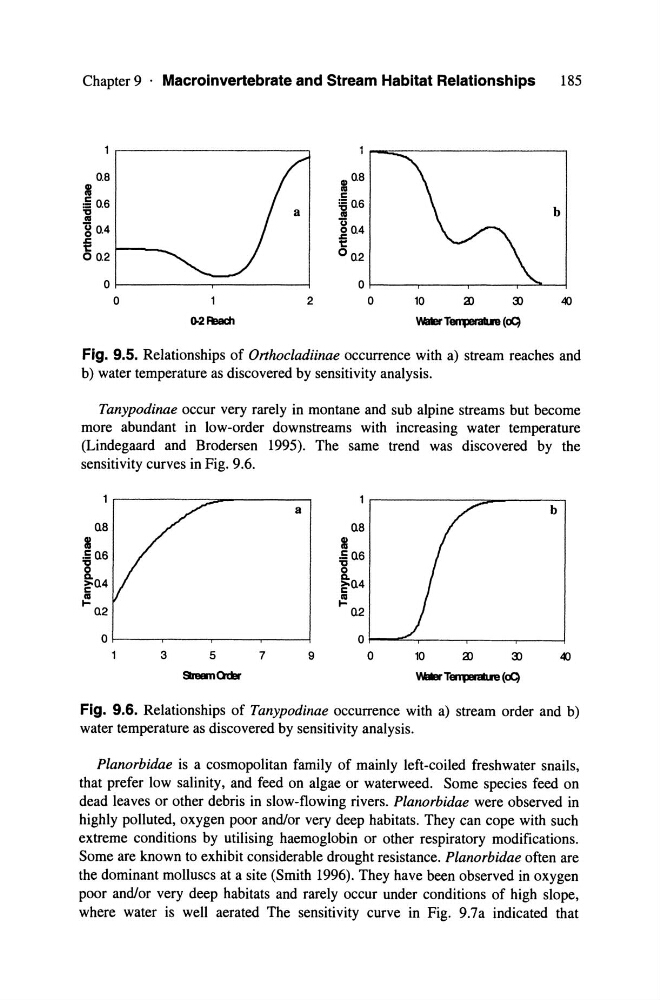
Fig. 9.5. Relationships of Onhocladiinae occurrence with a) stream reaches and
b) water temperature as discovered by sensitivity analysis.
Tanypodinae occur very rarely in montane and sub alpine streams but become
more abundant in low-order downstreams with increasing water temperature
(Lindegaard and Brodersen 1995). The same trend was discovered by the
sensitivity curves in Fig. 9.6.
a
Of----,----.-----,---~
3 5 7
SlrelmOdi!r
9
Q8
I
~Q6
~Q4
c
~
Q2
b
O~--~.--_.---_.----~
o
10
a>
:J)
WErTerrpenIIue (oQ
Fig. 9.6. Relationships of Tanypodinae occurrence with a) stream order and b)
water temperature as discovered by sensitivity analysis.
Planorbidae is a cosmopolitan family of mainly left-coiled freshwater snails,
that prefer low salinity, and feed on algae or waterweed. Some species feed on
dead leaves or other debris in slow-flowing rivers. Planorbidae were observed in
highly polluted, oxygen poor andJor very deep habitats. They can cope with such
extreme conditions by utilising haemoglobin or other respiratory modifications.
Some are known to exhibit considerable drought resistance. Planorbidae often are
the dominant molluscs at a site (Smith 1996). They have been observed in oxygen
poor andJor very deep habitats and rarely occur under conditions of high slope,
where water is weIl aerated The sensitivity curve in Fig. 9.7a indicated that
185
0.8
I
:§ 0.6
i
-g 0.4
.c
1:
00.2
Of---------r-----~
o
2
Fig. 9.5. Relationships of Onhocladiinae occurrence with a) stream reaches and
b) water temperature as discovered by sensitivity analysis.
Tanypodinae occur very rarely in montane and sub alpine streams but become
more abundant in low-order downstreams with increasing water temperature
(Lindegaard and Brodersen 1995). The same trend was discovered by the
sensitivity curves in Fig. 9.6.
a
Of----,----.-----,---~
3 5 7
SlrelmOdi!r
9
Q8
I
~Q6
~Q4
c
~
Q2
b
O~--~.--_.---_.----~
o
10
a>
:J)
WErTerrpenIIue (oQ
Fig. 9.6. Relationships of Tanypodinae occurrence with a) stream order and b)
water temperature as discovered by sensitivity analysis.
Planorbidae is a cosmopolitan family of mainly left-coiled freshwater snails,
that prefer low salinity, and feed on algae or waterweed. Some species feed on
dead leaves or other debris in slow-flowing rivers. Planorbidae were observed in
highly polluted, oxygen poor andJor very deep habitats. They can cope with such
extreme conditions by utilising haemoglobin or other respiratory modifications.
Some are known to exhibit considerable drought resistance. Planorbidae often are
the dominant molluscs at a site (Smith 1996). They have been observed in oxygen
poor andJor very deep habitats and rarely occur under conditions of high slope,
where water is weIl aerated The sensitivity curve in Fig. 9.7a indicated that