

Chapter 9 . Macroinvertebrate and Stream Habitat Relationships
181
9.3.2
Neural Network Modelling
The 'clean water' ANN models (Hoang et al. 2001) were developed by using data
from so-called 'reference sites' of the Queensland stream system that were
considered to be minimally affected by anthropogenie disturbance (see Conrick
and Cockayne 2000). Therefore only those environmental variables were chosen
as model inputs considered being relatively stable under the influences of human
impacts.
Data used for the development of the 'dirty water' ANN models were taken
from both reference and degraded sites containing physical and chemieal
variables.
Predictive ANN models were developed for each macroinvertebrate taxa
(mostly families) recorded in the Queensland streams database. ANN training was
carried out by the feed-forward back-propagation algorithm (Rumelhart, Hinton
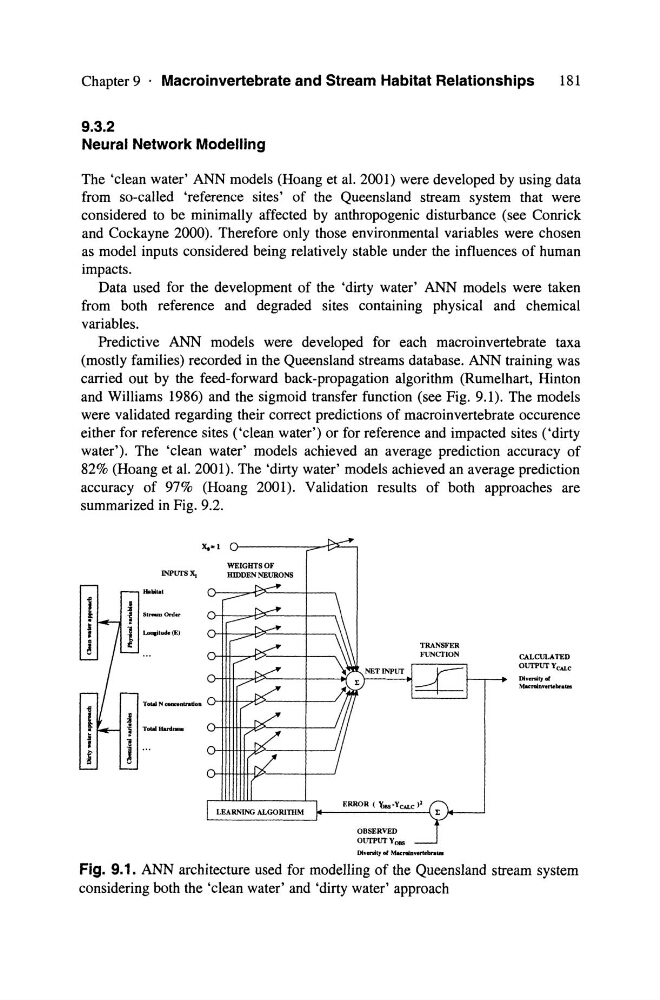
and Williams 1986) and the sigmoid transfer function (see Fig. 9.1). The models
were validated regarding their correct predietions of macroinvertebrate occurence
either for reference sites ('clean water') or for reference and impacted sites ('dirty
water'). The 'clean water' models achieved an average predietion accuracy of
82% (Hoang et al. 2001). The 'dirty water' models achieved an average prediction
accuracy of 97% (Hoang 2001). Validation results of both approaches are
summarized in Fig. 9.2.
INPUTS X,
HabItai
1
TGttd N toDHQtradOQ
:I
.~ Total HanlIJe9I
~
r
1
!
WEIGHTSOF
HIDDEN NEURONS
ERROR ( lles-YCALc )1
OBSERVED
oUfPutYOBS
CALCULATED
OUTPUT YCALC
Divfl'Sityot
MutUnyerubntes
Fig. 9.1. ANN architecture used for modelling of the Queensland stream system
considering both the 'clean water' and 'dirty water' approach
181
9.3.2
Neural Network Modelling
The 'clean water' ANN models (Hoang et al. 2001) were developed by using data
from so-called 'reference sites' of the Queensland stream system that were
considered to be minimally affected by anthropogenie disturbance (see Conrick
and Cockayne 2000). Therefore only those environmental variables were chosen
as model inputs considered being relatively stable under the influences of human
impacts.
Data used for the development of the 'dirty water' ANN models were taken
from both reference and degraded sites containing physical and chemieal
variables.
Predictive ANN models were developed for each macroinvertebrate taxa
(mostly families) recorded in the Queensland streams database. ANN training was
carried out by the feed-forward back-propagation algorithm (Rumelhart, Hinton
and Williams 1986) and the sigmoid transfer function (see Fig. 9.1). The models
were validated regarding their correct predietions of macroinvertebrate occurence
either for reference sites ('clean water') or for reference and impacted sites ('dirty
water'). The 'clean water' models achieved an average predietion accuracy of
82% (Hoang et al. 2001). The 'dirty water' models achieved an average prediction
accuracy of 97% (Hoang 2001). Validation results of both approaches are
summarized in Fig. 9.2.
INPUTS X,
HabItai
1
TGttd N toDHQtradOQ
:I
.~ Total HanlIJe9I
~
r
1
!
WEIGHTSOF
HIDDEN NEURONS
ERROR ( lles-YCALc )1
OBSERVED
oUfPutYOBS
CALCULATED
OUTPUT YCALC
Divfl'Sityot
MutUnyerubntes
Fig. 9.1. ANN architecture used for modelling of the Queensland stream system
considering both the 'clean water' and 'dirty water' approach