

170
T.-S. Chon . Y.S. Park' I.-S. Kwak . E.Y. Cha
coincidence between the field and predicted data tended to be low. The Pearson's
correlation coefficients lay between the field and predicted data, ranging from 0.45
to 0.65 (F=2.64, df =24, P
than in the on-time training. The occurrences of discrepancies were explainable in
many case. They were usually due to the limited availability of data for training
(Park et al., 2001b).
Patterning 0/ Changes in Exergy
The self-organizing Kohonen network could be also applicable to patteming time
development of exergies. Similar to the previous case, it is supposed to have a
linear array of M 2 output neurons (i.e., computation nodes) in the Kohonen
a)
1.0
>EI
Q)
0.5
x
W
0.0
0
0
0
a.
a.
a.
cn cn cn
cn cn cn
I0
'"
<0
~
Ll)
Cl
;:::
0
0
co
co
0
0
0
co
co
co
Cl
Cl
Cl
Cl
Cl
Cl
b)
1.0
>EI 0.5
Q)
x
W
:.::
:.::
:.::
:.::
:.::
0
0
0
0
0
>0
'" '" ... <0
;:::
;:::
0
0
0
co
co
co
Cl
'" '" '" '"
ce
ce
ce 0
0
I'" ... co ~ '"
;:::
0
0
;:::
0
co
co
co
Cl
Cl
Cl
Cl
Cl
Month/Site
:.::
0
0
ü
cn
cn
>co
~
0
0
~
co
r-co
'"
'"
'"
Month/Site
0
r-0
co
Cl
0
~
'" 0
co
'"
_ _ Field
....... T+O
... []. .. T +1
cn cn cn
I0
'"
<0
;:::
0
0
co
co
Cl
Cl
Cl
_ _ Field
....... T+O
... []. .. T+1
0
0
cn
cn
>Ll)
r-0
0
co
co
'" '"
0
cn
>Cl
0
co
'"
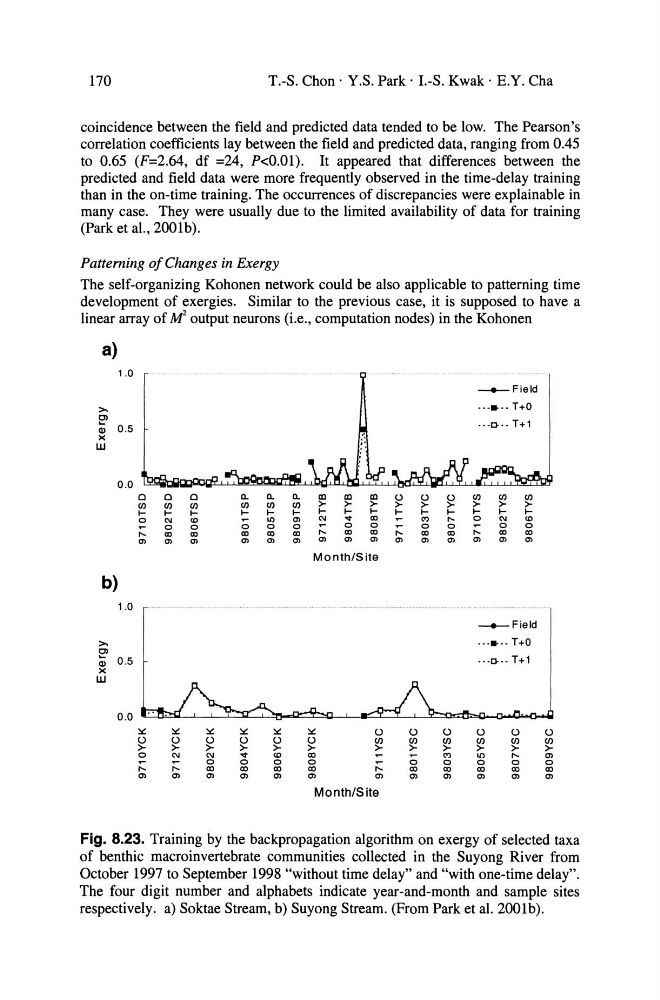
Fig. 8.23. Training by the backpropagation algorithm on exergy of selected taxa
of benthic macroinvertebrate communities collected in the Suyong River from
October 1997 to September 1998 "without time delay" and "with one-time delay".
The four digit number and alphabets indicate year-and-month and sample sites
respectively. a) Soktae Stream, b) Suyong Stream. (From Park et al. 2001b).
T.-S. Chon . Y.S. Park' I.-S. Kwak . E.Y. Cha
coincidence between the field and predicted data tended to be low. The Pearson's
correlation coefficients lay between the field and predicted data, ranging from 0.45
to 0.65 (F=2.64, df =24, P
than in the on-time training. The occurrences of discrepancies were explainable in
many case. They were usually due to the limited availability of data for training
(Park et al., 2001b).
Patterning 0/ Changes in Exergy
The self-organizing Kohonen network could be also applicable to patteming time
development of exergies. Similar to the previous case, it is supposed to have a
linear array of M 2 output neurons (i.e., computation nodes) in the Kohonen
a)
1.0
>EI
Q)
0.5
x
W
0.0
0
0
0
a.
a.
a.
cn cn cn
cn cn cn
I0
'"
<0
~
Ll)
Cl
;:::
0
0
co
co
0
0
0
co
co
co
Cl
Cl
Cl
Cl
Cl
Cl
b)
1.0
>EI 0.5
Q)
x
W
:.::
:.::
:.::
:.::
:.::
0
0
0
0
0
>0
'" '" ... <0
;:::
;:::
0
0
0
co
co
co
Cl
'" '" '" '"
ce
ce
ce 0
0
I'" ... co ~ '"
;:::
0
0
;:::
0
co
co
co
Cl
Cl
Cl
Cl
Cl
Month/Site
:.::
0
0
ü
cn
cn
>co
~
0
0
~
co
r-co
'"
'"
'"
Month/Site
0
r-0
co
Cl
0
~
'" 0
co
'"
_ _ Field
....... T+O
... []. .. T +1
cn cn cn
I0
'"
<0
;:::
0
0
co
co
Cl
Cl
Cl
_ _ Field
....... T+O
... []. .. T+1
0
0
cn
cn
>Ll)
r-0
0
co
co
'" '"
0
cn
>Cl
0
co
'"
Fig. 8.23. Training by the backpropagation algorithm on exergy of selected taxa
of benthic macroinvertebrate communities collected in the Suyong River from
October 1997 to September 1998 "without time delay" and "with one-time delay".
The four digit number and alphabets indicate year-and-month and sample sites
respectively. a) Soktae Stream, b) Suyong Stream. (From Park et al. 2001b).