

Chapter 8· Analysis of Stream Macroinvertebrate Communities
169
'I!~:I
'!!~I
'it~1
·lt.6:'~1
H~:!:::I
·lt~ . .J
'1!~1
1~~1
~I~I
it~1
H~":I ~I
O N D J F M A M J I A S
-+-Oligochael8
_Hirudinae
-.-Chironomidae
:1 ...... ~1
:lf~~1
:Uz: ~I
:~t~1
:~f\7V~1
: :H\LZ\J "[;1
:z
r : ; ['=:=6fll
r.l
u r - - - - - - - - - - ,
:U/?t.\:: .... 1
:1 [;J_:'.'..~J
:~t~.~1
O N D J F M A M J J A S
THP
TYS
TSP
TKC
TYZ
TYB
TYC
TSD
YSC
YCK
YPU
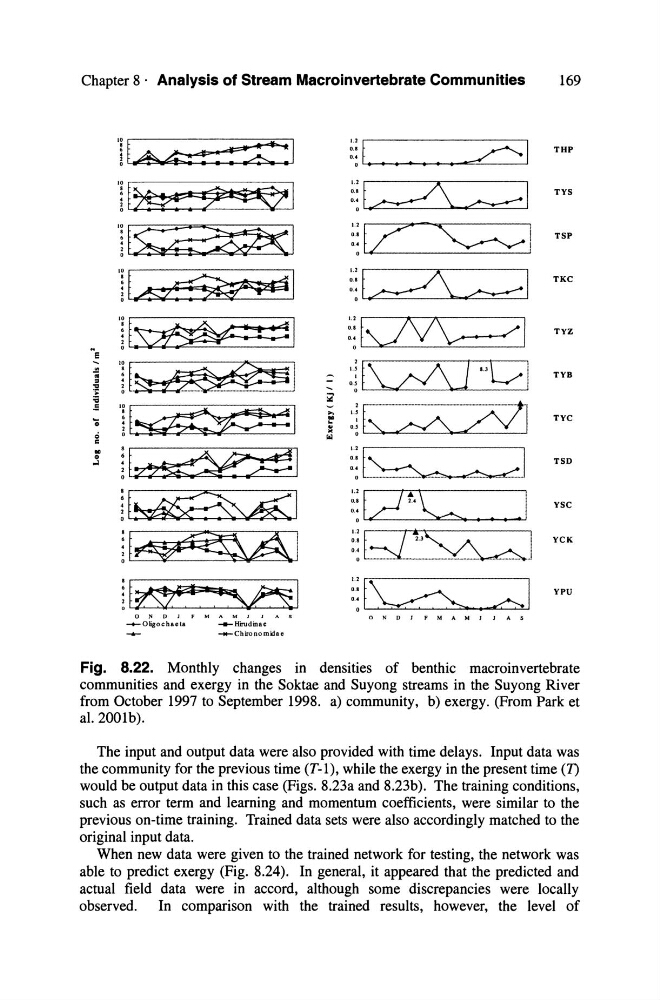
Fig. 8.22. Monthly changes in densities of benthic macroinvertebrate
communities and exergy in the Soktae and Suyong streams in the Suyong River
from October 1997 to September 1998. a) community, b) exergy. (From Park et
al. 2001b).
The input and output data were also provided with time delays. Input data was
the community for the previous time (T-l), while the exergy in the present time (I)
would be output data in this case (Figs. 8.23a and 8.23b). The training conditions,
such as error term and leaming and momentum coefficients, were similar to the
previous on-time training. Trained data sets were also accordingly matched to the
original input data.
When new data were given to the trained network for testing, the network was
able to predict exergy (Fig. 8.24). In general, it appeared that the predicted and
actual field data were in accord, although some discrepancies were locally
observed. In comparison with the trained results, however, the level of
169
'I!~:I
'!!~I
'it~1
·lt.6:'~1
H~:!:::I
·lt~ . .J
'1!~1
1~~1
~I~I
it~1
H~":I ~I
O N D J F M A M J I A S
-+-Oligochael8
_Hirudinae
-.-Chironomidae
:1 ...... ~1
:lf~~1
:Uz: ~I
:~t~1
:~f\7V~1
: :H\LZ\J "[;1
:z
r : ; ['=:=6fll
r.l
u r - - - - - - - - - - ,
:U/?t.\:: .... 1
:1 [;J_:'.'..~J
:~t~.~1
O N D J F M A M J J A S
THP
TYS
TSP
TKC
TYZ
TYB
TYC
TSD
YSC
YCK
YPU
Fig. 8.22. Monthly changes in densities of benthic macroinvertebrate
communities and exergy in the Soktae and Suyong streams in the Suyong River
from October 1997 to September 1998. a) community, b) exergy. (From Park et
al. 2001b).
The input and output data were also provided with time delays. Input data was
the community for the previous time (T-l), while the exergy in the present time (I)
would be output data in this case (Figs. 8.23a and 8.23b). The training conditions,
such as error term and leaming and momentum coefficients, were similar to the
previous on-time training. Trained data sets were also accordingly matched to the
original input data.
When new data were given to the trained network for testing, the network was
able to predict exergy (Fig. 8.24). In general, it appeared that the predicted and
actual field data were in accord, although some discrepancies were locally
observed. In comparison with the trained results, however, the level of