

142
T.-S. Chon . Y.S. Park' I.-S. Kwak . E.Y. Cha
producing the weights from Kohonen network first then training the weight
subsequently by ART, was not in general effectively conducted in comparison with
the ART-Kohonen process. However, it is still early to generalize that ART is
more effective in community data than the Kohonen network. Various other
factors are involved in formation of community groupings, and further
investigation is required.
The Kohonen network has another advantage of visual presentation. It projects
the data feature on a map in a reduced spatial dimension (conveniently 2 or3) as
shown in Fig. 8.3 and Fig. 8.8b. ART neurons were not structured spatially (Fig.
8.8a). The output results on the Kohonen network, then, are more comprehensible
in characterizing the conformation of neurons.
Large Scale Classification
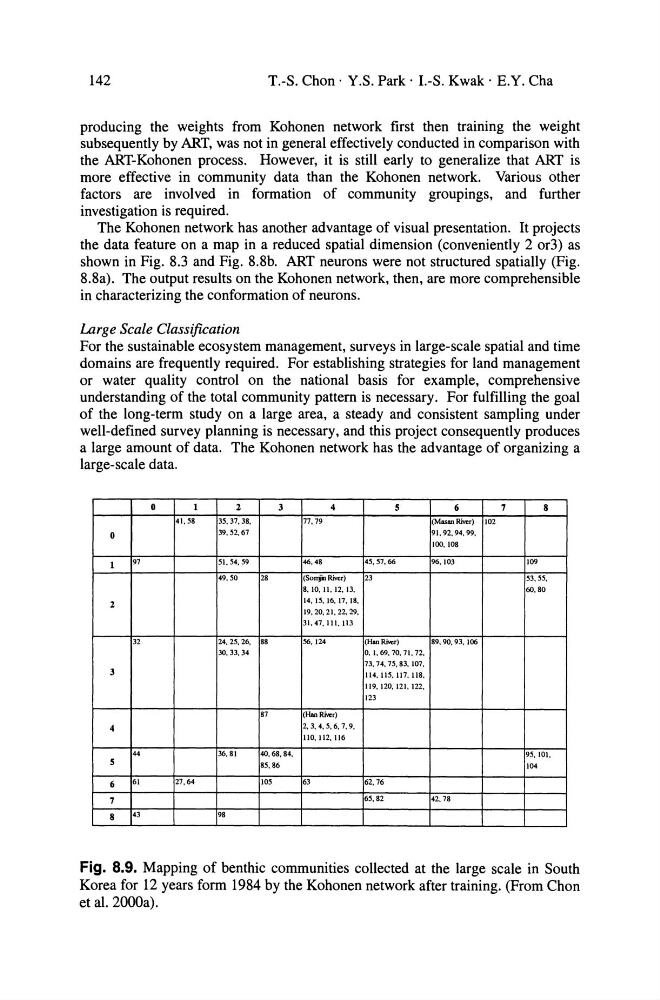
For the sustainable ecosystem management, surveys in large-scale spatial and time
domains are frequently required. For establishing strategies for land management
or water quality control on the national basis for example, comprehensive
understanding of the total community pattern is necessary. For fulfilling the goal
of the long-term study on a large area, a steady and consistent sampling under
well-defined survey planning is necessary, and this project consequently produces
a large amount of data. The Kohonen network has the advantage of organizing a
large-scale data.
0
1
2
3
4
S
6
7
8
41,58
35,37,38,
77,79
(Masan River)
\02
0
39,52,67
91,92,94,99,
100, \08
1
97
51.54.59
46,48
45.57.66
96,103
109
49,50
28
(Sonjio River)
23
53,55,
8, 10, 11, 12. 13.
60.80
2
14,15.16.17.18.
19,20,21.22,29,
31.47.111,113
32
24,25,26. 88
56.124
(HanRive,)
89,90.93,106
30,33,34
0,1,69,70,71.72.
73,74,75.83,107,
3
114, 115, 117, tlS.
119, 120, 121, 122,
123
87
(HanRive,)
4
2,3,4,5,6,7,9,
110, 112, 116
44
36,81
40,68,84,
95,101,
S
85,86
104
6
61
27,64
\05
63
62,76
7
65,82
42,78
8
43
98
Fig. 8.9. Mapping of benthic communities collected at the large scale in South
Korea for 12 years form 1984 by the Kohonen network after training. (From Chon
et al. 2000a).
T.-S. Chon . Y.S. Park' I.-S. Kwak . E.Y. Cha
producing the weights from Kohonen network first then training the weight
subsequently by ART, was not in general effectively conducted in comparison with
the ART-Kohonen process. However, it is still early to generalize that ART is
more effective in community data than the Kohonen network. Various other
factors are involved in formation of community groupings, and further
investigation is required.
The Kohonen network has another advantage of visual presentation. It projects
the data feature on a map in a reduced spatial dimension (conveniently 2 or3) as
shown in Fig. 8.3 and Fig. 8.8b. ART neurons were not structured spatially (Fig.
8.8a). The output results on the Kohonen network, then, are more comprehensible
in characterizing the conformation of neurons.
Large Scale Classification
For the sustainable ecosystem management, surveys in large-scale spatial and time
domains are frequently required. For establishing strategies for land management
or water quality control on the national basis for example, comprehensive
understanding of the total community pattern is necessary. For fulfilling the goal
of the long-term study on a large area, a steady and consistent sampling under
well-defined survey planning is necessary, and this project consequently produces
a large amount of data. The Kohonen network has the advantage of organizing a
large-scale data.
0
1
2
3
4
S
6
7
8
41,58
35,37,38,
77,79
(Masan River)
\02
0
39,52,67
91,92,94,99,
100, \08
1
97
51.54.59
46,48
45.57.66
96,103
109
49,50
28
(Sonjio River)
23
53,55,
8, 10, 11, 12. 13.
60.80
2
14,15.16.17.18.
19,20,21.22,29,
31.47.111,113
32
24,25,26. 88
56.124
(HanRive,)
89,90.93,106
30,33,34
0,1,69,70,71.72.
73,74,75.83,107,
3
114, 115, 117, tlS.
119, 120, 121, 122,
123
87
(HanRive,)
4
2,3,4,5,6,7,9,
110, 112, 116
44
36,81
40,68,84,
95,101,
S
85,86
104
6
61
27,64
\05
63
62,76
7
65,82
42,78
8
43
98
Fig. 8.9. Mapping of benthic communities collected at the large scale in South
Korea for 12 years form 1984 by the Kohonen network after training. (From Chon
et al. 2000a).