

138
T.-S. Chon . Y.S. Park' I.-S. Kwak . E.Y. Cha
n-l
d /t) = ~)bji (t) - x i ]2
(8.3)
i=O
where n is the number of input nodes. The distanee, dj(t), measures the degree
of similarity between weights and input data, and is used as a eriterion for
grouping inputs through the training proeess.
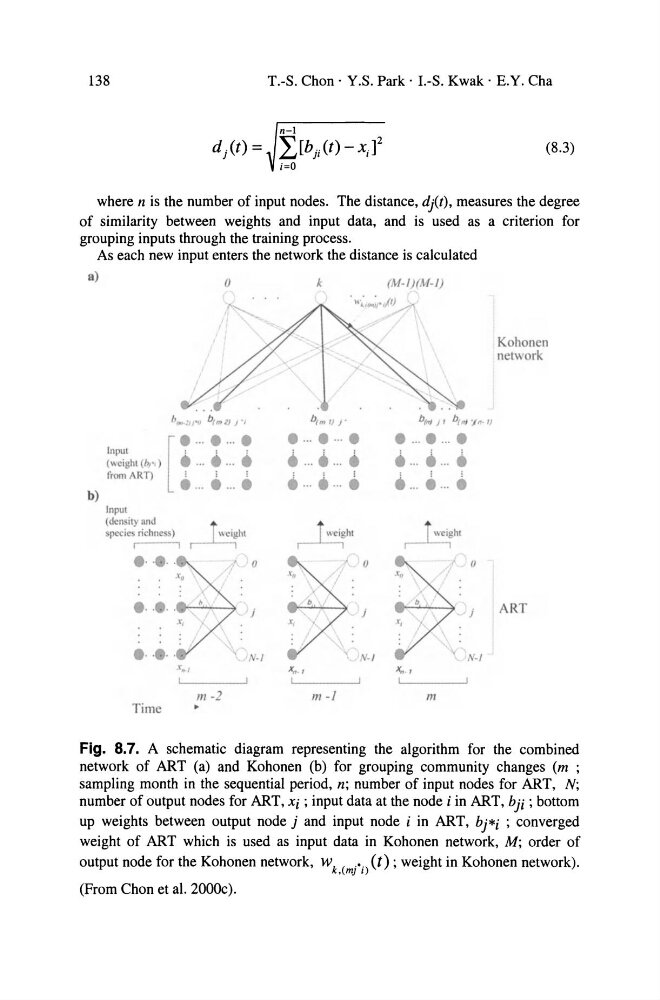
As eaeh new input enters the network the distanee is ealculated
a)
o
InpUI
' "
(wcighl (b,")
• •.. • ... •
[ ........ .
fromARn
'
;
;
•••• •••••
b)
InpUI
(densily and
sp<'cics richness)
r-----l
••••••
weight
, ' 0
k
•••• •••••
•••••••• •
••• • •••••
:
'y
. ,..,; I
o
I j
" I
j
•..•. . . /
·\:,,·1
In -2
Time
•
_ 'N-!
'_ N- !
xn. ,
I
m -I
(M-IHM-I)
•••••••••
•• • • •••••
• • • • •••••
weighl
I 0
A;,. ,
I
m
N-!
Kohonen
network
Fig. 8.7. A sehematie diagram representing the algorithm for the eombined
network of ART (a) and Kohonen (b) for grouping eommunity ehanges (m ;
sampling month in the sequential period, n; number of input nodes for ART, N;
number of output nodes for ART, xi; input data at the node i in ART, bji ; bottom
up weights between output node j and input node i in ART, bj*i ; eonverged
weight of ART which is used as input data in Kohonen network, M; order of
output node for the Kohonen network, w k ( .•. )(t); weight in Kohonen network) .
• mJ I
(From Chon et al. 2000e).
T.-S. Chon . Y.S. Park' I.-S. Kwak . E.Y. Cha
n-l
d /t) = ~)bji (t) - x i ]2
(8.3)
i=O
where n is the number of input nodes. The distanee, dj(t), measures the degree
of similarity between weights and input data, and is used as a eriterion for
grouping inputs through the training proeess.
As eaeh new input enters the network the distanee is ealculated
a)
o
InpUI
' "
(wcighl (b,")
• •.. • ... •
[ ........ .
fromARn
'
;
;
•••• •••••
b)
InpUI
(densily and
sp<'cics richness)
r-----l
••••••
weight
, ' 0
k
•••• •••••
•••••••• •
••• • •••••
:
'y
. ,..,; I
o
I j
" I
j
•..•. . . /
·\:,,·1
In -2
Time
•
_ 'N-!
'_ N- !
xn. ,
I
m -I
(M-IHM-I)
•••••••••
•• • • •••••
• • • • •••••
weighl
I 0
A;,. ,
I
m
N-!
Kohonen
network
Fig. 8.7. A sehematie diagram representing the algorithm for the eombined
network of ART (a) and Kohonen (b) for grouping eommunity ehanges (m ;
sampling month in the sequential period, n; number of input nodes for ART, N;
number of output nodes for ART, xi; input data at the node i in ART, bji ; bottom
up weights between output node j and input node i in ART, bj*i ; eonverged
weight of ART which is used as input data in Kohonen network, M; order of
output node for the Kohonen network, w k ( .•. )(t); weight in Kohonen network) .
• mJ I
(From Chon et al. 2000e).